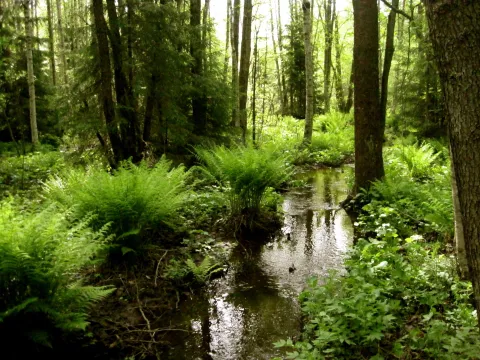
Kylmäojankorpi forested wetland, Vantaa, Finland
Year of issue
2025
Summary
The Kylmäojankorpi case study represents research work where water quality (dissolved oxygen, electrical conductivity, turbidity, and temperature) and stream-stage measured continuously. The existing forest wetland (c.a. 11ha), Kylmäojankorpi, is located in Vantaa city which is neighboring the capital city Helsinki. The study results show that forested wetland improves and regulates stream water quality and flow regime. The obtained knowledge can be used to estimate environmental effects from the similar type of forested wetlands in urban areas.
Photo Gallery


Location
60.33989, 25.036
Project
NWRM
National ID
Finland_01
Sector
Urban
Contact
Kristina Veidemane, BEF
Overview
Country
Finland
NUTS2 Code
Helsinki-Uusimaa
Sponge measures implemented in the case study
Urban forest parks
Ponds and scrapes
Wetland restoration and management
Involved partners
| Authority type | Authority name | Authority role | Comments |
|---|---|---|---|
| Other | Vantaa City | Implementation | In charge of spatial planning in the area |
| Forest owners | Vantaa and Helsinki Parish Church Council | Other | — |
| Regional / sub-national water authority | Water Protection Association of the River Vantaa and Helsinki Region | Monitoring | — |
| Regional / sub-national water authority | — | Other | Regulatory framework for wetland protection |
| — | University of Helsinki | — | Conducted the study to assess effectiveness of wetland for NWRM and pollutant attenuation |
Documents
Document
cs-fi-01-final_version.pdf
(810.32 Ko)
Site Information
Climate Zone
Cool temperate moist
Precipitation
650.00 mm
Temperature (°C)
4.90 °C
Runoff coefficient
0.20
Slope range
nearly level (0-1%)
Vegetation class
Site surrounded by discontinuous urban fabric (112) and industrial or commercial units (121); actual site is 100% covered by vegetation (tree canopy and ground vegetation)
Design and Implementation
Project area
11,3000001907349
Area subject to Land use change or Management/Practice change (ha)
37.30 ha
Size
37.30
Size unit
ha
Constraints
This is a protected area to maintain a semi-natural forest and wetland in an urbanizing landscape. The main factors influencing site selection are thus pre-existing flow paths and historical land use.
Financing
Total cost information
this is not relevant
Costs investment information
this is not relevant
Costs operation maintenance information
this is not relevant
Policy and Governance
Policy description
The study monitored a forest wetland, Kylmäojankorpi, in Vantaa city. Because of the large amount of land sealing surrounding the wetland, there are potential problems with flashy runoff and water quality.
Policy targets
Peak-flow reduction
Runoff control
Pollutants Removal
Part of a wider plan
Non
Public consultation
Non
Has contractual arrangements
Non
Contractual arrangements
| Comments |
|---|
| Site protected in 2000 (given conservation area status). The study of the water quality and flow regime was conducted within the MSc programme of the HELSINKI University |
Impacts and Monitoring
Impact Assessment Methodology
Performance impact assessment method
Catchment outlet
Performance impact estimation information
The case study represents a research project where water quality (dissolved oxygen, electrical conductivity, turbidity, and temperature) and stream-stage measured continuously. Intermittent water samples for chemical and biochemical analysis were also taken during base flow and rainfall events for more detailed study of wetland impacts on water quality and export loads of solutes.
Socio-economic Impacts
Direct benefits information
The economic benefits from maintaining forest wetland in urban areas have not been estimated.
Biophysical impacts: Hydrology
Runoff reduction
38.00
Runoff reduction unit
% Percent
Information on runoff reduction
Stream discharge (Jun †“Aug 2010) decreased, i.e. reduced runoff and risk of flooding downstream, which is housing areas
Peak flow reduction
47.00
Peak flow reduction unit
% Percent
Information on peak flow reduction
Mean peak flows (6 rainfall events, Jul-Aug 2010) reduced
Ecosystem water supply
0
Information on ecosystem flood control volume
Risk of flooding downstream reduced
Biophysical impacts: Biodiversity
Improved biodiversity
Oui
Information on improved biodiversity
The protected area and wetland complex will provide more natural habitat and may contribute to meeting Habitats Directive requirements.
Biophysical impacts: Water & Soil Quality
Water quality overall improvements
Positive impact-WQ improvement
Water quality improvements - Phosphorus (P)
54.00
Water quality improvements - Phosphorus (P) - Unit
ppm
Water quality improvements - Nitrogen (N)
1.70
Water quality improvements - Nitrogen (N) - Unit
mg/L
Water quality improvements - Total Suspended Solid (TSS)
5.00
Water quality improvements - Total Suspended Solid (TSS) - Unit
mg/L
Water quality improvements - Copper (Cu)
2.30
Water quality improvements - Copper (Cu) - Unit
ppm
Water quality improvements - Zinc (Zn)
10.30
Water quality improvements - Zinc (Zn) - Unit
ppm
Water quality improvements - Escherichia Coli (E.coli)
296.00
Water quality improvements - Escherichia Coli (E.coli) - Unit
cfu
Soil quality overall improvements
Neutral impact-no change in SQ status
Biophysical impacts: Others
Ecosystem impact climate regulation
No information available
Lessons Learned
Key lessons
The Kylmäojankorpi case study represents a research work which aimed to assess whether and how existing forested wetland improves and regulates stream water quality and flow.
Drivers
| Comments |
|---|
| Not relevant |
Success factors
| Comments |
|---|
| Not relevant |