Landscape revitalisation program in Slovakia
The national Landscape Revitalisation and Integrated River Basin Management Program (2010) aimed to curb ecosystem degradation and flood/drought risk by retaining rain where it falls, especially in damaged parts of the landscape. It deployed many small water-retention elements across 488 municipalities, restoring landscape storage via basins, ponds and similar measures. Early phases created ~7,700 seasonal jobs with about €43 million invested; the programme was adopted by Government Resolution 744/2010.
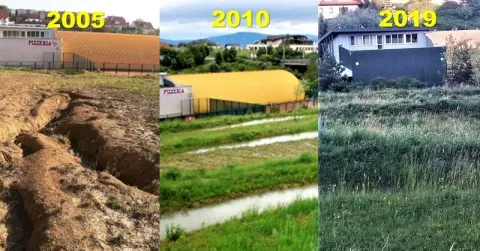
Following a change of government in 2012, the national programme was wound down; only ~4% of planned funds were disbursed and monitoring was not established in time. Yet many structures remained in place. In the Košice region alone, ~250,000 m³ of green/retention works were completed in 2010–2012, and the approach continues there under a region-wide Restoration Programme approved in 2021 with a 2021–2030 horizon. The Ministry of Agriculture is also preparing a ‘Climate Fund for Soil’ to support such measures.


Overview
Activate 23 pilot municipalities first, then scale up nationwide.
Engage ~95% of Slovakia’s territory in flood-prevention actions through landscape revitalisation and better land-use practices.
Create jobs: ~300 initially; ≥5,000 jobs by 2011 (conditional on ~€33.5 m allocation).
Improve governance and maintenance of small streams/melioration, and establish a system for upkeep of new retention structures, as part of integrated river-basin management.
| Authority type | Authority name | Authority role | Authority responsibility |
|---|---|---|---|
| Regional / sub-national water authority | Government Plenipotentiary for Self-Government and Integrated River Basin Management and Landscape | Implementation | Responsible |
| NGO | People and Water NGO | Implementation | Responsible |
| National water authority | Central office of Labour | Other | Supporting |
Site Information
Design and Implementation
Financing
Policy and Governance
| Wider plan type | Wider plan focus | Name | Comments |
|---|---|---|---|
| National | Water | Integrated River Basin Management | Adopted by the Slovak Republic Government on 27 August 2010 |
| National | Other | Act of Employment Services | In cooperation with the Central Office of Labor, Social Affairs and Family to help with the high unemployment rate that especially consists of young people and the long-term unemployed. |
| Activity stage | Activity type | Comments |
|---|---|---|
| Design phase | Workshops | Hundred of workshop with mayors in different regions of Slovakia and meetings with representatives of local public administration authorities. |
Impacts and Monitoring
Monitoring System
Maintenance
Impact Assessment Methodology
Socio-economic Impacts
Biophysical impacts: Hydrology
Biophysical impacts: Biodiversity
Biophysical impacts: Water & Soil Quality
Biophysical impacts: Others
Lessons Learned
Yet programme continuity matters as much as design. The national roll-out ended early after a change in government; only about 4% of the allocated funds were ultimately used and monitoring was halted before it began. Future nationwide schemes need governance and budget safeguards that outlast political cycles.
Build monitoring in from day one. The Košice regional follow-up (2021–2030) explicitly includes research and monitoring but notes current funding gaps for gauging stations - evidence that instrumentation and data management must be budgeted and scheduled alongside works, not after.
Local stewardship is crucial. Municipalities were implementers and, per grant contracts, must keep the small retention works functional for 20 years after completion; routine post-storm checks and cleaning are part of staying power. This underscores the value of simple designs that communities can maintain.
Quality control and permitting need special attention when deploying tens of thousands of micro-structures. Public debate and inspections in 2013–2014 highlighted concerns and led to financing being stopped at national level; clear technical standards and oversight are essential to maintain safety and credibility.
Finally, scale itself is a management challenge. The NWRM record notes that the “huge amount of small measures for such a big project” was a barrier - future programmes should plan for the administrative load (landowner consents, supervision, documentation) as part of the core design.
| Driver type | Driver role | Comments |
|---|---|---|
| Organisation committed to it | Main driver | NGO People and Water |
| Other | Secondary driver | Competition between the stakeholders who will invent something original that is better, more effective and of a higher added value. |
| Success factor type | Success factor role | Comments |
|---|---|---|
| Communication activities | Secondary factor | Hundred of workshop with mayors in different regions of Slovakia and meetings with representatives of local public administration authorities. |
| Attitude of decision makers | Secondary factor | — |
| Existing staff and consultant knowledge | Secondary factor | The experience gained in the first implementation project help to make better the next ones with a big difference. |