Infiltration trenches in Kungsbacka, Sweden

Year of issue
2025
Summary

Flow-weighted sampling was performed at the inlet and outlet of one of the infiltration trenches beneath the parking lot of a supermarket in Kungsbacka, south of Gothenburg. Monitoring ran from April–June 2012 and five storm events were originally analysed. The trench is part of a larger system serving the Maxi ICA site (≈3.1 ha) with three subsurface macadam trenches; the monitored “trench 1” had ~176 m³ storage with a permitted outflow of 6.17 L s⁻¹ (site cap 15 L s⁻¹). Runoff passes an oil separator and then discharges to stormwater ponds located between the car park and the Björkris residential area (toward Björkrisån/Kungsbackaån). Reported pollutant removals were high for TSS and metals and moderate for nitrogen, alongside clear flow attenuation. A subsequent peer-reviewed paper expanded the dataset to seven events and confirmed these trends. More recent municipal stormwater guidance (2023) highlights the Björkris/Hede ponds as part of the local network; while this corroborates the downstream arrangement, publicly available sources do not document the current maintenance or operational status of the specific trenches.
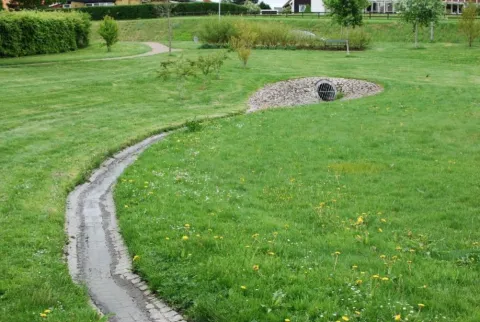
Photo Gallery
Location
57.514515, 12.069297
Project
NWRM
National ID
Sweden_02
Sector
Urban
Implementation status
Completed
Contact
Mats Ivarsson, Enveco

Overview

Location of the project
Beneath the car park of ICA Maxi in the Borgås industrial/retail area of Kungsbacka; Arendalsleden borders the site to the south and Göteborgsvägen to the east; immediately west is the Björkris residential area and the Björkrisån stream, which drains to Kungsbackaån. Runoff from the trenches passes an oil separator and discharges to stormwater ponds between the car park and Björkris.
Country
Sweden
NUTS2 Code
Västsverige
Sponge measures implemented in the case study
Infiltration Trenches
Objectives
Hydraulic design target: the monitored trench was “designed to only discharge 6.17 L/s (site cap 15 L/s) to the Björkris stormwater ponds/Kungsbackaån”, based on a 2-year, 4-hour design rainfall. Design storage reported as ~176 m³ for the trench (with 243 m³ design detention from its drainage area). These values were used to evaluate performance during the 2012 monitoring.
Water-quality investigation objective: the 2012 campaign’s stated aim was to quantify pollutant removal efficiencies and flow detention for one trench at the site (later expanded to seven events in a journal article), i.e., a research objective rather than a regulatory removal target.
Involved partners
Authority type Authority name Authority role Authority responsibility
Local water authority The municipality of Kungsbacka Implementation Responsible

Site Information

Climate Zone
Cool temperate moist
Precipitation
900.00 mm
Temperature (°C)
8.00 °C
Runoff
500.00 mm
Runoff coefficient
0.56
Elevation range
7 m
Slope range
generally flat
Groundwater level
~3 m below ground level
Vegetation class
The measure lies under an asphalted parking lot (impervious surface); no vegetation cover above the trenches themselves is indicated.
WFD Ecological status
Moderate
WFD Chemical status
Failing to achieve good
Water quality status
Björkrisån → Kungsbackaån → Kungsbacka fjord. Kungsbackaån is a sensitive recipient and part of Natura 2000 interests; noted issues include acidification upstream and eutrophication downstream (nutrient inputs from agriculture & private treatment systems)

Design and Implementation

Project scale
Micro
Project scale specifications
A localised intervention at a single commercial site (supermarket parking and its immediate drainage path), not a district or basin-wide programme.
Project area
1,20
Constraints
Null
Favourable preconditions
The measures was constructed as part of the development of the industrial and commersial area.

Financing

Total cost
19255.00 €
Total cost information
Kungsbacka planning reports give indicative costs for macadam trenches (makadamdiken) around SEK 400–1,000 per m³ of storage (StormTac 2023), but they do not relate to the ICA Maxi installation.
Costs investment
19255.00 €
Costs investment information
The figure is an estimate based on the proxy 700 SEK/m3 (79,2 €/m3) from the Swedish consultancy firm Norconsult (À-Prislista Markarbeten, Gothenburg 2010-06-01: Norconsult 2010)
Costs operation maintenance
1925.00 €
Costs operation maintenance information
The general estimation is that the maintenance costs are
ranging between 5 and 20 percent of the construction costs. The value in the field represents 10% of the construction cost.
Financing authorities
Type of funding
Private funds
Compensations
Non

Policy and Governance

Policy description
The measure addresses urban stormwater from a large supermarket parking lot, aiming to attenuate peak flows and reduce pollutant loads (TSS, metals, nutrients) before discharge to downstream stormwater ponds and ultimately Kungsbackaån. The installation was designed with a capped outflow to avoid overloading the receiving ponds/stream—i.e., a hydraulic control to meet local stormwater management needs. At water-body level, VISS records for reaches of Kungsbackaån indicate failure of good chemical status due to PFOS exceedances (and mercury in biota nationally), which frames diffuse urban pollution as a relevant WFD pressure for the recipient. Kungsbacka’s 2023 Dagvattenplan/Handbok provides the municipal policy backdrop promoting detention/treatment facilities such as ponds and infiltration systems.
Land ownership
The commercial property where the ICA Maxi car park (and the infiltration trenches) are located is Skårby 3:31 in Kungsbacka, owned by Ancore Fastigheter AB
Policy targets
Pollutants Removal
Peak-flow reduction
Target remarks
The main function of infiltration trenches is to control the stormwater flow and to reduce the pollutant load of the stormwater. The measure targets the WFD pressure 2.1 Diffuse - Urban run-off by reducing the discharge of nutrients and hazardous substances carried by stormwater.
Part of a wider plan
Non
Public consultation
Non
Has contractual arrangements
Non

Impacts and Monitoring

Monitoring System

Monitoring requirements
Beyond the 2012 Chalmers–Norconsult research campaign (5–7 events), no ongoing monitoring requirements are reported.
Monitoring parameters
Flow-weighted composite sampling at inlet/outlet with ISCO samplers and NIVUS PCM3 flow meters; a rain gauge on the ICA Maxi roof provided site rainfall. Analysed parameters: TSS, volatile solids, total inorganic nitrogen (TIN), phosphate-P (measured but too low to report consistently), and heavy metals (Zn, Pb, Cu, Cr, Cd, Ni). For access, the outlet manhole’s overflow/choking pipe was temporarily removed during measurements; EMCs and reductions were computed from cumulative pollutant loads.

Maintenance

Maintenance requirements
No publicly available source specifies who maintains the ICA Maxi trenches/oil separator or what routine O&M is performed.

Impact Assessment Methodology

Performance impact assessment method
Laboratory
Performance impact estimation information
The experimental procedure consisted of stormwater sampling at the infiltration trench in Kungsbacka. Five storm events from April to June, in 2012, have been analysed. After sampling, water quality analyses have been performed; such as heavy metals, total suspended solids (TSS), volatile solids (VS), total inorganic nitrogen (TIN) and phosphate-phosphorous (PO4 3-). The pollutant removal efficiencies have been determined using a mass balance approach, based on flow-weighted samples collected from the inlet and the outlet of the infiltration trench. Moreover, Event Mean Concentrations (EMC) have been calculated for each storm event. The flow detention of the infiltration trench has been measured by flow meter devices installed at the inlet and outlet of the infiltration trench and the results are presented as
hydrographs. Based on the observed detention characteristics, the flow detention function has been evaluated and compared to the design capacity.

Socio-economic Impacts

Direct benefits information
There are no monetary valuation of the direct benefits accruing from the infiltration trench available. Qualitatively, the direct benefits can be described as reduced risk for flooding of the parking lot in connection to the supermarket, and adjacent areas, during events of extreme precipitation.
Ancillary benefits information
The aditional benefits from this measure are connected to reduced eutrophication in the Kungsbackaån and in the coastal water receiving the river discharge, strengthened biodiversity in both the Kungsbackaån and in the coastal water due to reduced discharce of pollutants and harmful substances. Positive effects can also be anticipated on cultural ecosystem services such as recreation in the affected areas.

Biophysical impacts: Hydrology

Information on retained water
The infitration trench and associated retention pond can therorethically contain 243 m3. The monitored trench provides ~176 m³ effective storage, designed on a 2-year, 4-hour storm; the outlet is throttled to 6.17 L s⁻¹ (site cap 15 L s⁻¹). During monitoring, outflow hydrographs were generally lower than inflow, evidencing detention (note: the outlet choke was temporarily removed for instrumentation, so measured peaks could exceed the normal limit). Runoff then passes an oil separator and stormwater ponds downstream.
Information on increased water storage
The therorethical maximum volume stored per area equates to 202,5 m3/ha.
Information on runoff reduction
The maximal allowed discharge of stormwater from the parking lot and area for loading to
the stormwater ponds is 15 l/s of detained flow

Biophysical impacts: Biodiversity

Improved biodiversity
Oui
Information on improved biodiversity
Reduction of nutrients and hazardous substances will improve the overall ecological status in Kungsbackaån and the coastal water receiving the river discharge.

Biophysical impacts: Water & Soil Quality

Water quality overall improvements
Positive impact-WQ improvement
Information on water quality overall
Reduction in discharge of nutrients and hazardous substances.
Reported mean removals across the monitored events: ~80% TSS, ~50% total inorganic nitrogen, >50% for all metals (Zn, Pb, Cu, Cr ~70–80%; Cd, Ni ~50–60%). Phosphate-P was analysed for the first four events but levels were so low that further analyses were not pursued.
Because the outlet choke had to be removed to fit samplers, observed detention was below design at some events; under extreme, long-duration storms, the authors caution that rapid bypass could reduce treatment and temporarily worsen receiving-water quality if such events were frequent.
Soil quality overall improvements
N/A info

Biophysical impacts: Others

Ecosystem impact climate regulation
Not relevant for the specific application

Lessons Learned

Key lessons
The core performance finding is robust: inlet concentrations matched typical Gothenburg stormwater, outlet means were below the discharge guideline values, and average removal was ~80% for TSS, ~50% for total inorganic nitrogen, and >50% for all heavy metals (Zn, Pb, Cu, Cr ~70–80%; Cd, Ni ~50–60%). Outflow hydrographs were generally lower than inflow, showing detention. These results were first based on five storms (Apr–Jun 2012) and later confirmed on seven storms, strengthening statistical confidence.
The measured detention under field monitoring was lower than design because the outlet’s overflow/throttle (“strypning”) had to be temporarily removed to fit the samplers; as a result, peak outflows sometimes exceeded the normal 6.17 L s⁻¹ limit even though the trench is designed to respect it in operation. This is an important caution for study design and for interpreting monitoring data against design intent.
The facility functions as a sealed macadam tank with controlled discharge via an oil separator to downstream stormwater ponds between the car park and Björkris, i.e., detention/treatment rather than groundwater recharge. The integrated train helps protect the sensitive recipient Kungsbackaån by adding downstream detention and polishing capacity.
Maintenance under a paved, subsurface macadam store is inherently challenging: cleaning and stone replacement are difficult compared with open trenches, so performance can decline with age unless maintenance is planned and executed. This lifecycle constraint should be anticipated at design stage.
Extreme, long-duration storms may reduce treatment as water bypasses rapidly; repeated occurrences could risk short-term deterioration of receiving-water quality. Designing for such events and verifying performance over longer periods would improve resilience.
Barriers
Barrier type Barrier role Comments
Other Secondary barrier Monitoring required removing the outlet choke, biasing detention results vs. design.
Expected maintenance needs Main barrier Subsurface, paved configuration complicates O&M; likely performance decline without targeted maintenance.
Other Secondary barrier Short monitoring window (spring–early summer); no seasonal performance evidence.
Other Secondary barrier Sealed design gives no groundwater-recharge co-benefit at this site.
Other Secondary barrier Potential treatment shortfalls under extreme, long-duration storms.
Drivers
Driver type Driver role Comments
Legal obligations Main driver In Sweden, the responsibility for adressing the issue of storm water is delegated to the municipalities. The actions are regulated in a number of policy frameworks; the Swedish environemntal code, containing the national implementation of WFD plus a number of other national regulations, the Plan and buildning act regulating the planning process which also covers stormwater issues, the Swedish Road act and the Water services act.
Success factors
Success factor type Success factor role Comments
Existing technical standards Main factor —
Conducted assessments (incl. economic) Main factor Flow-weighted monitoring over seven events provided credible, decision-grade evidence.
Transferability
Transferable to large paved commercial sites needing peak-flow control and pollutant reduction, especially where discharge to stormwater ponds exists. Use a throttled outlet and adequate storage; plan access and maintenance for subsurface macadam (performance may decline); note sealed designs don’t recharge groundwater; and verify behaviour under long-duration/extreme storms.

Sources