Restoration of raised bog Aklais in Latvia
The Aklais Mire is a degraded raised bog located in western Latvia, within the Aklais Mire Nature Reserve, part of the Natura 2000 network. Covering approximately 2003 hectares, the site suffered significant drainage during the 20th century, which disrupted its natural hydrology and led to a decline in typical bog habitats and biodiversity.
From 2010 to 2013, Aklais was one of four sites restored under the EU-funded LIFE+ project “Restoration of Raised Bog Habitats in the Especially Protected Nature Areas of Latvia” (LIFE08 NAT/LV/000449). The project was led by the University of Latvia, with several national partners including the Nature Conservation Agency, the Latvian Fund for Nature, ELM Media, and the municipal company Rīgas meži. Restoration actions at Aklais focused primarily on blocking old drainage ditches using peat dams to raise the water table and restore natural bog hydrology. The project also involved the development of a management plan, ecological monitoring of vegetation, birds and invertebrates, and outreach activities such as exhibitions and public communication.
The goal was to enable the regeneration of active raised bog habitats and associated species, particularly *Sphagnum* mosses. Some edges of the site are adjacent to former peat extraction areas, which have further altered local conditions. By restoring hydrology, the project sought to create favourable conditions for long-term peat accumulation and biodiversity recovery.
Follow-up assessments between 2013 and 2017 showed that the rewetting actions were effective in raising the water table, but changes in vegetation composition were still limited in the short term. No significant increase in typical bog species or *Sphagnum* mosses was observed during the first years after restoration. This suggests that full ecological recovery will take longer or may require additional active interventions.
Although Aklais was not directly included in the later LIFE REstore project (2015–2019), this initiative offered valuable complementary knowledge for Latvian peatland restoration. It emphasized the importance of combining rewetting with plant reintroduction and of monitoring greenhouse gas fluxes in restored peatlands. The case of Aklais thus contributes to a broader understanding of peatland restoration dynamics in the Baltic region, highlighting both the opportunities and challenges of large-scale hydrological rehabilitation.
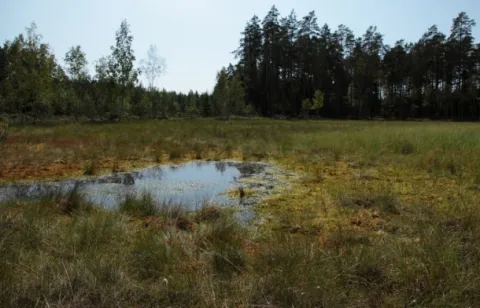
Overview
| Authority type | Authority name | Authority role | Comments |
|---|---|---|---|
| Other | University of Latvia | Initiation of the measure | Project manager, iniciator of the measure, monitoring |
| Other | SJSC Latvian state forests | Monitoring | Manager of state-owned forest lands and Aklais Mire is located in state-owned forest land |
Site Information
Design and Implementation
Financing
Policy and Governance
living conditions for plant and animal species, many of them rare and protected in EU
| Activity stage | Activity type | Key issues | Comments |
|---|---|---|---|
| Other | Stackholder consutation | Location of dam sites, changes of groundwater level, impact on habitats | In total 4 stakeholders meetings were organised during the whole elaboration process of nature management plan (elaboration of technical design of the measures is included). Meeting were attended by local governance, inhabitants, relevant state institutions ect. |
| Other | Exhibition and guided visits | — | A mobile photo exhibition showing the bogs and restoration process was displayed in schools, libraries, and cultural centres. Some site visits and field days were organized to show restoration in practice, including for students and decision-makers. |
| Arrangement type | Responsibility | Name | Role |
|---|---|---|---|
| Contractual agreement | Development of nature management plan | Latvijas Fund for nature | Development of nature management plan |
| Contractual agreement | Development of technical design and construction of NWRM | Melioprojekts | — |
Impacts and Monitoring
Monitoring System
Maintenance
Impact Assessment Methodology
Biophysical impacts: Hydrology
Biophysical impacts: Biodiversity
Monitoring from 2010 to 2013 across Aklais, Rožu and Aizkraukle mires (71 survey plots) found no statistically significant increase in Sphagnum cover or in species typical of raised bog habitats during that early post-restoration period. Cover of drainage‑tolerant species (e.g. heather Calluna vulgaris) persisted, and overall vegetation response remained limited in the short term. No quantitative data on invertebrate or bird responses at Aklais are reported in the sources consulted.
Biophysical impacts: Water & Soil Quality
Biophysical impacts: Others
Lessons Learned
Recent evaluations emphasize that while hydrological restoration - via construction of peat-dam dams - consistently succeeded in raising groundwater levels, vegetation response remained limited in the short term. Monitoring of 71 plots in Aklais (and two other sites) from 2010 to 2012 revealed no significant increase in Sphagnum cover or decline in drainage-tolerant mosses; even typical indicators such as heather vitality showed little change by 2012
The behaviour at Aklais aligns with outcomes from other restored bogs (Rožu, Aizkraukle), where vegetation dynamics lagged behind hydrological improvement, indicating that ecological recovery of raised bog habitats often requires more time or active reintroduction measures .
Follow-up initiatives, notably the LIFE REstore project, underscore the need to integrate hydrological rehabilitation with GHG flux monitoring and active species reintroduction to maximize climate mitigation and biodiversity benefits—strategies that were not included in the original LIFE Raised Bogs scope but are now considered best practice in peatland restoration in Latvia.
| Driver type | Driver role | Comments |
|---|---|---|
| Other | Main driver | izmaiņas hidrol režīmā un biotopa/ veģetācijā |
| Success factor type | Success factor role | Comments |
|---|---|---|
| Attitude of relevant stakeholders | Main factor | common understanding about nature assets maintenece |