Germasogeia riverbed artificial groundwater recharge in Cyprus

Year of issue
2025
Summary

Germasogeia (Amathos) River crosses Yermasoyia municipality near Limassol. The measure, launched in 1982, restores natural purification and recharge of the Germasogeia alluvial aquifer, processes disrupted by the upstream dam. It works by gradual reservoir releases while maintaining the riverbed’s high transmissivity. Monitoring includes flows at four weirs, groundwater levels in observation wells and coastal salinity; pumped water supplies Limassol and nearby communities.

More recently, the Water Development Department (WDD) and academic partners developed and validated optimisation models (2016–2019) on WDD data to keep target water tables with lower release volumes, formalising the conjunctive-use operation. In 2015, a 1–1.5 m concrete weir on the Germasogeia was removed within a hydromorphological restoration project; it had reportedly been built to enhance recharge. In parallel, desalination capacity serving Limassol (e.g., Episkopi, Vasilikos, and new/expanded units) now provides a major share of potable supply, easing pressure on the aquifer in dry years. In the wider district, WDD also operates a separate MAR scheme at Akrotiri (17 recharge ponds, since 2016) using tertiary-treated effluent against seawater intrusion.

Overall, Germasogeia remains a long-running SAT/MAR scheme, now embedded in a diversified water-supply system and supported by modelling and river restoration actions.
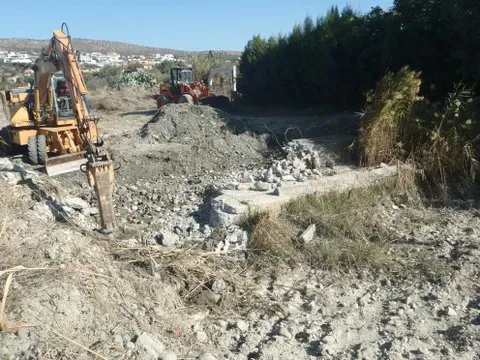
Photo Gallery
Location
34.742003, 33.084036
Project
NWRM
National ID
Cyprus_02
Sector
Hydromorphology
Installation Date
1982-03
Implementation status
Completed
Contact
Ayis Iacovides, I.A.CO

Overview

Location of the project
In Yermasoyia (Germasogeia) municipality, just east of Limassol, between Germasogeia Dam and the coast.
Country
Cyprus
NUTS2 Code
Κύπρος (Kýpros)
Sponge measures implemented in the case study
Restoration of natural infiltration to groundwater
Removal of dams and other longitudinal barriers
Objectives
Restore recharge & SAT via controlled releases (~15,000–25,000 m³/d typical).
Operate conjunctively (dam + riverbed aquifer) to supply Limassol and nearby communities; average ~5.9 Mm³/yr pumped (1982–88) after implementation; flows measured at 4 weirs and levels in 43 wells to maintain heads and curb seawater intrusion.
Involved partners
Authority type Authority name Authority role
National water authority Water development Department Implementation

Site Information

Climate Zone
Warm temperate dry
Precipitation
615.00 mm
Temperature (°C)
16.50 °C
Evapotranspiration
1230.00 mm
Runoff
143.50 mm
Runoff coefficient
0.23
Imperviousness
23.00 %
Elevation range
58 m
Slope range
1.0
Groundwater level
1.9, 6.4 and 17.6 m a.s.l. at 3 monitoring points
Vegetation class
Bare river bed with disperds reedbeds
WFD Ecological status
Good
WFD Chemical status
Good
Water quality status
Historic/ongoing risk of seawater intrusion due to reduced natural recharge and over-pumping; chloride used as indicator.

Design and Implementation

Project scale
Meso
Project scale specifications
River-reach scale within a metropolitan area
Project area
192
Size
5000.00
Size unit
m2
Constraints
A streambed aquifer of high transmissivity and large storage coefficient is required. High infiltration capacity is also needed of the riverbed to enable recharge to occur. Low or free from sediment surface water will maintain infiltration rates.
Favourable preconditions
Availability of surface water (reservoir), need for increased recharge due to use of aquifer, suitable hydrogeologic conditions of streambed aquifer such as high infiltration capacity and permaeability coupled with high storage coefficient.

Financing

Total cost information
No costs for the upstream reservoir or for the pumping wells are considered. Estimated costs are of the order of 60000€ for observation wells, weirs, earthworks, and initial studies by hydrologists and engineers.
Costs capital
38000.00 €
Costs capital information
Estimated costs for drilling of 5 observation boreholes (2500€each) equipped with water level recorders (1000€ each) and construction of 4 weirs at every 700 m along the riverbed (3000€each) with recorders (1500€each). Earthworks within riverbed (2500€).
Costs operational
6000.00 €
Costs operational information
Estimated expenses 6000€/year Dam Attendant for releases and Technician for operating weirs and carrying out monitoring. Assumed 20% of their time per year. No cost of fresh water is assumed.
Costs maintenance
3500.00 €
Costs maintenance information
2500€/year for earthworks within riverbed. 1000€/year to maintain recorders, wells and water meters.
Economic costs additional
7500.00 €
Information on Economic costs additional
Estimated cost for staff for evaluating results of the measure and planning of its further implementation being about 7500 €.
Administrative annual cost information
Estimated Costs for the operation of the measure (Scientific staff and field assistants (at 10% of their annual time) not including drilling and construction but including travelling and analytical costs are about 18000€/year.
Financing authorities
Type of funding Financing share
National funds 100 %
Compensations
Non

Policy and Governance

Policy description
Construction of the upstream dam disrupted natural recharge; increasing urban/tourism demand around Limassol; need to secure potable supplies while preventing seawater intrusion and minimizing freshwater losses to the sea. WFD-related pressures: Abstraction (quantitative pressure) and saline intrusion risk (chemical pressure signal).
Land ownership
unknown
Policy targets
Groundwater Recharge
Increase Water Storage
Pollutants Removal
Oher Societal Benefits
Part of a wider plan
Oui
Wider plan
Name
Drinking water supply
Public consultation
Non
Has contractual arrangements
Non

Impacts and Monitoring

Monitoring System

Monitoring requirements
Continuous tracking of releases, river flows at four weirs, groundwater levels in 43 piezometers, pumped volumes and chloride for seawater-intrusion control, supported by modelling.

Maintenance

Maintenance requirements
Routine earthworks in the active riverbed and servicing of instruments (recorders, wells, meters) are carried out by WDD, budgeted at ~€3,500/yr. NWRM

Impact Assessment Methodology

Performance impact assessment method
Catchment outlet
Performance impact estimation information
Monitoring included: surface water released, flow in stream monitored by four weirs 700 m apart, groundwater pumping, water-table fluctuation through 43 observation wells, samples for chemical analysis to monitor sea intrusion and a groundwater model.

Socio-economic Impacts

Direct benefits information
The aquifer is used as a natural water treatment plant. By the regulation of the aquifer a) the water demand with groundwater of acceptable quality is met, b) sea intrusion is controlled and groundwater losses to the sea are minimized.
Water supply reliability & capacity: By 1988, total groundwater extraction (65% for Limassol; plus four nearby communities) increased by ~90% compared to pre-measure (1982), meeting potable demand with acceptable quality.
Ancillary benefits information
Defertment of additional works to meet growing water supply demand (desalination, treatment works, drilling for wells etc.) Reduced cost of water supply to consumer.

Biophysical impacts: Hydrology

Retained water
7.10
Retained water unit
mio m3/month
Information on retained water
The number given refers to monthly average infiltrated water (1982-87) between weirs 700m apart (or 1400 m length) and a riverbed of 50 m width.
Modelling with recent WDD data (2013–2016) shows optimised recharge can maintain target water tables with lower release volumes (“considerable water savings” vs. current practice).
Increased water storage
5.90
Increased water storage unit
mio m3/year
Information on increased water storage
The number refers to average annual quantity pumped (1982-88) from the aquifer as a result of the artificial recharge plus losses from the upstream reservoir.
Runoff reduction
188.00
Runoff reduction unit
% Percent
Information on runoff reduction
The number refers to the ratio of extraction of 1988 to that of 1982

Biophysical impacts: Biodiversity

Improved biodiversity
Oui
Information on improved biodiversity
Riparian vegetation as habitat has improved. Related river action (same river, 2015): a 1–1.5 m concrete weir was removed on the Germasogeia (Amathos) to restore hydromorphology and aid eel migration (complementary to, not the same as, the MAR works).

Biophysical impacts: Water & Soil Quality

Water quality overall improvements
Positive impact-WQ improvement
Information on water quality overall
Chloride in time for selected wells in the delta area is used as index to the extent of sea intrusion. This fluctuates in response to the recharge releases and to prolonged periods of extraction without recharge. No deterioration trend is observed.
Soil quality overall improvements
Neutral impact-no change in SQ status
Information on soil quality overall improvements
Water is released in the active normally dry riverbed. The fresh water is free of sediments being water stored in reservoir, thus no detrimental effect is noticed on infiltration rate.
Ecosystem erosion control
Non

Biophysical impacts: Others

Ecosystem impact climate regulation
No specific impact
Information on ecosystem impact climate regulation
It can be said that some impact of the measure may have to do with reduction of energy use and GHGs (desalination, treatment etc.)

Lessons Learned

Key lessons
Germasogeia shows how a river-bed alluvial aquifer can act as a natural treatment step while supplying potable water: controlled releases and regulated pumping keep groundwater quality acceptable, limit seawater intrusion, and minimise losses to the sea.
Success hinges on rigorous, data-rich conjunctive management. The scheme is operated with flows at four weirs (~700 m spacing), 43 observation wells and chloride as a seawater-intrusion indicator; recent modelling on WDD data demonstrates that target heads can be maintained with lower release volumes than empirical practice.
Maintaining riverbed transmissivity is critical: periodic earthworks and low-sediment water from the reservoir sustain infiltration capacity—otherwise clogging would degrade performance.
Embedding MAR within a diversified supply portfolio matters. Limassol now draws part of its drinking water from the Episkopi (Limassol) and Vasilikos desalination plants, reducing pressure on the aquifer in dry years.
Coordination with river restoration and continuity goals is needed: a 1-1.5 m weir on the Germasogeia (Amathos) was removed in 2015 to restore hydromorphology and aid eel migration.
Barriers
Barrier type Barrier role Comments
Limited staff and consultant knowledge Secondary barrier Demanding practice requiring good hydrogeologic knowledge of system to fine tune releases.
Attitude of decision makers Secondary barrier —
Expected maintenance needs Secondary barrier Risk of riverbed clogging if sediments are high; needs ongoing maintenance.
Other Secondary barrier Dependence on available reservoir inflows during drought.
Drivers
Driver type Driver role Comments
Legal obligations Main driver Downstream user rights affected by construction of Germasogeia dam together with increasing water demand
Organisation committed to it Secondary driver —
Success factors
Success factor type Success factor role Comments
Existing staff and consultant knowledge Main factor Studies and good knowledge of aquifer response. Models and trial releases are needed
Attitude of relevant stakeholders Secondary factor Strong operator: Water Development Department (national authority) with long operational memory.
Other Main factor Dense monitoring network + modelling capability to guide adaptive releases. 
Financing possibilities Secondary factor National funding and stakeholder buy-in. 
Transferability
Highly transferable to semi-arid coastal rivers with permeable alluvium and upstream storage. Requires low-sediment releases, strong governance, and dense monitoring/modelling to balance heads, pumping and seawater intrusion. Watch drought risk, clogging, and river continuity; optimisation can cut releases for the same service level.

Sources

Sources