Green Borders: Transboundary conservation activities in Romania and Bulgaria
LIFE-Nature “Green Borders” (LIFE07 NAT/RO/000681, 2009–2013), coordinated by WWF with Romanian and Bulgarian partners, aimed to secure Pygmy Cormorant (Phalacrocorax pygmaeus) and Ferruginous Duck (Aythya nyroca) by restoring nesting/feeding habitats and promoting best fisheries management. It created a cross-border framework for 11 Natura 2000 sites along the Lower Danube.
Key works included improving the hydrological regime of Kaikusha marsh in Persina Nature Park (BG), completed in 2012, and the ecological reconstruction of the Gerai(ului) backwater at the Olt–Danube confluence (RO) in 2011.
The project’s studies supported the 2013 designation of three Transboundary Ramsar complexes (Iezerul Călărași–Srebarna, Suhaia–Belene Islands Complex, and Bistret–Ibisha), strengthening coordinated wetland management across the border.
Follow-up restoration in the Lower Danube Green Corridor continued under the Living Danube Partnership: water control was modernised at Persina/Kalimok and a further project prepared for Kaikusha; in Romania, >400 ha at Gârla Mare–Vrata were reconnected to the Danube in 2022. Note: in Sept 2021, a major fire burned most reedbeds at Kaikusha, temporarily degrading habitat.
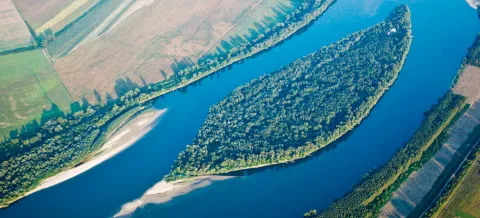
Overview
Hydrology – Kaikusha (BG): create a permanent water body with ≥ 0.6 m depth using two feeder canals (design flows 0.3 m³/s and 0.45 m³/s) and sluice structures.
Hydrology – Balta Geraiului (RO): block three drainage canals with small dikes; supply water via a ~900 m feeder canal tapping local brooks (~60–80 L/s) to maintain nesting-season water for target birds; ~600–900 ha reported as benefitting from improved conditions by project end.
| Authority type | Authority name | Authority role |
|---|---|---|
| NGO | WWF | Implementation |
| Local water authority | Directorate of Persina Nature Park | Implementation |
Site Information
Design and Implementation
Financing
Policy and Governance
| Name |
|---|
| Danube River Basin Management Plan |
| National Wetlands Conservation Plan - BG |
| National Biodiversity Strategy |
Impacts and Monitoring
Monitoring System
Maintenance
Impact Assessment Methodology
Socio-economic Impacts
Fisheries & livelihoods (Persina complex, follow-on): The later sluice/monitoring upgrade cited above projected substantial fisheries benefits (carp recruitment), indicating positive spillovers for local fishers when water-level management is improved at these marshes.
Ecotourism/education (Kaikusha): Construction of a birdwatching tower, boardwalk and platforms aimed to improve visitor experience while managing disturbance - an enabling condition for nature-based tourism/education, though visitor numbers or revenues aren’t reported.
Biophysical impacts: Hydrology
Biophysical impacts: Biodiversity
On 14 Sept 2021, >95% of the marsh vegetation burned during a severe drought after the wetland had dried out that summer; park staff reported no large vertebrate casualties, but major damage to vegetation and small fauna. This event temporarily erased habitat structure gains until regrowth.
Biophysical impacts: Water & Soil Quality
Biophysical impacts: Others
Lessons Learned
Hydrology must be engineered and then actively managed: Kaikusha’s design hinged on feeder canals/sluices and adaptive reed management, supported by monitoring and operational decisions rather than “one-off” works.
Cross-border governance multiplies impacts: the project’s planning fed directly into the 2013 designation of three Transboundary Ramsar complexes, locking in coordinated management across the border.
Climate extremes can abruptly erase gains: after summer drying, a 14 Sept 2021 fire burned >95% of Kaikusha’s reedbeds - underscoring the need for drought/fire contingencies in wetland O&M.
Linking habitat maintenance to local livelihoods (e.g., reed-biomass PES) helps sustain outcomes but requires time to mature technically and commercially.
| Driver type | Driver role | Comments |
|---|---|---|
| Organisation committed to it | Main driver | Restoration of Kaikusha is part of larger project initiated by WWF |
| Success factor type | Success factor role | Comments |
|---|---|---|
| Financing possibilities | Main factor | LIFE Nature |
| Successful coordination between authorities | Main factor | Strong RO–BG partnership aligned with Ramsar/Natura 2000 frameworks. |
| Conducted assessments (incl. economic) | Secondary factor | Active hydrological operation and ecological monitoring by Persina NP and partners. |
| Available support tools | Main factor | PES/biomass approach to maintain open water and manage reeds. |