Barking Riverside Green Roof Ecomimicry Experiment

Year of issue
2025
Summary

Barking Riverside piloted an ecomimicry approach to green roofs to conserve a regionally important brownfield invertebrate community, including target species such as the brown-banded carder bee (Bombus humilis) and Gymnosoma nitens. Roof test bays reproduced open-mosaic niches (varied substrate depths, recycled aggregates, ephemeral pools), and monitoring showed these designs could retain pre-development biodiversity while delivering connectivity and ecosystem services. Since then, the method has been formalised in guidance and peer-reviewed research and used to inform wider green infrastructure across the development. At borough scale, by end-2017 Barking & Dagenham hosted 51,658 m² of green roofs, with over 25,000 m² at Barking Riverside (nearly half the borough total), evidencing roll-out beyond the initial trials. Current planning documents continue to mandate ecologically sensitive roofs, with Stage 2 South (2023) targeting 40% of total roof area as green roofs and 10% as brown roofs, and the 2024 Local Plan reinforcing green/brown roofs and locally appropriate planting. Early delivery included ~50 homes (≈20 m² each) and a 2,100 m² roof (1,500 m² vegetated), preceding the broader programme.
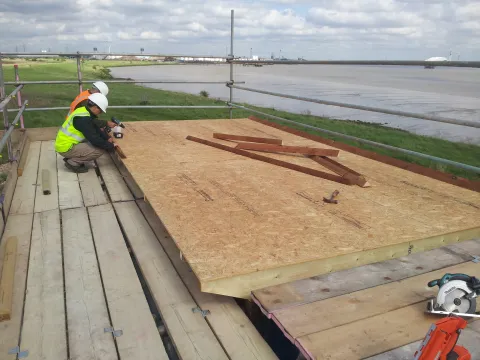
Photo Gallery
Location
51.520402, 0.118587
Project
NWRM
National ID
UK_7
Sector
Urban
Installation Date
2013-2014
Implementation status
Completed
Contact
Stuart Connop, Senior Research Fellow at UEL

Overview

Location of the project
Barking Riverside, London Borough of Barking & Dagenham, UK
Post-industrial brownfield site that supported important biodiversity now being redeveloped to provide 11,000 homes
Country
United Kingdom
NUTS2 Code
Outer London
Sponge measures implemented in the case study
Green Roofs
Objectives
Create green roofs that support ≥53 invertebrate species including nationally rare taxa.
Achieve vegetation cover supporting >110 plant species, with spontaneous colonisation.
Retain stormwater up to 80 mm temporarily.
Match or exceed the water retention of standard sedum roofs.
Improve floral and faunal richness over two years of monitoring
Involved partners
Authority type Authority name Authority role Comments Authority responsibility
Other Barking Riverside Ltd Initiation of the measure Developer; coordinated implementation Responsible
Research institute / University University of East London Monitoring Scientific lead for research and monitoring. Supporting
Local water authority London Borough of Barking and Dagenham Implementation Local authority; involved in planning and governance. Responsible
Local water authority Greater London Authority (GLA) Implementation Strategic oversight; partner in public-private cooperation. Responsible
Research institute / University Institute for Sustainability Determination of design details of the measure Provided sustainability expertise. Supporting
Architects / Engineers Green Infrastructure Consultancy Determination of design details of the measure Design specialists for GI integration. Supporting
Architects / Engineers Hertalan UK Determination of design details of the measure Provided roofing membrane expertise. Supporting
Architects / Engineers Shire Aggregates Ltd Implementation Supplied substrates mimicking local soil conditions. Supporting
Other European Commission (DG Research and Innovation) Financing Major funder via FP7/TURAS Supporting
Documents

Site Information

Climate Zone
Cool temperate moist
Temperature (°C)
11.00 °C
Elevation range
6 m
Slope range
1-2%
Vegetation class
The vegetation mimics early successional brownfield habitats and includes both dry and wetland species. Examples: Lotus corniculatus, Leucanthemum vulgare, Juncus effusus, Lythrum salicaria, etc. This forms a diverse assemblage reflecting open mosaic habitats.
WFD Ecological status
Moderate
WFD Chemical status
Good
Water quality status
Tidal Thames around Barking: all water bodies fail chemical status; ecological potential mostly moderate. Key pressures: physical modifications, urban/transport diffuse pollution, and wastewater discharges.

Design and Implementation

Project scale
Micro
Project scale specifications
The Barking Riverside development covers 443 acres, aiming to build 10,800 homes, schools, and infrastructure for 25,000 residents. Green infrastructure, including green roofs, is implemented across 40% of buildings and 40% of the land area.
Project area
179
Project area specifications
Total Barking Riverside development: 443 acres (~179 ha)
Green roofs installed on 40% of buildings (exact m² not specified)
Each test green roof: 6 × 3 m, with 9 test roofs in the experiment
Principles
The project was based on the principle of ecomimicry—designing green roofs to mimic the ecological functions of the original brownfield Open Mosaic Habitat. It also followed principles of multifunctional green infrastructure, climate resilience, biodiversity conservation, and urban sustainability. The aim was to preserve ecosystem services and regional biodiversity, especially rare invertebrates, by replicating their natural habitats on roofs. Additionally, it integrated SuDS principles and promoted co-creation between scientists, developers, and planners.
Constraints
Potential risks include roof load-bearing capacity limitations due to added water and substrate, risk of waterproof membrane failure if water pooling systems fail, and possible drought stress during dry seasons without irrigation.
Favourable preconditions
Pre-existing brownfield biodiversity and habitat diversity serving as ecomimicry templates.
No intensive vegetation management historically, enabling colonisation by rare species.

Financing

Total cost information
Experimental setup (9 green roofs on containers): €45,000
PhD studentship (3 years): €70,000
Information on Economic costs - income loss
No income loss is reported. The green roofs were cost-comparable or cheaper than standard systems, and land use changes did not displace economic activity that would result in losses.
Financing authorities
Authority name Type of funding Comments
European Union EU-funds: LIFE+ FP7 TURAS €45,000 for experimental setup
University of East London — €70,000 PhD funding
Compensations
Non

Policy and Governance

Policy description
Mitigates habitat loss from urbanisation and stormwater runoff impacts. Also addresses urban biodiversity fragmentation and ecosystem service degradation.
Land ownership
Barking Riverside Limited (BRL) holds the site freehold.
Policy targets
Improved Biodiversity
Runoff control
Increase Water Storage
Oher Societal Benefits
Target remarks
The design was multifunctional, embedding ecomimicry to mimic the regionally important habitats and their services. Biodiversity and runoff control were equally emphasized, with novel drainage designs enabling enhanced habitat variety and hydrological performance.
Policy pressure
Directive Relevant pressure
WFD identified pressure Pressure from urban development and hydromorphological changes.
WFD identified pressure Risk of pluvial and fluvial flooding in urbanised London.
Other non-EU Biodiversity Strategy for England & UK BAP: Protection of Open Mosaic Habitat.
Pressure remarks
Policy pressures shaped both the functional goals (flood mitigation, biodiversity conservation) and procedural requirements (e.g. planning consent mandates) for the project.
Policy impact
Directive Relevant impact
WFD identified pressure Supports better ecological status through diffuse pollution mitigation.
Floods Directive identified pressure Reduced runoff volumes and flood risk.
Other non-EU UK Biodiversity Action Plan: Mitigation for loss of Open Mosaic Habitat.
Other non-EU Climate Adaptation Policy: Contributes to urban cooling and water retention.
Impact remarks
The project responds to multiple interconnected goals across scales—local planning, national biodiversity priorities, and EU-wide GI strategies. It shows synergy in responding to multiple policy drivers simultaneously.
Requirement directive
Requirement directive Specification
WFD-mitigation of significant pressure Urban runoff
Floods Directive-mitigating Flood Risk —
Part of a wider plan
Oui
Wider plan
Wider plan type Wider plan focus Name Comments
National Urban National Planning Policy Framework (UK) Urban regeneration & brownfield reuse.
Regional Urban London Plan Regional policy for sustainable development and green infrastructure.
— Urban TURAS FP7 EU-funded urban sustainability programme.
Public consultation
Non
Has contractual arrangements
Non

Impacts and Monitoring

Monitoring System

Monitoring parameters
Plant diversity and structure via quadrats and transects.
Invertebrate community composition using pitfall traps.
Seasonal and spatial variation in vegetation development.

Maintenance

Maintenance requirements
Minimal. The biodiverse green roofs were designed to reduce management requirements compared to traditional landscaping. The use of drought-tolerant species and design that limits the need for irrigation or fertilization supports low-maintenance operation

Impact Assessment Methodology

Performance impact estimation information
The design compared three roof treatments with different drainage configurations to study biodiversity outcomes and hydrological dynamics.
Biophysical impact assessment method
Botanical and invertebrate surveys, habitat mapping, species richness/evenness calculations, and seasonal variation monitoring were used.
Cost assessment method
No formal cost assessment methodology is described beyond mentioning comparable costs to standard systems.

Socio-economic Impacts

Direct benefits
Reduced construction costs: Green roofs cost less than standard sedum roofs due to removal of drainage layers.
Improved local microclimate: Urban cooling benefits from increased evapotranspiration.
Compliance with planning conditions: Enabled development approval.
Research and innovation opportunities: Hosted PhDs and research funding.
Local engagement: Enhanced community value through aesthetic and nature-connected spaces.
Ancillary benefits information
Supports climate change adaptation (stormwater buffering, cooling).
Increases habitat connectivity for urban biodiversity.
Raises awareness and engagement around nature in urban development.
Enhances academic-practice partnerships and supports educational use.

Biophysical impacts: Hydrology

Hydrological effects
Slows down stormwater runoff using substrate saturation and surface pooling, enhances water retention at roof level, promotes evapotranspiration, reduces immediate runoff into SuDS infrastructure.
Information on retained water
Treatment 3 retained up to 80 mm of rainwater temporarily via elevated drainage.
Roofs retained water in substrate and surface pools. Geotextiles at base also held and gradually released water.
Information on runoff reduction
Ecomimicry roofs matched or outperformed standard sedum roofs in stormwater attenuation, with slower drainage from pooled designs.
Ecosystem water supply
No measurable change in supply.

Biophysical impacts: Biodiversity

Improved biodiversity
Oui
Information on improved biodiversity
Habitat creation: Mimics ephemeral wetland, ruderal, and scrub habitats.
Plant species: 114 species recorded (36 planted, 78 spontaneously colonised). Many colonisers were characteristic of high-quality brownfield sites.
Invertebrates: 53 species recorded, including Scybalicus oblongiusculus (RDB1), Bombus humilis (UKBAP), and Lasioglossum pauperatum (RDB3).
Community benefits: Created habitat heterogeneity with mounds, wet and dry areas, and bare ground, supporting a wide range of taxa.
Soil fauna and benthos: Not assessed due to rooftop context, but surface biodiversity was strong.
This confirms the effectiveness of ecomimicry for rare and conservation-priority species.

Biophysical impacts: Water & Soil Quality

Water quality overall improvements
N/A info
Information on water quality overall
Water quality effects are likely positive due to filtration by substrate and retention of pollutants in runoff, but no empirical water quality measurements are reported for Barking Riverside.
Information on soil quality overall improvements
No evidence of soil pollution reduction or carbon storage, but soil-like substrates were ecologically functional.
Information on soil quality, overall soil nutrients
Substrates were designed using low-nutrient aggregates to mimic brownfield soils, aiming to limit nutrient loading and support high biodiversity.
Information on soil quality, overall soil physical properties
Physical properties such as friability and heterogeneity were intentionally recreated using PFA and recycled materials to support early successional species.

Biophysical impacts: Others

Information on ecosystem impact climate regulation
Thermal insulation benefits were observed. Biodiverse roofs performed as well or better than standard sedum roofs in reducing building heat gain and promoting urban cooling through evapotranspiration, contributing to climate regulation
Increased evapotranspiration information
Evapotranspiration increased due to the use of deeper and moisture-retentive substrates. However, there is no quantified data.
Information on mitigation other biophysical impacts
Thermal insulation improvement, reducing urban heat island effects.
Habitat connectivity at roof level, acting as a “stepping stone” for species movement.
Microtopography impacts (mounds, slopes, depressions) enhanced diversity of niches.

Lessons Learned

Key lessons
Ecomimicry successfully replicated brownfield habitats on green roofs. Design must include microhabitat diversity and local ecological knowledge. Pooling design can be integrated without damaging the waterproof membrane. Industry standardisation limits biodiversity; flexibility and co-creation improve outcomes.Long-term monitoring is needed, but even short-term results showed high colonisation.
The partnership model between academia, developers, and public bodies was crucial.
Success factors
Success factor type Success factor role Comments
Attitude of relevant stakeholders Main factor Positive, with collaborative engagement.
Available support tools Secondary factor TURAS FP7 provided structure.
Cost effectiveness
Biodiverse green roofs were found to be as cost-effective, or even cheaper, than industry-standard sedum systems. They provided additional ecological benefits without increasing construction costs due to elimination of separate drainage layers.
Flexibility / Adaptability
Roof design allowed for variable drainage depths and substrate types.
Design adapted over phases to improve habitat simulation.
The system could revert to standard green roof function if pooling layer failed.
The project was designed to be context-sensitive, allowing other regions to adapt similar principles to different habitats.
Transferability
Transferable Elements:
- The ecomimicry approach (using local habitat templates) is universally applicable.
- Modular roof design adaptable to different species and substrates.
Challenges:
- Requires site-specific ecological knowledge and design expertise.
- Architects may resist standing water unless managed carefully.
- Must ensure drainage does not compromise roofing infrastructure.
Opportunities:
- Suited to urban redevelopment with biodiversity goals.
- Strong potential where brownfield land is being lost