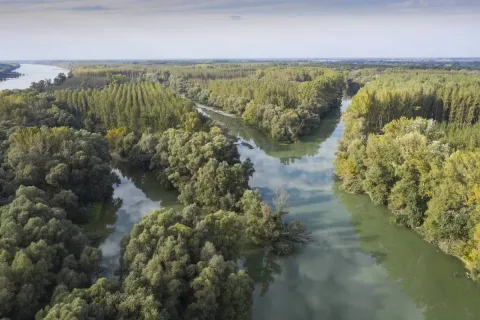
Preservation of floodplain forests, Slovakia
DANUBE FORESTS, coordinated by BROZ and funded by the LIFE programme, preserves the remaining floodplain forests of the Slovak Danube inland delta and introduces sound, sustainable forest management. Since then, a wider EU-LIFE effort has reconnected side-arms and restored wetlands while agreeing a new operational water regime: over 75 ha of wetlands and 18.5 km of tributaries have been brought back to life, supported by an operational manual that integrates Natura 2000 needs into water-management decisions.
Controlled “simulated floods” are now released via the Dobrohošť inlet, with flows up to 120 m³/s tested in 2023 and implemented again in spring 2024 to refresh the inland delta. In 2024 the Vojčianske side arm was reopened and in 2025 the Foki arm in the old Danube bed was restored, improving connectivity, habitats and local water retention. Further actions continue under Dynamic LIFE Lines Danube (AT–SK) and LIFE RESISTANCE, which also tackles invasive plants. Several areas proposed by DANUBE FORESTS have since been formally protected (e.g., Foráš PR, Pečniansky les protected area, Ostrovné lúčky).
Overview
Prepare a Sustainable Forest Management Framework Strategy for the whole area and update forest management plans for the project forests
Designate and enlarge protected areas in key sites of Dunajské luhy; the initial plan targeted ~549 ha of new protected areas
Apply close-to-natural forestry on selected stands: control/eliminate invasive plants, promote natural regeneration, and use selective cutting instead of clear-cuts.
Build capacity and awareness: training of State Forest Administration and State Nature Conservancy staff; study visits (CZ Morava–Dyje, AT Donau-Auen), outreach materials and public excursions/seminars.
Inventory local genetic seed sources for afforestation to support native species use.
| Authority type | Authority name | Authority role |
|---|---|---|
| NGO | BROZ - Regional Association for Nature Conservation and Sustainable Development | Initiation of the measure |
| National water authority | State Nature Conservancy of Slovak Republic | — |
| Local water authority | National park Donauauen (Austria) | — |
Site Information
Design and Implementation
Financing
Policy and Governance
| Wider plan type | Wider plan focus | Name |
|---|---|---|
| Project based | Forestry | Sustainable Forest Management Framework Strategy |
| Activity type | Comments |
|---|---|
| Dissemination activities | tickers, posters, postcards, information panels and a website (in Slovak and English) and organising field excursions and training seminars |
| Arrangement type | Responsibility | Name | Role | Comments |
|---|---|---|---|---|
| Contractual agreement | 25–30-year leases | Land leasing | ~300 ha leased by BROZ | Čunovo, Číčov, Veľké Kosihy, Zlatná na Ostrove |
Impacts and Monitoring
Monitoring System
Maintenance
Socio-economic Impacts
The Gajc nature reserve was enlarged from 0.84 to 62.72 ha and a new 76.7 ha nature reserve, Stary haj, was designated. Proposals to designate two further areas (Foras and Gabcikovske luhy) as nature reserves and one (Pecniansky les)as a protected site were submitted to the competent authorities, along with proposals to enlarge the existing nature reserves at Ostrovne lucky and Cicovskemrtve rameno. The total area of the new proposed protected areas is 1 935.68 ha,substantially exceeding the original project plan of 549 ha.
Public backing: a petition “For Water for the Life of the Danube Inland Delta” gathered 11,603 signatures (2020), helping reopen negotiations on the water-regime.
Events & audiences: 19 school presentations (648 participants) and 15 public talks (1,450 participants); six annual Family Days reached ~3,000 visitors; 11 information boards installed; children’s summer camps ran repeatedly.
Land secured for conservation/management: 67.07 ha purchased and 349.22 ha leased (15–30 yrs) to guarantee long-term stewardship.
Traditional grazing reintroduced with local cooperatives: 8.1 ha (Bodíky), 22.04 ha (Veľký Lél), 28.5 ha (Apálsky ostrov); 23 ha of wet arable converted back to grassland near Číčov.
Biophysical impacts: Hydrology
“Simulated floods” now re-water the branch system via the Dobrohošť inlet. In spring 2024 the flood ran 25 days with a 120 m³/s peak for 15 days; a summer 2024 flood ran 21 days with 60 m³/s for 18 days.
The Vojčianske side arm was reopened (Aug 2023–Jan 2024): 3.7 km of continuity restored, ~12,000 m³ of sediment removed, culverts upsized; post-works monitoring is in place.
In spring 2025 the simulated flood lasted 34 days but reportedly did not exceed ~30 m³/s, lower than 2024’s 120 m³/s peak.
Biophysical impacts: Biodiversity
Biophysical impacts: Water & Soil Quality
Biophysical impacts: Others
Lessons Learned
Restoring flow in a regulated system required governance first, then earthworks. The team had to renegotiate operating rules and coordinate conservationists, water managers and energy companies before bringing back larger, regular “simulated floods”; only after that did side-arm dredging, culvert upgrades and weir reconstructions deliver full benefits.
Operations must follow ecology. Amphibian monitoring showed that timing and magnitude matter (e.g., early-spring floods and testing 120 m³/s), and results were fed back into how floods are scheduled. Remote probes and an operations app now link ecological and hydraulic responses in near-real time.
Physical constraints and legacy pressures are real barriers. Decades of siltation and dozens of small barriers had degraded branches; in addition, buildings in the intended inundation zone capped flows for safety reasons until authorities addressed them. These constraints shaped what could be achieved, and when.
Public support helps unlock decisions. A 2020 petition and sustained outreach underpinned the agreement to resume and upscale simulated floods, and the project’s consensus-building was recognised at EU level.
| Success factor type | Success factor role | Comments |
|---|---|---|
| Successful coordination between authorities | Main factor | Formalised, multi-actor operating regime for floods (negotiations + updated rules). |
| Public participation | Main factor | Broad stakeholder and public backing (petition; EU Natura 2000 Award finalist for conflict resolution). |