Water retention management in the broader area of Ancient Olympia, Elia, Greece
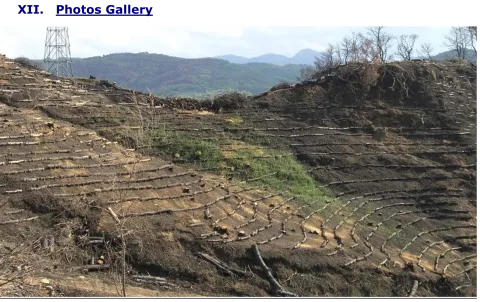
The project focuses on post-fire water retention management in the broader area of Ancient Olympia, Elia, Peloponnese, Greece. It involves afforestation of mountainous areas and the temporary installation of wooden structures using locally available timber to retain water, stabilize slopes, and reduce erosion. These natural measures aim primarily at flood control and risk mitigation, with secondary benefits for biodiversity conservation.
Recent scientific studies (2022–2025) have confirmed the effectiveness of these interventions. Field measurements showed that post-fire treatments in Olympia significantly improved soil infiltration capacity, up to 300% higher in deposition zones compared to eroded ones two years after implementation. Satellite-based erosion models (using Sentinel-2 and RUSLE) also indicated a sharp increase in soil erosion after wildfires, which was partly mitigated by restoration works that reduced erosion rates by approximately 18%. These findings demonstrate the long-term hydrological benefits of such nature-based solutions under Mediterranean conditions.
Key success factors remain the strong engagement of decision-makers, the willingness of local stakeholders, positive public perception, and the availability of expert knowledge and tools. The project is an example of adaptive, evidence-based post-fire watershed management in a culturally and environmentally sensitive region.


Overview
Soil retention & erosion control : Retain 7.5 mm fertile soil; 2,500 m³ over 30 ha
Biodiversity conservation : Protect gene pool in riparian zones
Hydro-regulation : Reduce peak flows; sustain baseflows via afforestation
Project scale & duration : 49.5 ha affected; intervention executed Nov 2007–Feb 2008; lifespan 4–5 years
| Authority type | Authority name | Authority role | Comments | Authority responsibility |
|---|---|---|---|---|
| Other | Institute of Mediterranean and Forest Ecosystems | Determination of design details of the measure | The Institute along with NAGREF are the scientific / technical responsible parties | Supporting |
| Regional / sub-national water authority | Hellenic Ministry of Culture and Sports . The main stakeholders involved for the study and the implementation of the restoration of the site were the | Monitoring | The Ministry is the beneficiary, responsible for initiating and monitoring the interventions procedures | Responsible |
| Other | Ephorate of Prehistoric and Classical Antiquities | Monitoring | The Ephorate is the regional cultural authority of the pilot area | Responsible |
| Other | Forest Products Technology of the National Agricultural Research Foundation (NAGREF) | Determination of design details of the measure | NAGREF along with the Institute of Mediterranean and Forest Ecosystems are the scientific / technical responsible parties | Supporting |
Site Information
Design and Implementation
49.5 ha are the area affected by the fires and restored. In particular, Kronios Hill, International Olympic Academy – Zone A, International Olympic Academy – Zone B, Zouni Hill, Kolosaka Hill.
In these areas 80-100% of the vegetation has been burned.
The soils of the study area are also very loose and corrodible; thus vulnerable to the rainfall.
A high challenge for the temporary small structures is the hydraulic undercut.
Improving the condition of existing rainwater drainage system e.g. cleaning of the rainwater drainage system to avoid filling the road network with logging waste and increasing the flood risk.
Financing
Policy and Governance
| Directive | Relevant pressure |
|---|---|
| Floods Directive identified pressure | Other pressure contributing to flooding/flood risk |
| WFD identified pressure | Other hydromorphological alterations |
| Directive | Relevant impact |
|---|---|
| Floods Directive identified pressure | Other Environmental impacts |
| WFD identified pressure | Altered habitats due to hydrological changes |
| Requirement directive | Specification |
|---|---|
| Floods Directive-mitigating Flood Risk | Flood risk management and flood impacts mitigation |
| WFD-mitigation of significant pressure | Mitigation of hydromorphological alterations e.g. soil erosion |
Fire protection laws (Law 998/1979, P.D. 86/69, 2612/1998, 3013/2002, 3208/2003, 3511/2006 (protection of forest ecosystems, reorganization of fire department & upgrade of its mission). In terms of water policies these laws (esp. 3208/2003) are addressing the protection of the forest ecosystem including water resources.
Impacts and Monitoring
Monitoring System
Maintenance
Impact Assessment Methodology
Socio-economic Impacts
Biophysical impacts: Hydrology
Deposition zones (DZ)—areas adjacent to the timber structures—showed significantly higher unsaturated hydraulic conductivity (K) compared to erosion zones (EZ):
Wattles: DZ K was 159 % higher than EZ in 2022; 145 % higher in 2023. K increased over time: +29 % in DZ and +36 % in EZ from 2022 to 2023.
Log barriers: DZ K was 174 % higher than EZ in 2022; 243 % higher in 2023.
Log dams: DZ K was 240 % higher in 2022; 190 % higher in 2023. Both DZ and EZ saw increases in K from 2022 to 2023 (+42 % in DZ, +67 % in EZ).
The rating for the log erosion barriers was “excellent” or “good” in 70% of the measurements.
Biophysical impacts: Biodiversity
Biophysical impacts: Water & Soil Quality
The total estimated soil material w/30 ha or retention of a total 7.5 mm of fertile soi, equivalent to approximately 2,500 m³ over 30 ha.
Biophysical impacts: Others
Lessons Learned
Scientific monitoring confirmed the long-term hydrological benefits of the measures. Infiltration capacity was significantly higher—up to 300%—in areas where structures were installed, even two years after implementation. This demonstrates that well-designed post-fire interventions can lead to sustained improvements in soil-water dynamics under Mediterranean conditions.
The project's design combined temporary physical structures with long-term ecological goals. Once vegetation recovered, it was expected to take over erosion control functions, making the solution both cost-effective and resilient. Supporting natural regeneration was key to amplifying long-term impacts.
Social and institutional engagement played a crucial role in implementation. The support of local authorities, the willingness of stakeholders, and the availability of expert knowledge were all essential for the project's success.
However, the lack of long-term environmental monitoring limits a full evaluation of its broader impacts. While soil retention and infiltration improvements were documented, there is little information on water quality, biodiversity, or climate regulation outcomes. Ensuring continuity in monitoring would strengthen the case for replicating such measures elsewhere.
| Driver type | Driver role | Comments |
|---|---|---|
| Other | Main driver | Morphology, vegetation, climate and geology of the area. |
| Success factor type | Success factor role | Comments |
|---|---|---|
| Attitude of relevant stakeholders | Main factor | The active involvement of the two Institutes was of critical importance |
| Attitude of decision makers | Secondary factor | — |
| Existing staff and consultant knowledge | Secondary factor | The expertise and knowledge tools of the two Institutes was important |