OPTAIN : Pesnica river catchment [Austria/Slovenia]
Year of issue
2025
Summary
The Pesnica river catchment is characterized by intensive agricultural production, mainly cattle/pig breeding and arable farming. In spring and summer, the catchment is exposed to drought, while in autumn and winter to severe precipitation events. Soils with a high proportion of clay, which are subject to rapid surface runoff, erosion and nutrient leaching, are further contributing to unfavourable conditions. Market requirements regarding quality and reliability of production are leading towards changes in the tillage technology, but also towards searching for reliable water sources and economically efficient, yet sustainable measures for the longest possible retention of water in the soil.
Photo Gallery


Location
46.59989, 15.72467
Project
OPTAIN
National ID
EU_02
Sector
Agriculture
Installation Date
2020-2026
Implementation status
Completed
Contact
Gregor Kramberger Chamber of Agriculture and Forestry of Slovenia – Institute of Agriculture and Forestry Maribor e-mail:gregor.kramberger@kmetijski-zavod.si
Overview
Location of the project
Podravska region/Pernica/Jareninski dol
Podravska region/Pesnica/Gačnik
Podravska region/Pesnica/Gačnik
Country
Slovenia
NUTS2 Code
Osrednjeslovenska regija
Sponge measures implemented in the case study
Minimum tillage
Ponds and scrapes
Cover crops
Buffer strips and hedges
Mulching
Crop rotation
Forest riparian buffers
Involved partners
| Authority type | Authority name | Authority role | Comments | Authority responsibility |
|---|---|---|---|---|
| Other | Ministry of Agriculture, Forestry and Food (Ministrstvo za kmetijstvo, gozdarstvo in prehrano) | Initiation of the measure | Responsible for strategic planning and policy development | Responsible |
| Other | Agency for Agricultural Markets and Rural Development (Agencija Republike Slovenije za kmetijske trge in razvoj podeželja) | Implementation | Responsible for administrative oversight, implementation, and payment of CAP measures. | Responsible |
| Other | Chamber of Agriculture and Forestry of Slovenia (Kmetijsko gozdarska zbornica Slovenije) | Other | Provides technical advice and direct support to farmers regarding the adoption of sustainable practices and the use of CAP instruments | Supporting |
Site Information
Climate Zone
Cool temperate moist
Precipitation
1000.00 mm
Temperature (°C)
9.50 °C
Evapotranspiration
600.00 mm
Runoff
300.00 mm
Slope range
14%
Soil type
Cambisols
Luvisols
Groundwater level
5-50 meters
Vegetation class
arable crops, permanent grasslands, and mixed forest vegetation
WFD Ecological status
Poor
WFD Chemical status
Failing to achieve good
Design and Implementation
Project scale
Meso
Project area
137 km2
Project area specifications
Rural area
Basis of design
The design relied on local knowledge and was adapted to field conditions, using funding instruments already available to Slovenian farmers.
Principles
Individual farm households are average in wealth and they are basically mechanized/motorized. The examined farm household, as all housholds in the region has good access to all services and infrastructures. Farm is medium in scale with land owned partly by the farmer and partly leased from other private owners.
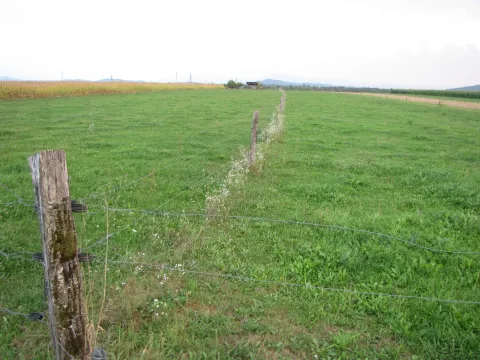
Cropland area was converted to permanent grassland or pasture land by sowing of grass and by a fence as protection. Grazing is organized in a rotation system between suckler cow's pasture and paddocks.
The purpose of the technology is to use the natural potential of the soils. As soils are shallow with low water holding capacity permanent grassland is much more resilient and adapted to the drought; permanent grassland needs not only less water, but as well less nutrients. Grass has the capacity to grow well after any rainfall event at any time of the growing period. During drought when, maize fields get dry, grasslands subsist and just wait until the rain falls. While maize yield is lost in drought years, grassland can sustain and nurrish animals until mid-autumn. Another advantage of grassland is its building up of organic matter in the soils.
Mulch-till: (also called “conservation agriculture” or “minimum tillage”) is a method of land management with modified, less intensive tillage, where land is covered with plant residues year-round (at least 30% cover) or grass, energy consumption is reduced, and there is less trampling/ compaction of the soil because of fewer machine passes and the protected surface. Under mulch-till, special agricultural machinery and attachments are required. Disc harrows and chisel ploughs are used to loosen the soil, and direct drills are employed for seeding.
Retention ponds: “Retention ponds” comprise both simple, small ponds (up to 2000 m3, up to 4 m deep) and larger, more complex reservoirs (greater than 2000 m3). Retention ponds are designed to provide storage capacity to attenuate surface runoff during rainfall events. Each consists of a permanent ponded area with landscaped banks. Retention ponds achieve both storm water attenuation and water quality treatment through supplementary storage capacity of runoff. Water is then released at a controlled rate once the risk of flooding has passed. The technology can be applied in a natural or human environment. Before construction of a pond it is essential to follow legislation, which covers conditions and restrictions for the given location. Once a site is selected, technical documentation is prepared: first the conceptual design, then documentation for obtaining opinion, consent and a building permit. Later there is also project documentation for implementation. If the water is to be used for other purposes as well (e.g. for irrigation), it is necessary to plan for usage and environmental impact. Retention and still water promotes pollutant removal through sedimentation, while aquatic vegetation and biological uptake mechanisms offer additional treatment. Retention ponds are effective in removing urban pollutants and improving water quality.
Financing
Total cost information
Total costs were divided into initial investment costs and annual operational (maintenance) costs. They include basic design, construction (retention ponds, buffer strips), low tillage equipment use, green cover seeds, and basic site adaptation/preperation.
Costs investment information
Grazing : land preparation, equipment purchase and plant material procurement : 1 535 EUR
Mulch till : equipment procurement : 63 500 EUR
Retention pond: Document preparation, planning permission, construction of pond: 73 600 EUR
Mulch till : equipment procurement : 63 500 EUR
Retention pond: Document preparation, planning permission, construction of pond: 73 600 EUR
Costs operation maintenance information
Retention Ponds: Desilting of retention ponds; re-seeding costs every few years.
Riparian Buffer Strips and Hedges: Periodic mulching, mowing, or manual cutting (chainsaw work); removal of invasive species; occasional replanting or gap filling.
Green Cover / Cover Crops: Annual seed purchase and sowing; field preparation; potential herbicide or mowing costs for cover termination. These are recurring agronomic costs, varying by crop type and seasonal conditions.
Low Till Agriculture: Ongoing costs are related to specific machinery operations (e.g. disc harrows, no-till seeders). Costs depend on field size, soil condition, machine maintanance and fuel/labor inputs.
Crop Rotation:
No direct maintenance costs, but crop selection and planning must consider nutrient needs, pest cycles, and market viability. Minor administrative or advisory costs may apply.
Crop Rotation: Ongoing costs depend on the specific crop grown in each rotation year. These include variable production costs such as seeds, fertilizers, plant protection products, labor, and machinery use — all considered standard farm operational expenses.
Costs operational information
Retention Ponds: Pond inspection; occasional re-seeding; vegetation management around retention ponds.
Riparian Buffer Strips and Hedges: Regular inspection; vegetation control through mulching; selective cutting and trimming with chainsaw; removal of invasive species.
Green Cover: Monitoring of cover crop establishment; re-sowing if cover is insufficient; control of unwanted species; soil condition checks.
Low Till Agriculture: Annual review of soil structure and compaction; equipment maintenance; occasional weed pressure monitoring (especially where herbicide use is reduced).
Crop Rotation: Planning and documentation of rotation cycles; monitoring nutrient balance and soil health; adjusting rotation based on market and ecological feedback.
Policy and Governance
Land ownership
Land partly owned and partly leased from private owners. The area is used for sedentary mixed or commercial agriculture, with <10% off-farm income. Farms are medium-scale and mechanized, with good access to services and infrastructure
Policy targets
Runoff control
Peak-flow reduction
Groundwater Recharge
Increase Water Storage
Pollutants Removal
Requirement directive
| Requirement directive |
|---|
| Water Framework Directive (WFD) 2000/60/EC |
| Nitrate Directive (NiD) 91/676/EEC |
Part of a wider plan
Oui
Public consultation
Non
Has contractual arrangements
Non
Impacts and Monitoring
Maintenance
Maintenance requirements
several maintenance activities are needed like occasional re-seeding; vegetation management around retention ponds, routine farming operations,
Impact Assessment Methodology
Performance impact estimation information
Measures have impacted different elements of their environment.
The application of mulch-till on farm plots has had significant ecological impact, decreasing surface run-off and evapotranspiration. Soil moisture and cover has also been improved while reducing soil compaction, soil loss and crusting. Finally, it is thought to have a beneficial impact in decreasing the impact of droughts.
The installation of retention ponds in the agricultural landscape has resulted in both socio-economic and ecological impacts. In socio-economic terms, their presence increases crop production and reduces the risk of crop production failure. It is also thought to contribute to improving irrigation water quality. In ecological terms, retention ponds increase water quantity by harvesting and collecting water and surface run-off. It is also anticipated that they will reduce climate change risks associated with flooding and drought events,
Biophysical impacts: Water & Soil Quality
WFD ecological status obj quantity
Poor (2021)
Information on WFD ecological status obj quantity
According to WFD Article 4 assessments, the ecological status of the water bodies is rated Poor (2021).
Lessons Learned
Key lessons
Implementation was simple, cost-effective
Drivers
| Driver type | Driver role | Comments |
|---|---|---|
| Public pressure | Main driver | Visibility of local hydrological issues |
| Public pressure | Main driver | Eutrophication of Lake Pernica |
| Other | Main driver | Soil erosion control Climate resilience Soil conservation Water retention in the landscape Biodiversity improvement |
Success factors
| Success factor type | Success factor role | Comments |
|---|---|---|
| Other | Main factor | Low-impact requirements |
| Available support tools | Main factor | Simple design, minimal land use change |
| Attitude of relevant stakeholders | — | Awareness of local water and soil management challenges |