Jardin des Eaux (water garden) in Fourqueux, a water management system for the city centre

Year of issue
2025
Summary

Fourqueux (≈4,000 inh.) requalified its centre with new housing and created the “Jardin des Eaux” to manage stormwater from ~1.7 ha. The park routes runoff through a sequence of dry basins to a planted permanent pond, infiltrating frequent rain and avoiding direct discharge to the separate sewer draining to the Seine via the ru de Buzot. Delivered in 2016 after 2014–15 studies (as part of the Cœur de village programme), the site is both hydraulic infrastructure and neighbourhood amenity. Recent technical records report ~482 m³ of storage and ~5,000 m³/year of volumes kept out of sewers (≈80% of ~700 mm annual rainfall) over ~9,000 m² of active surfaces; typical events up to ~8 mm are handled on site, with measured infiltration times of 15–58 h depending on the basin. The landscaped area itself is ~3,800 m², reconnects clean water to the ru, and supports colonisation by aquatic fauna. The project has been showcased in professional visits and local programming, and remains highlighted by Saint-Germain-en-Laye; it was co-funded by AESN, Île-de-France Region and Yvelines Department.
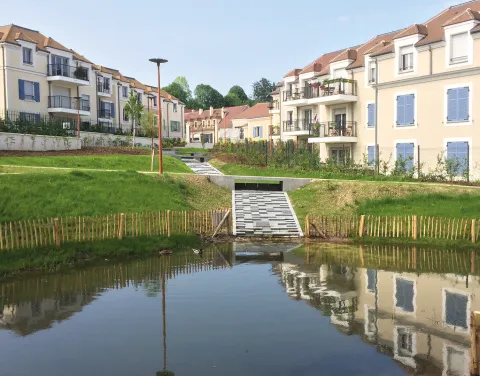
Photo Gallery
Location
48.887901, 2.064136
Project
NWRM
National ID
France_11
Sector
Hydromorphology
Installation Date
2013
Implementation status
Completed

Overview

Location of the project
The commune of Fourqueux is located in the Yvelines, and has 4000 inhabitants.
In 2014, the center of the municipality of Fourqueux underwent an urban redevelopment operation, consisting of the creation of 80 housing units and the renovation and restructuring of the municipal social and cultural center. In addition, this work has led to the establishment of separate networks.
The area under requalification covers 1.7 hectares. In the center of this area was a private garden of 3200 m² dating from the 1930s, abandoned and left fallow. It was acquired by the city with the objective of making it a local park. Stormwater management was initially planned through underground networks in the road network, before the construction of the water garden in the park was considered.
The private garden was fallow, with natural biodiversity and no direct pressure. The subsoil of the area consists of very low-permeability green clays, which leads to the presence of several springs on the site.
Country
France
NUTS2 Code
Île de France
Sponge measures implemented in the case study
Basins
Swales
Rain Gardens
Objectives
The objectives of the project are:
Manage 1.7 hectares of rainwater in the open air;
Create a local square;
Improvement of the living environment (thermoregulation, cultural site);
Participation in integrated water resources management.
Involved partners
Authority type Authority name Authority role Comments Authority responsibility
Other Ville de Fourqueux Initiation of the measure — Responsible
Architects / Engineers Agence Bertrand Paulet Implementation Lead landscape architect Supporting
Architects / Engineers Agence ATM Implementation Water management Supporting
Architects / Engineers SETU Implementation Roads and utilities engineering office Supporting
Documents

Site Information

Climate Zone
Cool temperate moist
Precipitation
722.00 mm
Temperature (°C)
11.50 °C
Elevation range
105 m
Slope range
8%
Vegetation class
On-site: planted wetlands and swales with macrophytes for phyto-/bio-retention; first basin planted with “hyper-accumulator” species. Local matrix: deciduous forests (oak and chestnut dominate the Marly/Saint-Germain forests bordering Fourqueux).
WFD Ecological status
Bad
WFD Chemical status
Failing to achieve good
Water quality status
Ru de Buzot WFD water body. Historically mediocre ecological and poor chemical status; pressures from urban runoff and channel alterations.

Design and Implementation

Project scale
Micro
Project scale specifications
A neighborhood park (~3,100–3,800 m²) managing runoff from ~1.7 ha via basins/swales; a site-specific intervention within the town center.
Project area
1.7
Size
3100.00
Size unit
m2
Basis of design
Multifunctional park + at-source, open-air management; sequence of dry basins, planted permanent pond, swales, and bypass. Designed to retain ~8 mm events on-site, storage ≈ 482 m³, ~5,000 m³/yr kept out of sewers (~80% of ~700 mm/yr); measured infiltration 15–58 h.
Factor constraints
8% slope
Favourable preconditions
To be consistent with the city's desire to share urban space with natural spaces, it was necessary to integrate a hydraulic and ecological dimension into the urban space, in particular by managing rainwater over an area of 3 ha. The choice of these types of developments was important so that the artificialization of the area by housing was not associated with soil sealing (and therefore runoff and stormwater management by the sewerage network).

Financing

Total cost
703846.00 €
Financing authorities
Authority name Type of funding Comments Financing share
Seine Normandie Water Agency Sub-national funds €194,361 27 %
Île-de-France Region Sub-national funds €210,956 30 %
Yvelines Department Sub-national funds €235,000 33 %

Policy and Governance

Policy description
Municipal owner/lead, MOE team (Bertrand Paulet—lead landscape; ATM—hydrology; SETU—VRD). Project embedded in the “Plaines & coteaux de la Seine centrale urbaine” basin contract; AESN policy favors on-site infiltration of small storms; WFD target for the ru de Buzot. Addresses CSO/urban runoff discharges and public-realm quality.
Land ownership
Owned by the municipality: the City of Fourqueux (now Saint-Germain-en-Laye) acquired the former private garden to create a public park.
Part of a wider plan
No
Public consultation
No
Has contractual arrangements
No

Impacts and Monitoring

Monitoring System

Monitoring requirements
No monitoring requirements.

Maintenance

Maintenance requirements
Maintenance was carried out by the company that completed the works for 3 years. After that, maintenance is managed by the city: mowing, tree pruning, and cleaning of the basins.

Impact Assessment Methodology

Biophysical impact assessment method
No assessment methods or practices was used for assessing the biophysical impacts.

Biophysical impacts: Hydrology

Hydrological effects
Frequent storms retained on-site (~8 mm); ~482 m³ storage; ~5,000 m³/yr not sent to sewers; reconnection of clear water to the ru de Buzot; local habitat creation.
Information on retained water
The current rains are infiltrated, the heavier rains (over 8 mm) are partly infiltrated, the overflow joining the Seine.

Biophysical impacts: Biodiversity

Improved biodiversity
Yes
Information on improved biodiversity
The arrival of waterfowl (Mallard ducks) and amphibians has been observed in the central basin.

Lessons Learned

Key lessons
The water garden is capable of managing rainfall up to 8 mm without discharging stormwater into the separate sewer system. Infiltration occurs over a period of 15 to 58 hours depending on the basins. For heavier rainfall, the stormwater flows into the Seine. The basins are vegetated in such a way as to have a purifying effect on the water, although this effect has not been quantified due to a lack of monitoring. The site has been colonized by aquatic species, particularly amphibians. Finally, the impact of the Nature-Based Solutions (NBS) on the living environment is considered very positive by the project leader.
Barriers
Barrier type Barrier role Comments
Other Main barrier The prime contractor's proposal to consider stormwater management on site was a trigger for the project. However, the fact that work had already begun on the other areas of the site's requalification was a difficulty, given that the rainwater to be collected came from these areas. Many meetings were necessary to determine the possible interfaces in the water garden and other sites.
Other Main barrier The slope of the site represented a technical difficulty because it was not suitable for rainwater infiltration. The solution proposed by the project manager was the use of a system of successive basins in "Asian terraces" format.
Success factors
Success factor type Success factor role Comments
Attitude of decision makers Main factor The city's strong commitment to an integrated stormwater management solution, and in line with the urban park objective, was a facilitating element during these discussions.
Transferability
Highly transferable to dense centers if infiltration feasibility is confirmed and bypass/overflow routes exist. Key enablers: early multi-actor coordination, staged maintenance, public communication. Cautions: steep slopes, clayey soils, scope creep.

Sources