Renaturation of the Seymaz river, Switzerland
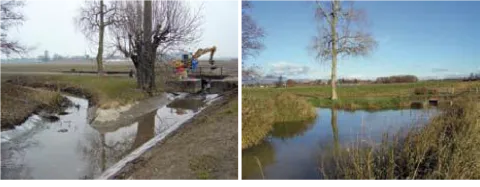
Located in eastern Geneva canton, the Seymaz renaturation replaces concrete channelization with a softer, wider river corridor and recreates marshland, under the canton’s long-running programme to improve ecological and landscape quality and reduce flood risk by managing peak flows. Governance has relied on the “Charte Seymaz” negotiation forum and a management group to coordinate local arrangements; land tenure and agricultural impacts were key constraints that required dialogue and compensation for farmers.
Since 2020 the canton has consolidated and showcased results (book + short film). In 2024–25 a new phase at Bel-Air (Vandœuvres–Thônex–Chêne-Bourg) removed illegal bank fill, narrowed the low-flow channel, installed terraces, root wads/blocks and fish shelters, and stabilized banks with bioengineering, while reorganising heavy recreational use along the riverside path. Client: Office cantonal de l’eau; engineering: Karakas & Français SA and EcoEng SA; works: SCRASA SA and SITEL Environnement-Paysage. Six months on, beaver activity is already structuring flows and habitat. Maintenance of the Haute-Seymaz wetlands and channel has been handled by SITEL since 2019 with local association oversight; mowing/faucardage is adapted to hydrological conditions. Coordination around Bel-Air also required short Greenway bridge closures in March 2024.

Overview
Restore habitats & status from medium→good; re-establish wetland complex.
Provide ~800,000 m³ of natural storage.
| Authority type | Authority name | Authority role | Comments |
|---|---|---|---|
| Other | Grand Conseil and Conseil d'Etat of Genève State | Financing | Responsible for voting two laws/programs on Seymaz renaturation |
| Local water authority | Geneve Canton: Genaral Direction of Water, renaturation of rivers and banks service ; Genaral Direction of Nature and Landscape ; Agriculture and the environment Department | Initiation of the measure | Responsible authority for the implementation of the renaturation program |
| Farmers | Members of the Charte Seymaz group (all actors concerned by the project) | Determination of design details of the measure | "negociation" group on the renaturation program |
| NGO | — | — | — |
| — | Members of the management group | Determination of design details of the measure | Responsible for coordinating and managing the local arrangements |
Site Information
Design and Implementation
- acceptability through participative process and governance
- compatibility with local economic activities (farming)
- acceptable costs
- public perception and social benefits (tourism)
Political context, legislation and existing funding sources have been a main factor leading the choice for the implementation of the NWRM, instead of “traditional” works for flood management.
Financing
15 million € for works financed by Cantonal renaturation fund
22 million € for functioning
1,6€/m2 for farmers (owners or not)
And 819€/ha more for farmers who didn't sell their lands
The State also created a fund for regional agriculture promotion, beneficiating for land sales. The renaturation department transferred 1,9million CHF to this fund.
Policy and Governance
Flood control and flood risk mitigation
| Directive | Relevant pressure |
|---|---|
| WFD identified pressure | 4.1.2 Physical alteration of channel/bed/riparian area/shore of water body for agriculture |
| WFD identified pressure | 4.3.1 Flow diversions/hydrological alteration - agriculture |
| Directive | Relevant impact |
|---|---|
| WFD identified pressure | Altered habitats due to hydrological changes |
| Floods Directive identified pressure | Property |
| Floods Directive identified pressure | Landscape |
| Floods Directive identified pressure | Rural Land Use |
| Wider plan type | Wider plan focus | Name | Comments |
|---|---|---|---|
| Local | Environment & Biodiversity | Renaturation framework Action Plan | The project aims at improving rivers ecological and landscape quality and reducing flood risks. Those requirements are mentioned by a federal legislation (Law on rivers amenagements in 1991 and ordonance on water protection in 1998) and aimed by the program implemented by Geneve State (Renaturation framework Action Plan in 1999). |
| — | Water | — | — |
| Activity stage | Activity type |
|---|---|
| Design phase | Charte Seymaz |
| Implementation phase | — |
| Arrangement type | Name | Comments |
|---|---|---|
| Contractual agreement | Contrats Nature | Farm owners and farmers have received financial compensation, either for selling their land or keeping it and managing it respecting a "nature contract". The payment was function of the number of concerned hectares. Moreover, punctual compensations have been done, for instance during works periods and for a loss of three year yields during when land was leveled. Farmers also beneficiated for tax advantages. The State also created a fund for regional agriculture promotion, beneficiating for land sales. The renaturation department transferred 1,9million CHF to this fund. |
Impacts and Monitoring
Monitoring System
Water quality is monitored:
- physic-chimical quality through parameters: nitrogen, phosphorous, metal, pesticides, organic carbon
- ecological quality through two parameters: benthic macrofauna and diatomees
Maintenance
Impact Assessment Methodology
Socio-economic Impacts
- Flood security and protection: reduction of flood damages in urban areas (houses, school, roads...)
- creation of a touristic area for the inhabitants of Geneve canton. The area now benefits from a positive image which has a positive impact on tourism.
- landscape conservation
- benefit for farmers by selling products on their farm from this increasing number of visitors
- employment (agritourism, works)
Biophysical impacts: Hydrology
Biophysical impacts: Biodiversity
It has become the 3rd site formigratory birds in Geneva.
Biophysical impacts: Water & Soil Quality
Between 2013 and 2019, chemical quality decreased mainly because of copper and phosphorus pollution. Biological quality kept improving.
Biophysical impacts: Others
Lessons Learned
Moreover, the measure happens to be more cost-efficient than previous projects of flood regulation.
| Driver type | Driver role | Comments |
|---|---|---|
| Past flooding events | Main driver | Land use constraints have been the initiator factor to the implementation of the measure, since frequent floods happened to occur on farmlands in the Seymaz basin itself, linked to the artificialisation of the river during the past centuries. Floods in the urban areas downstream were already a problem. Political context, legislation and existing funding sources have been a main factor leading the choice for the implementation of the NWRM, instead of "traditional" works for flood management. |
| Organisation committed to it | Secondary driver | — |
| Availability of subsidies | Secondary driver | — |
| Success factor type | Success factor role | Comments |
|---|---|---|
| Existing institutional framework | Main factor | Main success factors have been: - the local political context, much more in favor of renaturation than other cantons (laws, fund...) - local arrangements such as the †œdrainage right† given t farmers - the high participation rate of farmers and other actors in the process decision and implementation (through Charte Seymaz group) |
| Specific incentives for stakeholder involvement | Secondary factor | — |
| Financing possibilities | Main factor | — |
| Public participation | Main factor | — |
Necessary preconditions seem to be a participative decision process, involving the main impacted stakeholders (economically and regarding their property rights). The participative process, which can be considered as a success factor, is adaptable to other contexts. A favorable political context and financing possibilities is another precondition for the implementation of the NWRM.