Restoration of Durrow floodplain alluvial woodland, Ireland
This site was one of nine included in the LIFE05 project to restore priority woodland habitats in Ireland. The Durrow site lies on the floodplain of the River Erkina and had been affected by planting of non-native conifers and associated drainage. A network of shallow ditches across the site was reducing the retention time of floodwaters; to counter this, c.350 ditch-dams were installed (installation 2009, LIFE05/NAT/IRL/000182). Since then, Durrow has been confirmed as part of the River Barrow & River Nore SAC (002162), where alluvial forests (91E0*) are a qualifying interest; assessments also record calcareous “petrifying springs” (7220*) within the alluvial woodland along the Erkina floodplain, and describe Durrow as one of the largest remaining alluvial woodlands in Ireland. At catchment scale, EPA WFD characterisation shows the downstream waterbody ERKINA_050 declined from Good to Moderate status with elevated phosphate and agriculture as a significant pressure, framing ongoing risks to riparian habitats. Nationally, Coillte’s LIFE05 programme restored >550 ha of priority native woodlands across nine Natura 2000 sites (including Durrow). Locally, the Durrow Biodiversity Action Plan 2023–2028 highlights the Erkina, the Nore and associated woodlands within the SAC.
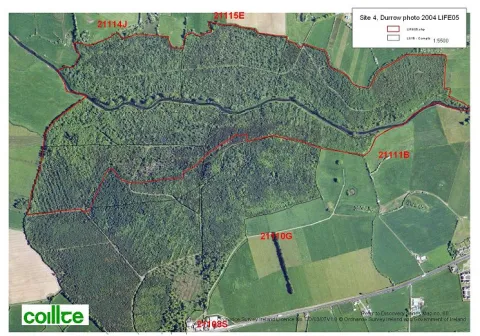

Overview
Block 350+ drains to raise water table.
Remove non-native species across the site.
Promote regeneration of native wet woodland vegetation.
| Authority type | Authority name | Authority role | Comments | Authority responsibility |
|---|---|---|---|---|
| Forest owners | Coillte Teoranta [The Irish Forestry Board] | Implementation | Coillte is the commercial company responsible for Irish forestry. They were responsible for the initiation and implementation of this project, based on improvements they wished to make to forests on their own land. | Responsible |
| Nature park | National Parks and Wildlife Service (NPWS) | Implementation | Co-implementer; provided conservation expertise, monitoring, and habitat assessment. | Responsible |
| Other | EU LIFE-Nature | Financing | Main financial backer; funded restoration under EU Habitats Directive goals. | Supporting |
| NGO | Woodlands of Ireland | Determination of design details of the measure | Contributed ecological input and promoted traditional woodland management practices. | Supporting |
| Private property owners | Local stakeholders/community | Other | Participated in awareness-raising and informal monitoring. | Supporting |
Site Information
Design and Implementation
Financing
Policy and Governance
| Directive | Relevant pressure |
|---|---|
| WFD identified pressure | Hydromorphological degradation |
| WFD identified pressure | Poor ecological status |
| Floods Directive identified pressure | Increased runoff due to drainage |
| Other EU | Habitats Directive: Unfavourable conservation status of Annex I habitats. |
| Directive | Relevant impact |
|---|---|
| WFD identified pressure | Supports good ecological status via wetland restoration. |
| Floods Directive identified pressure | Helps mitigate localized flood risk by restoring flood retention functions. |
| Other EU | Habitats Directive: Contributes to Favourable Conservation Status of 91E0 habitat. |
| Wider plan type | Wider plan focus | Name | Comments |
|---|---|---|---|
| — | Environment & Biodiversity | LIFE project LIFE05 NAT/IRL/000182 | The title of the LIFE project was "Restoring priority woodland habitats in Ireland". It covered 9 sites, with the Natural Water Retention Measure installations at one site (Durrow). |
| National | Environment & Biodiversity | National Biodiversity Plan (Ireland) | Durrow aligns with national targets for woodland recovery. |
| Activity stage | Activity type | Comments |
|---|---|---|
| Implementation phase | Interpretation boards | Two interpretation boards at Durrow |
| Screening phase | Project website | Set up at project commencement and updated through the project and with final deliverables |
| Implementation phase | Production of project brochures | Introductory brochure produced early in the project, with a final results brochure on completion. Hard copies printed for dissemination locally and internationally |
| Implementation phase | Annual "woodland walk" | Held annual during the project duration at three demonstration sites (although Durrow was not one of them) |
| Screening phase | Public consultation meetings | In total eight events in year 1, 20 in year 2, 14 in year 3 and seven in year 4 |
| Implementation phase | End of project conference | — |
Impacts and Monitoring
Monitoring System
Maintenance
Impact Assessment Methodology
Socio-economic Impacts
Increased eco-tourism and education via trails and interpretive signage.
Biophysical impacts: Hydrology
Biophysical impacts: Biodiversity
Significant habitat restoration of Annex I alluvial woodland.
Native wet woodland species (e.g. alder, willow) recolonized.
Enhanced bird, insect, and understory flora diversity.
Specific species/community indexes not given, but high biodiversity gains confirmed through vegetation surveys.
Biophysical impacts: Others
Lessons Learned
- Pre-implementation monitoring was crucial to determine appropriate actions, such as installing over 350 dams to restore hydrology.
- Public engagement ensured community understanding and support for the measures.
- Stakeholder attitudes and communication activities were significant success factors.
| Driver type | Driver role | Comments |
|---|---|---|
| Organisation committed to it | Main driver | The project took place as a result of Coillte's commitment to restoring priority habitats |
| Success factor type | Success factor role | Comments |
|---|---|---|
| Communication activities | Main factor | These included signs, guided walks, and outreach for schools and visitors. They were key to local understanding. |
| Financing possibilities | Main factor | Made possible by access to LIFE Nature and matching national funds. |
| Attitude of relevant stakeholders | Main factor | Coillte collaborated actively with government agencies and NGOs. |
| Attitude of decision makers | Main factor | Proactive. The Forest Service supported the project and provided monitoring via the National Forest Inventory. |
| Existing institutional framework | Secondary factor | Clear and functional partnership among Coillte, NPWS, Forest Service, and Woodlands of Ireland. |
Factors that complicate transfer : Dependence on EU funding (e.g. LIFE), not always available elsewhere. Land use change (e.g. abandoning intensive forestry) may be harder to justify or negotiate on private lands than public land ownership here with Coillte.