Wetland restoration and remeandering in SPA Dunajské luhy (Slovakia) and SPA Szigetkoz (Hungary)
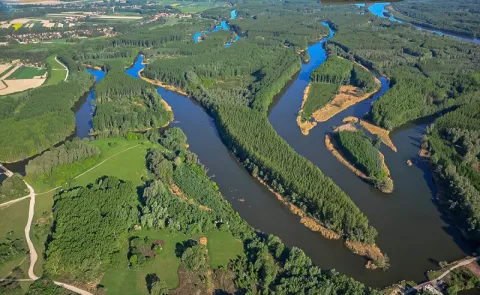
This project improves the conservation status of floodplain bird species protected in the Natura 2000 sites SPA Dunajské luhy (Slovakia) and SPA Szigetköz (Hungary). It is funded by the LIFE Programme. Since 2015, the follow-up LIFE Danube Floodplains (LIFE14 NAT/SK/001306) and partners have restored river connectivity and water regimes by reopening 18.5 km of tributaries, restoring >75 ha of wetlands and advancing earlier, better-timed simulated floods; water-regime improvement now covers ~1,805 ha. Recent actions in Slovakia include reopening 3.7 km of the lower Vojčianske side arm (2023–24), partial reconnection at Kráľovská lúka (2024) and re-excavation/reconnection of the Foki side arm in the Old Danube (~2.0 km; 2025). Monitoring reports note positive responses of rheophilic fish, amphibians and floodplain vegetation; hydromorphological works have restored extensive floodplain forest and riparian habitats (e.g., 482 ha of 91E0* and 115 ha of 91F0). In Hungary’s Szigetköz, the water-replenishment system was extended in 2014–15 and connectivity enhanced with fish passes at Dunasziget (1998), Ásványráró (2015) and at the Mosoni-Danube outlet in Vének (operational 2022).


Overview
Restore selected wetlands, dried-up river branches and oxbows.
Restore river-branch connectivity, water regime and flowing-water conditions.
Lease/purchase land and introduce appropriate habitat management.
Eliminate fish-migration barriers at two strategic points.
Restore abandoned meadows (feeding/nesting habitat).
Plant native trees to restore refuges/nesting areas; prevent disturbance; gather scientific data; raise awareness.
Following (LIFE14) project :
Acquire/lease ~70 ha for restoration.
Create/reconstruct ≥5 technical structures; improve water regime over ~1,850 ha.
Restore ≥2 major river branches over ≥4,500 m and reconnect side arms.
Decrease human disturbance on 135 ha; restore 4 wetlands (37 ha).
Establish gene pool (3.8 ha) with 45,000 seedlings; plant 57,500 native trees on 45 ha.
Remove invasives on 40 ha; restore targeted habitats over ~745.5 ha; clean waste/ammunition on 5 ha; restore 84 ha of grasslands; ≥150 pollard willows restored and 200 planted; plus outreach targets.
| Authority type | Authority name | Authority role | Comments | Authority responsibility |
|---|---|---|---|---|
| NGO | BROZ Regional Association for Nature Conservation and Sustainable Development | Implementation | Project Management, bookkeeping, networking with other projects, Project auditing and After-LIFE conservation plan | Responsible |
| Research institute / University | Prírodovedecká fakulta - Univerzita Komenského | Monitoring | Hydrological monitoring | Supporting |
| NGO | Szigetköz Nature Conservation Association | Monitoring | Monitoring impact of project actions on bird populations and other biota | — |
| Regional / sub-national water authority | North-Transdanubian Environmental and Water Directorate | Initiation of the measure | — | Supporting |
| Architects / Engineers | Vodohospodárska výstavba š.p. | Implementation | Water management construction, state enterprise | Supporting |
| Local water authority | Agravia Ltd. | Other | — | Supporting |
Site Information
Design and Implementation
Financing
Following project: LIFE14 NAT/SK/001306 – “Restoration and management of Danube floodplain habitats (LIFE Danube floodplains)” (2015–2024): Total eligible budget: €5,999,420.
Policy and Governance
| Activity type | Comments |
|---|---|
| Information material | Raise awareness about target bird species, river restoration and nature conservation issues through the creation of information and promotional materials (book, calendars, leaflets, website, panels, etc) and through media coverage (local to international). |
| Regular meetings with stakeholders | — |
| Arrangement type | Responsibility | Name | Comments |
|---|---|---|---|
| Contractual agreement | BROZ | Land long term leasing | 349.22 ha leased |
Impacts and Monitoring
Monitoring System
Maintenance
Socio-economic Impacts
Tourism, angling & agriculture (HU – Szigetköz): The water-replenishment programme reports positive socio-economic effects: better aquatic tourism opportunities, improved angling, and additional water for irrigation benefiting local farmers; it also supports drinking-water provision and enhances flood protection. (This is a parallel public works project in the same SPA, led by ÉDUVIZIG.)
Biophysical impacts: Hydrology
Flood pulse (simulated floods): experimental 120 m³/s for 4 days in 2023; 120 m³/s for 15 days in spring 2024, reported as crucial for refilling branches, wetland inundation and spawning/reproduction windows.
Biophysical impacts: Biodiversity
Amphibians: simulated spring/summer floods and wetland refilling led to high breeding activity/abundance at monitored sites.
Habitats restored (examples): floodplain forests and riparian types exceeded targets (e.g., 91E0* ≈ 482 ha, 91F0 ≈ 115 ha).
Biophysical impacts: Water & Soil Quality
Biophysical impacts: Others
Lessons Learned
Early land tenure work is decisive. The project explicitly calls land purchase/long-term leases a “crucial” precondition, and pairing in-house experience with legal experts proved essential; by the end it had secured 67.07 ha purchased and 349.22 ha leased for durable management.
Hydrology must be managed as an integrated package. Physical works on side-arms went hand-in-hand with active operation (simulated floods); involving the project team in flood-planning improved outcomes, with peak discharges reaching 120 m³/s in 2023–2024.
Timing matters for biota. Shifting to earlier spring controlled floods (from 2021 onward) increased suitability for amphibian reproduction; negotiating spring and summer releases each year became part of adaptive management.
Structured conflict resolution is a lever. A consortium of agencies, water managers, NGOs and users agreed a new water regime and an updated operational manual that aligns releases with Natura 2000 needs—unlocking restoration at scale.
Plan for longer monitoring horizons. The final evaluation notes that many ecosystem-function effects could not yet be measured in the field; medium-term monitoring is recommended, as several processes manifest over years to decades.
| Driver type | Driver role |
|---|---|
| Organisation committed to it | Main driver |
| Availability of subsidies | Secondary driver |
| Success factor type | Success factor role |
|---|---|
| Existing staff and consultant knowledge | Main factor |
| Financing possibilities | Secondary factor |