The Vonarje flood storage reservoir in Croatia

Year of issue
2025
Summary

The Sutlansko Lake area is a wetland with a high biological diversity. The Vonarje reservoir was initially built in the early 1980s for drinking water supply, irrigation and flood protection along the transboundary Sutla/Sotla River between Croatia and Slovenia. The reservoir was later drained due to difficulties in managing its water quality and sedimentation. Since then, it has operated as a dry retention basin for flood protection. At the bottom of the reservoir, wetland ecosystems gradually developed. For this reason, the area of the reservoir on the Slovene side has been designated as a Natura 2000 site.

In recent years, the reservoir infrastructure was modernised through the FRISCO 2.1 project (2017–2019), funded by the Interreg V-A Slovenia–Croatia programme. The project aimed to reduce cross-border flood risks by reinforcing and upgrading the Vonarje dam and associated hydro-mechanical and electrical systems. The works were completed in 2019, enhancing the safety and functionality of the flood retention structure and improving its operational reliability.

The retention basin continues to serve as a key flood protection measure in the rural transboundary basin, offering temporary water storage during flood events while supporting ecological functions. Hydrological and sediment modelling have shown that the structure plays an important role in managing downstream sediment and nutrient flows, despite ongoing pressures from agricultural and point-source pollution.
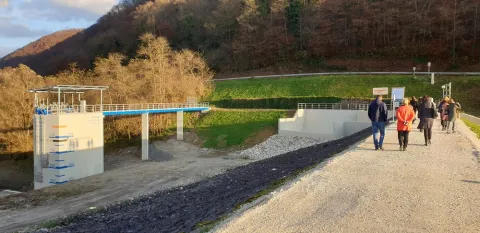
Photo Gallery
Location
46.181, 15.628
Project
NWRM
National ID
Croatia_03
Sector
Hydromorphology
Installation Date
1980
Implementation status
Ongoing
Contact
Adriana Raveau, ACTeon

Overview

Location of the project
The Vonarje reservoir is located near the village of Vonarje, directly on the Slovenia–Croatia border, adjacent to road 107 between Hum na Sutli (Croatia) and Podčetrtek (Slovenia).
Country
Croatia
NUTS2 Code
Kontinentalna Hrvatska
Sponge measures implemented in the case study
Basins
Wetland restoration and management
Objectives
Flood prevention, downstream water quality improvements
Involved partners
Authority type Authority name Authority role
Regional / sub-national water authority Slovenian government Financing
Regional / sub-national water authority Croatian government Financing

Site Information

Climate Zone
Cool temperate moist
Precipitation
1200.00 mm
Temperature (°C)
11.00 °C
Evapotranspiration
650.00 mm
Runoff
27.00 mm
Elevation range
324
WFD Ecological status
Moderate
WFD Chemical status
Failing to achieve good
Water quality status
The reservoir suffered from extreme eutrophication shortly after its creation, leading to drainage in 1988.Even today, nutrient and sediment loads remain problematic due to diffuse and point pollution (agriculture, industry, wastewater).

Design and Implementation

Project scale
Meso
Project scale specifications
Affects a significant part of a watershed, protecting several municipalities from flood risks.
Area subject to Land use change or Management/Practice change (ha)
590.60 ha

Financing

Financing authorities
Authority name Type of funding Comments
Slovenia and Croatia National funds The reservoir was built as part of the joint water management plans of Croatia and Slovenia.

Policy and Governance

Policy targets
Peak-flow reduction
Part of a wider plan
No
Public consultation
No
Has contractual arrangements
No

Impacts and Monitoring

Monitoring System

Monitoring requirements
Water quality is monitored at four stations in Croatia
Monitoring parameters
Parameters mentioned include overall water quality class trends, nutrients (N, P) and sediments.

Maintenance

Maintenance requirements
Modernization and equipement upgrade once, during the FRISCO 2.1 project (2017-2019)

Socio-economic Impacts

Direct benefits
The structure reduces flood risk for several towns (e.g., Hum na Sutli, Podčetrtek, Rogaška Slatina), increasing local safety.
Ancillary benefits information
The area has potential for tourism and education, including proposals for:
Recreation and eco-tourism
Nature learning areas
Cultural and wellness tourism (e.g., nearby spas)

Biophysical impacts: Hydrology

Retained water
12400000.00
Retained water unit
m3/day
Information on retained water
Capacity is 12.4 million m3, of which 3.7 million m3 is required for 100-year flood protection.
Information on reducing flood risks quantity
The dry retention basin helps mitigate floods by temporarily storing water during high-flow eventsHydrological modelling (HEC-HMS and SWAT) confirms its importance for downstream flood protection.

Biophysical impacts: Biodiversity

Improved biodiversity
Yes
Information on improved biodiversity
The Vonarsko Lake area with its specific geographical features, as well as ecological and economic characteristics, has numerous water resources and an extremely rich flora and fauna. This area is considered as a wetland, the value of which is reflected in the biological diversity of the flora and fauna, ecosystems, and landscapes. This region is also extremely important for research and education. In short, there are many reasons for preservation and protection.

Biophysical impacts: Water & Soil Quality

Water quality overall improvements
Not relevant for this application
Information on water quality overall
Due to the implementation of the European industrial and urban waste water treatment legislation and environmental agricultural policy in Slovenia and Croatia (Croatia becoming a new EU member State in 2013), emissions to water and risk to water quality in the Vonarje reservoirs are expected to be much lower in the future than in the 1980's. Nevertheless, past pollution residuals in the lake bottom, pollution due to higher traffic, pressure on the water environment from fisheries, touristic and recrational facilities, intensification of agricultural activities and expected changes of climate patterns do not necessarily support this expectation. Furthermore, uses of the catchment on the Slovene an Croatian side are a different. On the Slovene side, there is more industry, "industrial like" tourism (large congress, termal and wellness facilities) and larger urban areas. On the Croatian side, the catchment uses are mostly traditional agriculture. The water uses are less intensive. Waste water collection and treatment depend on settlement patterns and differ in the technologies applied.
Soil quality overall improvements
Positive impact-SQ improvement
Information on soil quality overall improvements
At the bottom of the reservoir wetland ecosystems developed. For this reason, the area of the reservoir on the Slovene side has been declared as Natura 2000 site.

Biophysical impacts: Others

Information on ecosystem impact climate regulation
No information found

Lessons Learned

Key lessons
The Sutlansko Lake area is a wetland with a high biological diversity. The Vonarje reservoir was initially built for drinking water supply and flood protection. The reservoir was drained due to difficulties encountered to manage its water quality. Now it operates as a dry retention basin for flood protection. At the bottom of the reservoir, wetland ecosystems developed. For this reason the area of the reservoir on the Slovene side has been declared as a Natura 2000 site.
Barriers
Barrier type Barrier role Comments
Other Main barrier Shortly after filling, water in the reservoir became eutrophicated. Furthermore, other extreme water quality problems have been detected not only in the lake water, but also in the river water downstream. There was a high risk to human and environmental health that has hardly been managed successfully. In the absence of better remediation measures, the reservoir was completely drained in 1988 and now operates only as a dry retention basin for flood protection.
Drivers
Driver type Driver role Comments
Other Main driver The main purpose was drinking water supply for both, Slovene and Croatian, settlements and flood protection of downstream areas.
Success factors
Success factor type Success factor role Comments
Successful coordination between authorities Main factor Both EU countries, Slovenia and Croatia, are expected to apply for new development and cohesion funds to develop environmental and other infrastructure in the catchment. For the water management, it is important to take into account the two national institutional systems and the different economic developments in the past two decades: Although there are strong cultural ties between local communites on both river sides, the challenge for catchment water quality management to secure good ecological and chemical status of the Sotla river today is even greater than it has been in the past.
Transferability
The concept of converting a degraded reservoir into a dry flood retention basin with ecological co-benefits could be adapted in other rural transboundary basins facing water quality degradation, sediment/nutrient pressures and/or flood risks.

Sources