Infiltration trenches in Kungsbacka, Sweden
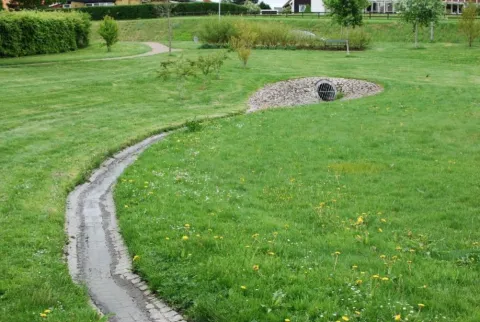
Flow-weighted sampling was performed at the inlet and outlet of one of the infiltration trenches beneath the parking lot of a supermarket in Kungsbacka, south of Gothenburg. Monitoring ran from April–June 2012 and five storm events were originally analysed. The trench is part of a larger system serving the Maxi ICA site (≈3.1 ha) with three subsurface macadam trenches; the monitored “trench 1” had ~176 m³ storage with a permitted outflow of 6.17 L s⁻¹ (site cap 15 L s⁻¹). Runoff passes an oil separator and then discharges to stormwater ponds located between the car park and the Björkris residential area (toward Björkrisån/Kungsbackaån). Reported pollutant removals were high for TSS and metals and moderate for nitrogen, alongside clear flow attenuation. A subsequent peer-reviewed paper expanded the dataset to seven events and confirmed these trends. More recent municipal stormwater guidance (2023) highlights the Björkris/Hede ponds as part of the local network; while this corroborates the downstream arrangement, publicly available sources do not document the current maintenance or operational status of the specific trenches.

Overview
Water-quality investigation objective: the 2012 campaign’s stated aim was to quantify pollutant removal efficiencies and flow detention for one trench at the site (later expanded to seven events in a journal article), i.e., a research objective rather than a regulatory removal target.
| Authority type | Authority name | Authority role | Authority responsibility |
|---|---|---|---|
| Local water authority | The municipality of Kungsbacka | Implementation | Responsible |
Site Information
Design and Implementation
Financing
ranging between 5 and 20 percent of the construction costs. The value in the field represents 10% of the construction cost.
Policy and Governance
Impacts and Monitoring
Monitoring System
Maintenance
Impact Assessment Methodology
hydrographs. Based on the observed detention characteristics, the flow detention function has been evaluated and compared to the design capacity.
Socio-economic Impacts
Biophysical impacts: Hydrology
the stormwater ponds is 15 l/s of detained flow
Biophysical impacts: Biodiversity
Biophysical impacts: Water & Soil Quality
Reported mean removals across the monitored events: ~80% TSS, ~50% total inorganic nitrogen, >50% for all metals (Zn, Pb, Cu, Cr ~70–80%; Cd, Ni ~50–60%). Phosphate-P was analysed for the first four events but levels were so low that further analyses were not pursued.
Because the outlet choke had to be removed to fit samplers, observed detention was below design at some events; under extreme, long-duration storms, the authors caution that rapid bypass could reduce treatment and temporarily worsen receiving-water quality if such events were frequent.
Biophysical impacts: Others
Lessons Learned
The measured detention under field monitoring was lower than design because the outlet’s overflow/throttle (“strypning”) had to be temporarily removed to fit the samplers; as a result, peak outflows sometimes exceeded the normal 6.17 L s⁻¹ limit even though the trench is designed to respect it in operation. This is an important caution for study design and for interpreting monitoring data against design intent.
The facility functions as a sealed macadam tank with controlled discharge via an oil separator to downstream stormwater ponds between the car park and Björkris, i.e., detention/treatment rather than groundwater recharge. The integrated train helps protect the sensitive recipient Kungsbackaån by adding downstream detention and polishing capacity.
Maintenance under a paved, subsurface macadam store is inherently challenging: cleaning and stone replacement are difficult compared with open trenches, so performance can decline with age unless maintenance is planned and executed. This lifecycle constraint should be anticipated at design stage.
Extreme, long-duration storms may reduce treatment as water bypasses rapidly; repeated occurrences could risk short-term deterioration of receiving-water quality. Designing for such events and verifying performance over longer periods would improve resilience.
| Driver type | Driver role | Comments |
|---|---|---|
| Legal obligations | Main driver | In Sweden, the responsibility for adressing the issue of storm water is delegated to the municipalities. The actions are regulated in a number of policy frameworks; the Swedish environemntal code, containing the national implementation of WFD plus a number of other national regulations, the Plan and buildning act regulating the planning process which also covers stormwater issues, the Swedish Road act and the Water services act. |
| Success factor type | Success factor role | Comments |
|---|---|---|
| Existing technical standards | Main factor | — |
| Conducted assessments (incl. economic) | Main factor | Flow-weighted monitoring over seven events provided credible, decision-grade evidence. |