Ecological reconstruction of the Gerai Pond, Romania
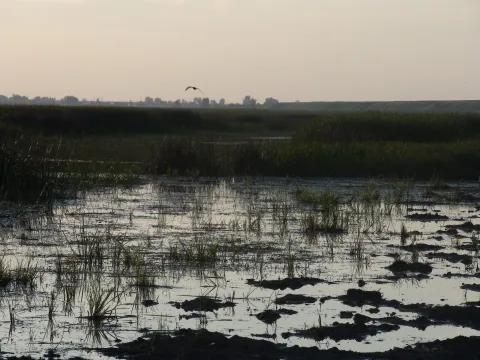
Gerai (Balta Geraiului), a Danube floodplain between Gârcov and Islaz, was restored under the LIFE+ “Green Borders” project. Works completed in 2011 reinstated the hydrological regime on about 1,000 ha to secure breeding water levels and open-water patches for Ferruginous Duck (Aythya nyroca) and Pygmy Cormorant (Microcarbo pygmaeus). Since then, the area has gained stronger protection and outreach: on 13 June 2012 it was designated as part of the Olt–Danube Confluence Ramsar Site (46,623 ha), and in June 2013 WWF, APM Olt and local communities opened a visitor observation point at Gerai. Governance has also been updated: in May 2023 Romania approved the official management plan for the Natura 2000 sites ROSPA0024 “Olt–Danube Confluence” and ROSCI0044 “Corabia–Turnu Măgurele”, which cover the Gerai area. Recent pressures include recurring reed/grass fires; in August 2022, over 600 ha around Islaz in the “Teleorman Delta”, including Balta Geraiului, burned. Overall, the project’s hydrological reconnection and bird-habitat aims remain relevant, now framed by Ramsar and Natura 2000 planning, while fire management is an ongoing challenge.


Overview
Ensure favourable living conditions for Ferruginous Duck (Aythya nyroca) and Pygmy Cormorant (Microcarbo pygmaeus) by reconstructing nesting/feeding areas, applying best practices in fisheries/reed/forest management, reducing accidental/deliberate killing, informing local communities, and mobilising funding.
Implement a hydrological reconnection able to store up to ~4.2 million m³ during floods on a site of ~950 ha, via three control structures on drainage canals and a ~900 m feeder canal.
| Authority type | Authority name | Authority role | Comments | Authority responsibility |
|---|---|---|---|---|
| NGO | WWF Danube Carpathian Programme Romania | Implementation | Financing/Programme: LIFE+ beneficiary; Implementation lead: coordinated works (2011); Monitoring/maintenance: WWF lists “Monitoring” and “Maintenance” phases for Gerai; Outreach: opened a visitor observation point in 2013. | Responsible |
| National water authority | Environmental Protection Agency (APM) Olt | Determination of design details of the measure | Design/Studies: co-conducted the project with the Technical University (authors include EPA Olt); Monitoring/regulatory: environmental authority for the county. | Responsible |
| National water authority | E.P.A Teleorman | Implementation | Environmetal Protection Agency | Supporting |
| NGO | Romanian Ornithological Society | Monitoring | Contextually supported avian conservation in the area. | Supporting |
| National water authority | MMAP / National framework for protected areas | Monitoring | Governance: 2023 ministerial order approved the management plan for the Natura 2000 sites covering Gerai, framing ongoing management/monitoring obligations. | Responsible |
Site Information
Design and Implementation
Financing
Policy and Governance
| Name |
|---|
| Lower Danube Green Corridor strategy |
| Activity stage | Activity type | Key issues |
|---|---|---|
| Design phase | Consultation meeting in Izlaz and Garcov on 29-30 September, 2009 | There were approximately 400 small landowners from Izlaz and Garcov villages on Balta Geraiului. |
Impacts and Monitoring
Monitoring System
Maintenance
Impact Assessment Methodology
Socio-economic Impacts
Tourism & education infrastructure. On 26 June 2013, WWF-Romania, with APM Olt and local communities, inaugurated a tourist observation point at Balta Geraiului to enable birdwatching while reducing disturbance; WWF also backed a cycling-route initiative along the Romanian Danube.
Biophysical impacts: Hydrology
Hydraulic works (connectivity): Three control dams on former drainage canals (≈110 m, 60 m, 40 m) plus a new feeder canal ~900 m long, 4 m wide to bring freshwater to the pond.
Biophysical impacts: Biodiversity
Habitat mosaic: WWF describes ~600 ha offering a mix of open-water pools, reedbeds and pastures after works (site description of outcomes).
Biophysical impacts: Water & Soil Quality
Biophysical impacts: Others
Lessons Learned
Locking restoration into formal protection and planning sustains outcomes. After works finished (2011), the area was included in the Olt–Danube Confluence Ramsar Site (2012), and an official Natura 2000 management plan for ROSPA0024/ROSCI0044 was approved in May 2023—providing a framework for ongoing management and monitoring.
Transparent local engagement helps when land is fragmented. The case documents consultations with village stakeholders/landowners from Islaz and Gârcov at project start, which supported access and acceptance for interventions on the floodplain.
Plan for maintenance and monitoring from day one. WWF lists “Monitoring” and “Maintenance” as explicit phases at Gerai, and reported that post-works monitoring showed the wetland “coming back to life,” with returning bird and plant communities—useful, concrete indicators for tracking success.
External pressures can erode ecological gains if unmanaged. Recurrent late-summer fires culminated in ~700 ha burned around Islaz in 2022 (including Balta Geraiului), underscoring the need to integrate fire-risk reduction and enforcement into wetland management.
Investing in low-impact visitor infrastructure aligns conservation and local benefits. The 2013 bird-watching observation point formalized access, supporting education and ecotourism while channeling visitors to reduce disturbance.
| Driver type | Driver role | Comments |
|---|---|---|
| Other | Main driver | The need to create and ensure the protection and conservation of threatened bird species. |
| Success factor type | Success factor role | Comments |
|---|---|---|
| Public participation | Main factor | There were approximately 400 small landowners from Izlaz and Garcov villages on Balta Geraiului. |