Climate-Proofing Social Housing Landscapes
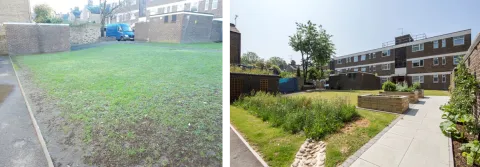
Groundwork London, with Hammersmith & Fulham Council, delivered the LIFE+ “Climate-Proofing Social Housing Landscapes” programme (2013–Sep 2016) across three estates (Queen Caroline, Cheeseman’s Terrace, and Cyril Thatcher/Eric MacDonald/Richard Knight) using affordable, light-engineering retrofits of blue-green infrastructure. The project coupled design with deep resident engagement and training for council staff and local apprentices.
Since completion, City Hall has published per-estate schemes and costs (Queen Caroline ~£254k; Cheeseman’s ~£117k; Cyril/Eric/Richard ~£79k) and a detailed measure matrix (e.g., Schotterrasen at Queen Caroline; trench tree pit at Richard Knight). Monitoring by the University of East London shows strong performance: 100% diversion of rainfall from 3,160 m² of impermeable areas into ground-level SuDS, up to 98% reduction in peak flows from pram-shed green roofs, notable roof-surface cooling during heat events, and ≈1.2 million litres of rainwater retained/diverted annually. Post-project, H&F reports continued roll-out of green roofs and SuDS across estates and highways, with mapping to target new sites. Recognition includes the Landscape Institute’s 2016 College of Fellows’ Award (plus a commendation) and susdrain’s 2018 SuDS Awards (Highly Commended).
Overview
The three estates, owned by the Local Authority, were chosen as demonstration sites because they reflect different social housing contexts (such as property types and estate sizes) that can be found across EU member states, demonstrate vulnerability to increasingly extreme weather conditions, and have high indices of multiple deprivation. In this way, the project was able to demonstrate how green infrastructure adaptation measures can be implemented in a wide range of urban housing settings.
-Design and implement comprehensive packages of retrofitting measures in three different types of social housing landscapes.
-Implement the main measures through employment programmes for long-term unemployed beneficiaries creating local jobs.
-Develop a set of training modules for housing and grounds maintenance professionals on the whole cycle of adaptation and green infrastructure relevant procurement systems, design, retrofit and maintenance.
-Develop a transferable methodology for resident stakeholder engagement, resulting in site-specific community adaptation action plans and practical involvement in retrofitting and maintenance activities.
-Design an evaluation methodology capturing technical performance and social return on investment.
-Develop interactive e-learning materials including a film to inform local, national and EU policy, strategy and best practice.
| Authority type | Authority name | Authority role | Comments | Authority responsibility |
|---|---|---|---|---|
| Other | Groundwork London | Implementation | Project implementation and community engagement. | Responsible |
| Other | London Borough of Hammersmith & Fulham | Implementation | Local authority support and integration into housing estate management. | Supporting |
| Research institute / University | University of East London | Monitoring | Monitoring and evaluation. | Supporting |
Site Information
Design and Implementation
Financing
Policy and Governance
| Requirement directive |
|---|
| Floods Directive-mitigating Flood Risk |
| Wider plan type | Wider plan focus | Comments |
|---|---|---|
| National | Climate adaptation | At the national level, the project has contributed to the development of the UK’s approach towards Sustainable Drainage Systems, inputting to a Defra/CLG consultation in 2014. The project has also contributed to SuDS guidance produced by national bodies including CIRIA. |
| Regional | Climate adaptation | At the regional level, the project is highly relevant for the London Sustainable Drainage Action Plan, which aims to ensure that London can manage its rainwater sustainably to reduce flood risk and improve water security, and is referred to in the Plan. The project has also contributed to London wide guidance documents, including Transport for London's SuDS Design Guide. |
| Local | Climate adaptation | The project has also helped to strengthen local planning policies associated with SuDS and climate change proofing of future developments within Hammersmith & Fulham Council’s new Local Plan, and is also feeding into the new Ecology / Biodiversity Policy that the local authority is proposing. |
Impacts and Monitoring
Monitoring System
• Performance of measures during rain events (e.g. infiltration rates) and the development of vegetation captured using fixed-point time lapse cameras at key locations near to the interventions, which took a photo every 15 minutes during the monitoring period (day and night)
• Environmental conditions, including the timings and size of rain events, temperature, wind direction and speed, and humidity, monitored using weather stations; this enabled a comparative analyses to be made with the fixed-point photo monitoring and other monitoring data
• Aspects such as rain water inputs and infiltration times monitored using flowmeters at inlets (e.g. downpipes from roofs) and pressure sensors in basins, in order to understand the impact of selected rainfall events on surface water run-off, and in turn calculate the amounts of water diverted from reaching the sewer network
• Thermal monitoring using a thermal imaging camera to understand the impact on the urban heat island effect, with a focus on key aspects such as green roofs on particularly hot/cold days and comparisons made with untreated surrounding areas
• Biodiversity monitoring on the green roofs, using vegetation surveys to understand the floral species diversity (inventories to record every floral species and quadrats to monitor experimental plots on Richard Knight House); % vegetation cover was also monitored through this process
• Photographic monitoring during site visits to create an archive of the development of biodiversity and to monitor elements as they develop and mature; residents were also encouraged to participate in this through a photography competition
• Simulated storm events to assess how selected interventions would perform in a 1 in 100 year storm event (as they were designed for), by pumping water into the intervention and monitoring data readings from the relevant monitoring equipment such as pressure sensors, as well as undertaking photographic documentation and visual assessment.
SROI:
This measured the benefit of the climate adaptation interventions to local communities beyond their immediate role of improving resilience to climate change - such as community cohesion, understanding of climate change, and awareness of its impacts.
Maintenance
Impact Assessment Methodology
• Performance of measures during rain events (e.g. infiltration rates) and the development of vegetation captured using fixed-point time lapse cameras at key locations near to the interventions, which took a photo every 15 minutes during the monitoring period (day and night)
• Environmental conditions, including the timings and size of rain events, temperature, wind direction and speed, and humidity, monitored using weather stations; this enabled a comparative analyses to be made with the fixed-point photo monitoring and other monitoring data
• Aspects such as rain water inputs and infiltration times monitored using flowmeters at inlets (e.g. downpipes from roofs) and pressure sensors in basins, in order to understand the impact of selected rainfall events on surface water run-off, and in turn calculate the amounts of water diverted from reaching the sewer network
• Thermal monitoring using a thermal imaging camera to understand the impact on the urban heat island effect, with a focus on key aspects such as green roofs on particularly hot/cold days and comparisons made with untreated surrounding areas
• Biodiversity monitoring on the green roofs, using vegetation surveys to understand the floral species diversity (inventories to record every floral species and quadrats to monitor experimental plots on Richard Knight House); % vegetation cover was also monitored through this process
• Photographic monitoring during site visits to create an archive of the development of biodiversity and to monitor elements as they develop and mature; residents were also encouraged to participate in this through a photography competition
• Simulated storm events to assess how selected interventions would perform in a 1 in 100 year storm event (as they were designed for), by pumping water into the intervention and monitoring data readings from the relevant monitoring equipment such as pressure sensors, as well as undertaking photographic documentation and visual assessment.
Socio-economic Impacts
• 90% of residents reported an increased understanding of climate change
• 81% of residents said they agree or strongly agree that the quality of the green spaces has improved significantly
• 58% of residents reported their use of the green spaces had increased
• 48% of residents reported an increased sense of belonging
• 67% of residents reported increased pride in the area they live in
• 22 Green Team trainees involved (a training and employment programme for those who are young, unemployed and lacking experience and qualifications)
• 11 job outcomes for Green Team trainees
Biophysical impacts: Hydrology
• 100% diversion of rainfall from 3,160 m² of impermeable areas to ground-level SuDS during monitored events.
• Up to 98% peak-flow reduction from green roofs; rapid basin infiltration observed.
• At Queen Caroline alone, runoff from ~1,750 m² was diverted from direct sewer connection
• 3,158m2 of impermeable surface diverted from draining directly to the sewer
• 100% of rainfall has been diverted away from the storm drain system by the ground level SuDS
• 89% (on average) of the rainfall landing on the green roofs has been absorbed
• 1,286,815 litres annual rainfall retention and diversion away from the storm drain system by the interventions
Biophysical impacts: Biodiversity
Biophysical impacts: Water & Soil Quality
Biophysical impacts: Others
• Vegetation cover: 782m2 increase in soft landscape
• Biodiversity: residential green roof at Richard Knight House: A net increase of 64 species compared to standard flat roof.
• Temperature: max 35.73% reduction in temperature on a green roof compared to surrounding grey infrastructure
• Green roofs: 432m2 area
• Food growing: 24m2 capacity
Lessons Learned
• Such projects work better when not delivered in isolation: climate adaptation is multi-faceted and requires cross-disciplinary working – from consultation to co-design, from community engagement activities to training and employment opportunities
• Communities, in particular residents, are expert users of spaces and have valuable knowledge of their local environment: their involvement from the start of the project has been essential to secure their input and support
• A comprehensive approach to monitoring and evaluation can help make the business case for such schemes: as exemplified by this project, this should not only include technical monitoring of the environmental benefits, but also additional evaluation to capture the wider social and economic benefits of the project.
| Driver type | Driver role | Comments |
|---|---|---|
| Past flooding events | Main driver | The three estates had all previously suffered from surface water flooding, water pooling on estate roads and paths, and located close to Category 1 CSO (meaning that it operates frequently and has adverse environmental impacts). |
| Organisation committed to it | Secondary driver | H&F Council is keen to be recognised as a lead authority in advancing effective approaches to climate adaptation at a neighbourhood and Borough wide scale. The local authority, who owns the three estates used as demonstration sites in this project, is now using the lessons learned from the project to explore the feasibility of rolling out green infrastructure based climate adaptation initiatives in other housing estates across the borough. |
| Success factor type | Success factor role | Comments |
|---|---|---|
| Financing possibilities | Main factor | Retrofitting open spaces in social housing environments is both necessary and cost-effective: affordable and socially acceptable light-engineering climate adaptation measures implemented through the project help to demonstrate the role these spaces can play in increasing urban resilience to climate change |
| Successful coordination between authorities | Main factor | Such projects work better when not delivered in isolation: climate adaptation is multi-faceted and requires cross-disciplinary working – from consultation to co-design, from community engagement activities to training and employment opportunities. This project benefited from Groundwork London working closely with the local authority, with a range of teams involved from each organisation and other external stakeholders involved in different aspects of the project - from design, to implementation and evaluation. |
| Public participation | Main factor | Communities, in particular residents, are expert users of spaces and have valuable knowledge of their local environment: their involvement from the start of the project has been essential to secure their input and support. |
| Conducted assessments (incl. economic) | Main factor | A comprehensive approach to monitoring and evaluation can help make the business case for such schemes: as exemplified by this project, this should not only include technical monitoring of the environmental benefits, but also additional evaluation to capture the wider social and economic benefits of the project |