Restoration of Amalvas and Žuvintas Wetlands, Lithuania
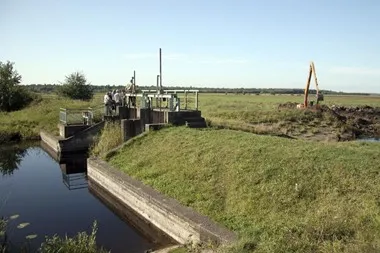
The WETLIFE project (2009–2012) in Amalva and Žuvintas mires sought to reverse negative changes by restoring hydrology (converting sluices to spillways, raising embankments, renovating the Amalva polder pump, blocking drainage) and by encouraging more sustainable peatland farming. It also aimed to raise awareness and provide a replicable model.
Since then, restoration has been expanded under LIFE WETLIFE 2 (2014–2018), which upgraded about 6.6 km of embankments, added spillways and a dam on the perimeter ditch, blocked underground drains and removed encroaching trees, with the goal of re-establishing “active raised bog” over ~775 ha in central and southern Amalva. Further rewetting (2019–2022, LIFE Peat Restore) targeted ~215 ha in southern Amalva with 28 retention structures across nine main ditches, four low berms with overflow crests, removal of woody growth and additional drain decommissioning.
Today the reserve operates long-term monitoring (2023–2033) of water levels and quality, while catchment management remains important due to pulsed discharges from the Simnas fishpond system that can affect Žuvintas Lake. Public access has been improved with a short boardwalk and viewing platform (2018), reinforcing outreach and stewardship.


Overview
Reconstruct sluice gates into spill-weirs
Extend dykes ~2 km (Amalva) and ~3 km (Žuvintas)
Renovate Amalva polder pump; block drains/plastic piling over ~207 ha in southern Amalva and ~6 km in Žuvintas
Tree removal on ~207 ha
Initiate grazing on ~30 ha in the polder.
| Authority type | Authority name | Authority role | Comments | Authority responsibility |
|---|---|---|---|---|
| NGO | Nature Heritage Fund | Implementation | Lead party and role in administration, finances and expertise. | Responsible |
| Local water authority | Marijampolė municipality administration | Initiation of the measure | Legislative initiatives for the project, active planning issues | Responsible |
| Forest owners | Marijampolė state forest enterprise | Implementation | Legislative initiatives for the project, active planning issues | Responsible |
| Other | Žuvintas Biosphere reserve directorate | Monitoring | Monitoring, biological activities | Supporting |
Site Information
Design and Implementation
Financing
€1,564,386 Phase II LIFE WETLIFE 2 (LIFE13 NAT/LT/000084, 2014–2018)
€5,943,535 Overall project (5 countries) Phase III LIFE Peat Restore (LIFE15 CCM/DE/000138, 2016–2022), Lithuania component including Amalva : €1,159,380
Policy and Governance
the effect of causing changes in the local and regional hydrological pattern, significant loss of wildlife and peat degradation, which in turn
resulted in various secondary negative effects: CO2 emissions (approximately 25% of currently reported anthropogenic CO2 emissions, which does not take into account emissions from peatlands), water pollution due to peat mineralization products and peat subsidence. The regulation of lakes, along with increased loads of nutrients caused a rapid deterioration of water quality, siltation, and overgrowth of the lakes or even the collapse of submerged vegetation. This further led to decreased water purification capacities, as well as secondary pollution from sediments negatively affecting water bodies down the stream and, finally, the Baltic Sea arguably the most polluted sea in the world.
Self-regulation of water by filtration / storage / accumulation by ecosystems
To achieve favourable conservation status of bog and swamp wood habitats
| Directive | Relevant pressure |
|---|---|
| WFD identified pressure | 4.1.2 Physical alteration of channel/bed/riparian area/shore of water body for agriculture |
| Other EU | Hydrological regime alterations impacting bog and swamp wood habitats |
| Directive | Relevant impact |
|---|---|
| WFD identified pressure | 4.1.2 Physical alteration of channel/bed/riparian area/shore of water body for agriculture |
| Requirement directive | Specification |
|---|---|
| WFD-mitigation of significant pressure | Water Framework Directive |
| WFD-achievement of good ecological status | — |
| WFD-achieving objectives for Protected areas | — |
| The Birds and Habitat Directives | — |
| Wider plan type | Wider plan focus |
|---|---|
| Regional | Water |
| Regional | Environment & Biodiversity |
| Regional | Climate adaptation |
| Local | Agriculture |
| Activity stage | Activity type | Key issues |
|---|---|---|
| Implementation phase | General project seminars | For project partners |
| Design phase | Information campaign on farming practices | A number of purchase negotiation meeting s with farmers, guideliness for sustainable peat grassland maangement presented to local farmers. |
| — | Name of policy/strategy 3 | — |
| — | Name of policy/strategy 4 | — |
| — | Name of policy/strategy 5 | — |
| — | Name of policy/strategy 6 | — |
| Arrangement type | Responsibility | Name |
|---|---|---|
| Contractual agreement | Amalvas wetland drainage blocking project, Amalvas wetland water level re-naturalization activity | Hydrologist-engineer |
| Contractual agreement | Purchase of 25 ha land | JSC Agrogeodezija |
| Contractual agreement | Restoration of the drained southern part of the Amalvas wetland | JSC Alytaus melioracija |
| Contractual agreement | Reconstruction of Amalvas polder | JSC Sumeda, etc. |
Impacts and Monitoring
Monitoring System
2. Žuvintas lake hydrological monitoring, daily
3. Meteorological monitoring, daily
4. Bambena and Dovine river flow monitoring, every 5 days
5. Amalvas hydrological and hydrochemical monitoring, every 10 days
Maintenance
Impact Assessment Methodology
Socio-economic Impacts
• Less than 60% of the polder area was used last year and bushes spread in the abandoned land. Some areas by contrast went under the plough increasing peat mineralization and subsidence. It is expected that after reconstruction of the polder most of the land will be maintained as grasslands because substantial areas will correspond to the criteria of land where management can be supported by higher agrienvironmental payments. This, in turn, is expected to facilitate development of alternative uses of grasslands, such as the production of grass seeds, grass biomass for alternative fuel etc.
• The introduced herd of beef cattle (16 units) in the Amalvas polder on a contract basis with the local farmer should increase in years to come, thereby maintaining 40- 70 ha of grazed wet meadows by 2016 and serve as an additional income source for the local farmer. It is expected to serve as a good example and involve more farmers in similar cooperation in the future.
• The reconstruction of the Žuvintas and Amalvas sluice-gates into permanent spillweirs, along with a reduction in the length of Amalvas protective dike by 0.8 km and blocked ditches in 250 ha will simplify maintenance and reduce costs.
• The revival of Amalva bog should significantly increase the amount of cranberries ready to be harvested by local people.
Agri-nature interface: meadow restoration (6 ha), advice for ~40 ha, adjustments to melioration to protect ~30 ha, 16 beef cattle provided to a local farmer to maintain wet peat meadows. 14 stakeholder events on mire services.
Biophysical impacts: Hydrology
Second phase (LIFE WETLIFE 2, 2014–2018) at Amalva: 6.6 km of dykes raised/restored/new; two spillways + a dam on the perimeter ditch; >20 ha underground drains blocked; ~140 ha tree removal. Target: regeneration of “active raised bog” on ~775 ha in central/southern Amalva.
2019–2020 piezometers show the water table below ground most of the time (e.g., AMAL02: >99% of days below; AMAL03/04 above ground 35–42%), confirming the need for rewetting.
Third phase (LIFE Peat Restore, 2019–2022) in south Amalva (~215 ha): 28 peat/ plastic-sheet piling dams across nine main ditches; four peripheral berms with overflow wells; woody vegetation removal; subsurface drains dismantled.
Biophysical impacts: Biodiversity
Biophysical impacts: Water & Soil Quality
Biophysical impacts: Others
Amalva south, ~215 ha : GEST-based estimate that emissions dropped from ~5,800 to ~800 t CO₂-eq/yr once rewetting and bog vegetation re-establish; reserve and state-forest services tasked with ongoing maintenance/monitoring.
Lessons Learned
Woody removal + ditch blocking work, but methods must adapt to site condition; at Amalva, repeated cutting failed in compacted/nutrient-rich patches and was replaced by herbicide.
Coupling with farming is key: explicit polder water-rules and grazing contracts reduced conflicts and sustained wet meadow management.
Design for safety: perimeter structures with overflow wells manage high-water events while keeping the bog wet.
Monitor for the long haul: piezometers + a formal 2023–2033 programme are essential to demonstrate outcomes and steer adaptive management.
Think catchment: external loads/abstractions (fishponds, drought) can undermine on-site gains; governance beyond site boundaries matters.
The project made an important push in promoting agi-environmental measures in the area. There is a common understanding achieved among decision makers regarding further land use on drained peatlands. However despite of significantly increased local awareness of environmental hazards related to unsustainable management of organic peat soils, there is a great need for national and European policies regarding this issue. Abandonment of subsidies for damaging farming on organic soils would prove to be extremely beneficial for biodiversity conservation and minimizing other negative environmental consequences.
| Driver type | Driver role | Comments |
|---|---|---|
| Legal obligations | Main driver | To ensure conservation status of the area |
| Organisation committed to it | Main driver | Nature Heritage Fund is a leading organisation in country to protect and maintain species of the comunity's interest (SCI) |
| Availability of subsidies | Secondary driver | LIFE Nature programme is supporting the biodiversity restoration projects |
| Success factor type | Success factor role | Comments |
|---|---|---|
| Successful coordination between authorities | Main factor | The project served as a good basis for establishing cooperation among protected area administration, municipality, environmental non-governmental organisation and local residents. |