
Summary
In the 1950s–60s, the Alzette floodplain was straightened for intensive agriculture, reducing water retention and ecological value. At Dumontshaff (Schifflange), the project set out to restore river-floodplain functioning (frequent overbanking, wetland habitat recovery) and to shift meadows to extensive management (late mowing, no fertiliser or biocides). After feasibility and land reallocation, works returned the river to its natural thalweg, widened and raised the bed, reactivated a secondary arm, and enabled floodplain and wetland restoration.
The main works on the Dumontshaff–Lameschmillen reach were completed in 2005 within a ~1.4 km section of the Alzette (plus ~600 m of the Kiemelbaach), with thalweg relocation and bed re-profiling; a dedicated project page reports a cost of ~€920k (excl. VAT). The wetland was formally designated as a National Nature Reserve in May 2023. Management now relies on year-round extensive grazing by Galloway cattle and water buffalo over >40 ha, and a nature trail (~4.4 km, 24 stations, observation tower) supports public access. Ecological outcomes include the return of Greater Spearwort (Ranunculus lingua) in 2009 and regular breeding of White Stork in the restored valley. Nearby, further renaturation on the Kiemelbaach was undertaken in 2020, while broader Alzette restoration continues upstream in separate projects.
Photo gallery
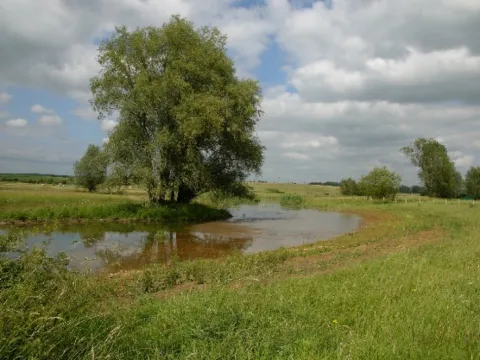
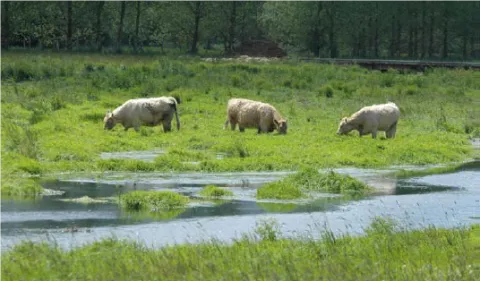
Overview
| Authority type | Authority name | Authority role | Comments | Authority responsibility |
|---|---|---|---|---|
| National water authority | Sutainable development and infrastructure ministry | Initiation of the measure | Project management and financing | Responsible |
| Other | Agriculture, vineyard and rural development ministry | Initiation of the measure | Project management and financing | Responsible |
| Farmers | Famers (Friedrich from Bertange, Friedrich from Aspelt and Witry from Bergem) | Implementation | They developed extensive agriculture and extensive grazing | — |
| Other | Shifflange, Bettembourg, Mondercange and Roeser municipal administrations | Implementation | Project partner. They owned a part of plantations. | Responsible |
| Architects / Engineers | Micha Bunusevac design office | Determination of design details of the measure | — | Supporting |
| Other | Acacia hotel, An der Schmedd restaurant, De Pefferkar restaurant | Other | They propose meals including meat produced in the area of the project. | — |
| NGO | Proactif association | Other | This association helps people remote from the labour market. They have breeding activities. | Supporting |
Site Information
Design and Implementation
Financing
Policy and Governance
| Directive | Relevant pressure |
|---|---|
| WFD identified pressure | Physical alteration of channel/bed/riparian area/shore of water body for agriculture |
| Floods Directive identified pressure | Other pressure contributing to flooding /flood risk |
| Directive | Relevant impact |
|---|---|
| Floods Directive identified pressure | Protected areas |
| Floods Directive identified pressure | Landscape |
| Floods Directive identified pressure | Rural Land Use |
| WFD identified pressure | Altered habitats due to morphological changes |
| Requirement directive | Specification |
|---|---|
| Other EU | Habitat directive 92/43/EEC |
| WFD-achieving objectives for Protected areas | A bird protection area was implemented |
| WFD-mitigation of significant pressure | Restoration of the water course itself |