
Summary
Aquifer recharge with highly polished treated effluents. With a high population density and almost no surface waters, Malta faces chronic over-abstraction: total demand exceeds the sustainable yield of naturally renewable freshwater. Demand comes from domestic and agricultural uses (domestic peaks can exceed agriculture during the tourist season). Groundwater quality is threatened by nitrates and seawater intrusion.
A pilot at Bulebel (2010–2013, MEDIWAT) tested injection of ultra-polished reclaimed water via an injection well under strict quality monitoring. Since then, Malta has pursued MAR within a broader strategy: the EU MARSOL demonstrator (2013–2017) designed an injection-well barrier near the Malta South plant (Ta’ Barkat) to counter seawater intrusion; the national New Water programme is expanding reclaimed-water production (~7 Mm³/yr capacity) and distribution for agriculture, creating seasonal surpluses that can supply MAR. Under the LIFE-IP RBMP (2021–2027), Action C8 is developing a pilot MAR scheme in the Pwales coastal groundwater body using reclaimed water when irrigation demand is low; a 2024 hydrogeological study characterised Pwales to support MAR design.
Photo gallery
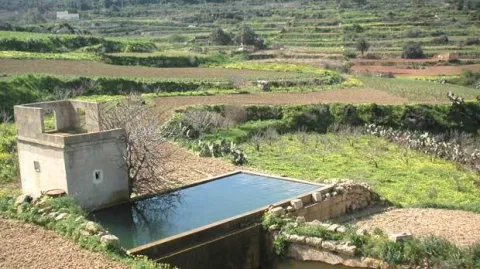
Overview
Determine the scale of impacts on aquifer status; enhance sustainability of freshwater systems; assess usability for irrigation.
Pilot configuration: UF+RO polishing, one injection well + 2–3 monitoring wells; test recharge at ~35 m³/day.
| Authority type | Authority name | Authority role | Comments |
|---|---|---|---|
| National water authority | Manuel Sapiano, Malta Resources Authority | Implementation | The MRA was responsible for leading the Maltese pilot project from the MEDIWAT research project's point of view. MRA is also responsible for issuing authorizations (after a quality control) for injecting water into the aquifer through boreholes. |
| Private property owners | Water Services Corporation | Monitoring | The WSC was responsible for assisting MRA from a technical and operational standing point. It owns the purification plant where the experiment took place, and provided the technical expertise and equipment. |
Site Information
Design and Implementation
Ultrafiltration and Reverse Osmosis Unit
Test-site, injection well and three monitoring wells Tools included:
Water level and water quality monitoring probes
Data loggers for continuous in-situ monitoring
On the scale of the island: three treatment plants produce app. 17 million m3 of treated effluent annually. Out of these 17 million m3, current use is estimated at 1.2 million m3 overall (constrained by a lack of a dedicated distribution network).
On the scale of the application:
Quality: ±105 mg/l of Nitrate content was mitigated. All tested organic pollutants except Dibromochloromethane yielded a negative result. Also, Alkylbenzene content in unpolished effluent ranged between 1.5 and 2.8 ug/l.
Quantity: water level in the first well showed an increase of ±1.3m over the drawdown levels and 0.6m over the long-term background level; water level in the second well showed a variation of 0.8m compared to 0.5m pre-recharge.
Determination of the scale of the impact of artificial recharge on the status of the aquifer; enhance the sustainability of (aquifer) freshwater systems; usability for irrigation.
The factors that influenced the selection and design of the application are linked to the context of over-abstraction of the aquifers due to the high water-demands on the island and to legal requirements (especially under the Urban Wastewater Treatment Directive (91/271/EEC), as well as the Water Framework and Groundwater Directives) – including the achievement of the good status objectives of the Water Framework Directive (Dir 2000/60/EC).
Financing
Policy and Governance
Regulation of the chemical status of freshwater
Self-regulation of water by filtration / storage / accumulation by ecosystems
While the primary target of this application is the assimilation (purification) of effluents to recharge the aquifer, it is only partly done in a natural way (passage through porous rock), as they are artificially treated first.
| Directive | Relevant pressure |
|---|---|
| WFD identified pressure | 1.1 Point – Urban waste water |
| WFD identified pressure | 3.2 Abstraction – Public Water Supply |
| WFD identified pressure | 3.1 Abstraction – Agriculture |
| Other EU | Groundwater Directive Direct and indirect inputs of hazardous substances in groundwater |
| Directive | Relevant impact |
|---|---|
| WFD identified pressure | Abstraction exceeds available GW resource (lowering water table) |
| WFD identified pressure | Saline pollution |
| WFD identified pressure | Nutrient pollution |
| Requirement directive | Specification |
|---|---|
| WFD-restoring a HMWB | — |
| Water Framework Directive (WFD) 2000/60/EC | WFD-achievement of good GWB quantitative status |
| Other EU | Groundwater Directive-protection of the qualitative status of the receiving GWB |
| Other EU | Urban Waste Water Treatment Directive |
| Wider plan focus | Name | Comments |
|---|---|---|
| Environment & Biodiversity | MEDIWAT project | Sustainable management of environmental issues related to water stress in Mediterranean Islands Second call of the MED programme (2007-2013). It involved 10 partners covering 6 NUTS II regions (islands in France, Italy, Greece, Spain, Malta and Cyprus). It was co-financed by the European Union and the European Regional Development Fund (ERDF) |
Impacts and Monitoring
Monitoring System
Solvents/Plasticizers/Surfactants - Dibutylphtalate, Glycol Ether, Alkyl Benzene, Dibromochloromethane, Perfluorooctanic Acid, Perfluorooctanesulfonic Acid, BisphenolA
Personal Care Products - Caffeine, Galoxolide, Oxybenzone, TCEP and DEET
Steroids - Androstenedione, Estradiol, Estriol, Estrone, Ethinylestradiol, Progesterone, Testosterone
AntiMicrobial Agents - Trimethoprim, Triclosan, Sulfamedthoxazole, Erythromycin) and conventional pollutants (electrical conductivity, chloride, nitrate and bacterial content).
Impact Assessment Methodology
Socio-economic Impacts
Biophysical impacts: Hydrology
Biophysical impacts: Water & Soil Quality
Lessons Learned
Any proposed artificial recharge scheme using treated effluents should seriously consider the impact on the aquifer system, through a hydro-geological assessment of the aquifer system in order to assess the prevalence of local and regional groundwater flow. If not so, groundwater users located in the immediate vicinity of the scheme could be strongly impacted should an unplanned incident occur, whereas the impact on a regional scale could only be minor.
| Driver type | Driver role | Comments |
|---|---|---|
| Legal obligations | Main driver | WFD requirements (annual abstraction from the groundwater body does not exceed the long-term annual average rate of overall recharge of the body of groundwater; necessary controls are in place to eliminate the possibility of any degradation in the qualitative status of the receiving body of groundwater) |
| Other | Main driver | Availability of European funding for research projects in this area |
| Success factor type | Success factor role | Comments |
|---|---|---|
| Financing possibilities | Main factor | Financing for the treatment of effluents that will be injected into the aquifer |
| Other | Main factor | Location of the recharge facility (close to a wastewater treatment plant) |
| Existing regulations | Secondary factor | Enforcement of control for illegal abstractions |