
Summary
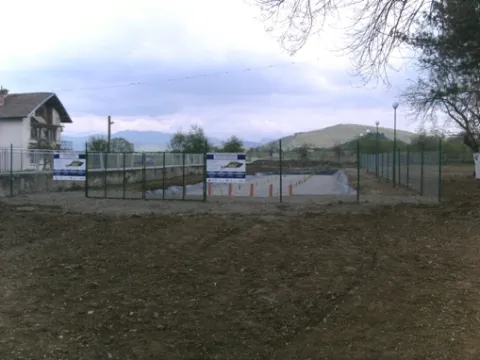
Women in Europe for a Common Future (WECF) implemented Bulgaria’s first constructed wetland in Vidrare (Pravets) to treat domestic wastewater from the St. Panteleimon home while building local capacity. The plant is a vertical subsurface-flow reed bed for ~80 PE, combining an 18 m³ two-chamber settling tank with intermittent pumping to a 266 m² planted sand filter split into two beds; treated effluent discharges to a nearby gully. Design: Otterwasser (DE) and Ecoproject (BG); works: Interstroy; funding: German Federal Environment Foundation (DBU). Construction ran Oct 2010–Apr 2011; the facility was officially inaugurated on 29 April 2011. O&M is handled by trained staff from the home; reported investment was about €45,000 (+≈10% for planning). The site has served as a national demonstration/education example and continues to be cited by Bulgarian authorities (e.g., Ramsar COP14 National Report, 2022).
Photo gallery


Overview
Provide on-site treatment for the Home’s domestic wastewater (kitchen, toilets, laundry) to “improve the existing situation,” by installing a constructed wetland on the Home’s plot.
| Authority type | Authority name | Authority role | Comments | Authority responsibility |
|---|---|---|---|---|
| NGO | Women in Europe for a Common Future (WECF) | Initiation of the measure | International ONG | Responsible |
| Local water authority | Pravets Municipality | Initiation of the measure | Co-funding | Responsible |
| Other | Ecoworld 2007 of Bulgaria | Initiation of the measure | — | Supporting |
| NGO | German Federal Environmental Fundation | Financing | — | — |
| Architects / Engineers | Otter Wasser | Determination of design details of the measure | Also instruction of staff for the maintenance of the constructed wetland | Supporting |
Site Information
Design and Implementation
Financing
Policy and Governance
| Activity stage | Activity type | Comments |
|---|---|---|
| Implementation phase | Seminar | November 19th, 2010; 25 participants; Related to the construction of the first constructed wetland in bulgaria |
| Implementation phase | National Conference | April 29th, 2011 in Gran Hotel Sofia; Presenting constructed wetlands as a sustainable and cost-effective wastewater treatment system |
Impacts and Monitoring
Monitoring System
Maintenance
Impact Assessment Methodology
Socio-economic Impacts
Public health / service quality
Biophysical impacts: Hydrology
Biophysical impacts: Water & Soil Quality
Biophysical impacts: Others
Lessons Learned
Early and hands-on capacity building is decisive. Training a named on-site operator, providing an operations diary, and agreeing simple daily/weekly/annual tasks made routine O&M feasible for a municipal care home with limited technical staff.
Permitting and administration are often the critical path. Time was spent aligning authorities with an unfamiliar technology; proactive engagement and clear responsibilities helped unlock approvals and clarify who monitors what, when.
Design details that prevent failure matter more than “optimal” performance tweaks. A robust pre-treatment, a fully lined VSSF bed, separation from stormwater, pumps with simple controls, and an emergency overflow plan reduced risks like hydraulic short-circuiting, rain ingress, or power-failure spills.
Expect and budget for minor “punch-list” corrections after start-up. Small fixes—drainage to keep runoff out, cleaning/adjusting outlet shafts, sealing—are normal and should be planned into commissioning, with roles shared between contractor and owner.
Economics favour low running costs over very low capex. With roughly €45k investment, ~1.5 h/week of labour and ~2 kWh/day electricity, the whole-life burden is modest for an institution-scale facility, making the solution attractive where operational simplicity is valued.
Evidence still needs structured monitoring. The case demonstrates likely improvements in effluent quality, but site-specific lab series are scarce; future replicas should lock in a simple, authority-aligned monitoring plan to generate data beyond visual checks.
Replication should target similar institutional settings. Municipal homes, schools, or small clusters with available yard space and a willing local operator are the sweet spot; nutrient polishing can be added only if the receiving context requires it.
| Driver type | Driver role | Comments |
|---|---|---|
| Organisation committed to it | Main driver | WECF NGO |
| Success factor type | Success factor role | Comments |
|---|---|---|
| Financing possibilities | Main factor | In rural areas, there is a lack of financial, technical and staff resources, thus low-tech, cost-efficient and sustainable wastewater management systemas are needed |
| Attitude of relevant stakeholders | Secondary factor | — |