
Summary
This case study documents applied research in Flanders that tested and scaled controlled drainage and simple adjustable weirs on arable land. The LEADER Drainage Plus pilot (2016 to 2019) converted nine parcels totalling 35 ha from conventional systems to level-controlled drainage, installing control pits and combining on-farm demonstrations with monitoring and modelling led with the Belgian Soil Service. The goal was to retain winter water in the root zone, reduce downstream peaks, and improve yields in a region facing summer drought and wetter winters. The project showed that, on suitable flat and permeable fields, controlled drainage increased crop growth, with income gains from about €100 up to several hundred euro per hectare depending on crop and year, and it triggered wider farmer uptake.
Follow-up regional work expanded monitoring and practical guidance (Van Landbouw tot Waterbouw) and OP-PEIL is mapping where conversion is technically and economically viable; weirs were promoted as fast, no-land-take devices to hold ditch water with siting criteria. Field rules of thumb were consolidated: a 10 cm groundwater rise can add roughly 30 to 35 mm evapotranspiration and about 1 t/ha dry matter; maize water stress can be postponed up to two weeks; indicative local storage is about 500 m³ per hectare. Barriers included permit complexity for each weir, costs and the legacy preference for fast evacuation. Typical costs reported are about €2,000 per hectare when reusing drains, about €4,500 per hectare for full renewal, and about €4,500 per weir. A major outcome was policy change: Flanders created a subsidy for controlled drainage (75 percent support up to €2,000 per hectare) and 100 percent subsidy for weirs with limited budgets, directly linked to the early pilots. Today the pilot is finished, follow-ups delivered monitoring and guidance, and conversions continue where site conditions and farmer motivation align.
Photo gallery
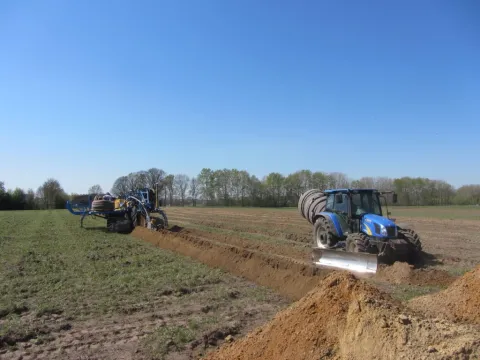


Overview
Reduce drought stress and downstream peak flows
Improve yields and farm income
Demonstrate feasibility and build farmer awareness
| Authority type | Authority name | Authority role | Comments | Authority responsibility |
|---|---|---|---|---|
| NGO | Boerennatuur Vlaanderen | Initiation of the measure | formerly agrobeheercentrum Eco² vzw project promoter, coordination, farmer engagement, administration, communication | Responsible |
| Architects / Engineers | Bodemkundige Dienst van België (BDB) | Monitoring | monitoring, modelling, technical studies | Supporting |
| Farmers | Participating farmers in Kempen en Maasland | Implementation | — | Responsible |
Site Information
Design and Implementation
Existing drains in good condition and not too old
Drain gradient limits and small ground-level differences per drain run
Accessible locations for weirs, typically at least 300 m spacing between weirs
Financing
Approx. 2,000 €/ha when existing system can be reused
Approx. 4,500 €/ha when full renewal is needed
Indicative cost per weir around 4,500 €
Flanders subsidy reported for conversions: 75 percent support up to 2,000 €/ha, developed following Drainage Plus experience
Weirs: 100 percent subsidy reported, but budget amounts limited
Policy and Governance
Lower downstream peak flows and pressure on drainage networks
Improve yields and resilience at farm scale
| Activity stage | Activity type |
|---|---|
| Other | Field demonstrations on farms |
| Arrangement type | Responsibility |
|---|---|
| Contractual agreement | Farmer : gives monitoring rights to the association and takes care of maintenance needs Association : handles the complex paperwork and finances the works |
Impacts and Monitoring
Monitoring System
Follow-up project: continuous groundwater logging with divers at eight locations from Nov 2019 to Apr 2021; twice-yearly water quality sampling; extended simulations 2007–2021 of groundwater, drought stress, and plant-available water with a water balance model
Maintenance
Impact Assessment Methodology
Modelling of groundwater levels for undrained, conventional, and controlled scenarios
Water balance model producing drought stress index and plant-available water
Conversion of evapotranspiration changes to biomass and to financial value using published water productivity relationships and crop prices
Socio-economic Impacts
Biophysical impacts: Hydrology
Reported rule of thumb from interviews: +10 cm groundwater can yield 30–35 mm extra evapotranspiration and higher biomass
Storage effect indicative: about 500 m³ per hectare retained locally
In maize, farmers reported up to two extra weeks without water stress
Local water retention and drought mitigation at field scale
Potential reduction of downstream peak flows
Biophysical impacts: Water & Soil Quality
Overall effect of measures on water quality not quantified
Lessons Learned
| Driver type | Driver role | Comments |
|---|---|---|
| Past flooding events | Main driver | Climate pressures of summer drought and winter surpluses |
| Availability of subsidies | Main driver | Availability of subsidies following Drainage Plus |
| Organisation committed to it | Secondary driver | Motivated farmers and local willingness to pilot |
| Success factor type | Success factor role | Comments |
|---|---|---|
| Conducted assessments (incl. economic) | Main factor | Pre-site assessments and field visits |
| Communication activities | Main factor | On-farm demonstrations and communication |
| Conducted assessments (incl. economic) | Secondary factor | Technical support from drainage company and BDB monitoring/modelling |
Opportunity mapping and guidance under OP-PEIL to identify suitable areas in Flanders