
Summary
Along the lower ~8 km of the Ezousa riverbed near Paphos, a MAR/SAT scheme uses the aquifer as a natural reservoir: tertiary-treated effluent from the Paphos WWTP is conveyed to infiltration ponds in the riverbed, naturally filtered, stored and later abstracted for irrigation. Built in 2003, the system comprises five pond groups (23 basins in total) supplied by a 500-mm main, with a design capacity of roughly 9,000–12,000 m³/day. Annual recharge increased from ~1.63 Mm³ (2004) to 4.44 Mm³ (2015); WDD’s assessment (2006–2015) reported no adverse effects attributable to recharge, with only occasional chlorination by-products detected downstream. Research at the site indicates slight attenuation of nutrients and notes copper in groundwater exceeding EPA standards, likely of geogenic origin. Today, all reclaimed water produced in Paphos is routed to the Ezousa aquifer and then pumped and distributed for irrigation through the government network.
Since 2021, real-time sensors (water level, EC, temperature) linked to the INOWAS platform complement routine sampling, strengthening operational control.
Photo gallery
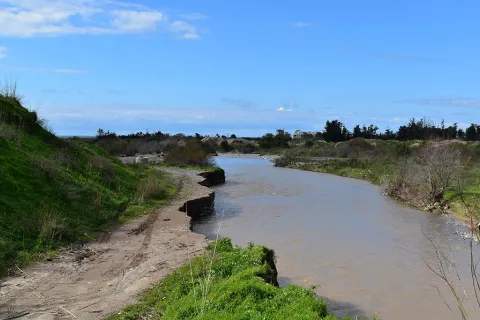
Overview
| Authority type | Authority name | Authority role | Authority responsibility |
|---|---|---|---|
| National water authority | Water Development Department | Implementation | Responsible |
| Other | Sewrage Board of Paphos | Implementation | Responsible |
Site Information
Design and Implementation
Financing
€3.9 M for tertiary plant, pumps and transfer main; ≈€0.1 M for ponds, boreholes and pumps
Policy and Governance
| Name |
|---|
| Reuse of treated water effluent and improvement of aquifer status |
Impacts and Monitoring
Monitoring System
Continuous water level, EC, temperature at selected wells; lab campaigns (every ~3 weeks Jan–Jun 2021) for physico-chemical & microbiological suites, with emphasis on nitrate, pathogens, heavy metals (incl. copper) and sulfate.
observation borehole upstream of the recharge site for the native groundwater.
Maintenance
Impact Assessment Methodology
From the flow model it is suggested that artificial recharge can compensate the lack of upstream recharge only to a point. Thus, a water deficit could potentially be created that will induce the saltwater intrusion phenomenon in the costal area.
The general behavior of phosphorus and Copper was captured relatively well with some exceptions.
Socio-economic Impacts
Conjunctive use & domestic water savings: WDD notes the scheme stores effluent for reuse, enables conjunctive use with dam water, and saves equivalent volumes of fresh water for domestic supply.
Regional demand context: the coastal area’s demand is high (≈17 Mm³/yr agriculture; ≈3 Mm³/yr tourism), underscoring the utility of MAR in the local economy.
Biophysical impacts: Hydrology
Stored/recharged water: annual recharge rose from 1.63 Mm³ (2004) to 4.44 Mm³ (2015); modelling (2014–2018) shows non-decreasing groundwater heads, indicating losses are compensated by recharge/pumping management.
Seawater intrusion: WDD reports the scheme controls saltwater intrusion; maximum practical recharge with existing structures estimated ~7 Mm³/yr.
Biophysical impacts: Biodiversity
Biophysical impacts: Water & Soil Quality
Metals: scientific assessment highlights copper in groundwater exceeding EPA standards; authors recommend controlling infiltration capacity and increasing travel times to improve performance.
Baseline pressures: naturally high sulphates (~450 mg/L) and boron in the area; over-abstraction and salinity pressures pre-recharge.
Overall effect: 2006–2017 monitoring found no negative impact on groundwater quality attributable to recharge; no pesticides detected in groundwater; organics only sporadically detected (mainly chlorination by-products such as chloroform) and not due to recharge.
Biophysical impacts: Others
Lessons Learned
Experience shows that artificial recharge with treated effluent is transferable to other drought-prone areas with comparable geology; conjunctive use of surface water and groundwater maximizes available resources; saving equivalent volumes of freshwater for domestic supply is achievable when reclaimed water is stored and later used for irrigation; and controlling sea intrusion is feasible in practice.
Design and operations matter. The scheme uses five groups of basins (23 ponds) distributed along the lower Ezousa; pilot tests reported high infiltration rates (≈70–120 mm/h), confirming the suitability of the permeable alluvium. Strategic blending with Asprokremmos canal water (e.g., 1:20 at the canal) supports irrigation quality and operational flexibility.
Monitoring under WDD’s long-running program found slight nitrate dilution and strong phosphorus sorption, with metals sometimes higher in groundwater than in the inflow; a later assessment reported copper in groundwater exceeding EPA standards—underlining the need to manage residence times and pathways. Since 2021, real-time sensors (water level, EC, temperature) linked to the INOWAS platform complement lab sampling and help track risks (including clogging).
There are limits: modelling indicates that artificial recharge can compensate for reduced upstream recharge only up to a point; likewise, sea-intrusion control is effective but not absolute, so abstractions and recharge must be balanced over time.
| Driver type | Driver role | Comments |
|---|---|---|
| Organisation committed to it | Main driver | WDD is responsible for water resources management in the island. |
| Success factor type | Success factor role | Comments |
|---|---|---|
| Existing staff and consultant knowledge | Main factor | Previous experience with succesful Artificial recharge in riverbed with fresh water. |
| Attitude of decision makers | Main factor | Strong public authority leadership and policy backing for reuse (WDD as driver; national policy to maximize recycled water). |
| Conducted assessments (incl. economic) | Secondary factor | Robust monitoring : legacy WDD program plus SMART-Control real-time telemetry—enabling adaptive operation and risk reduction. |