
Summary
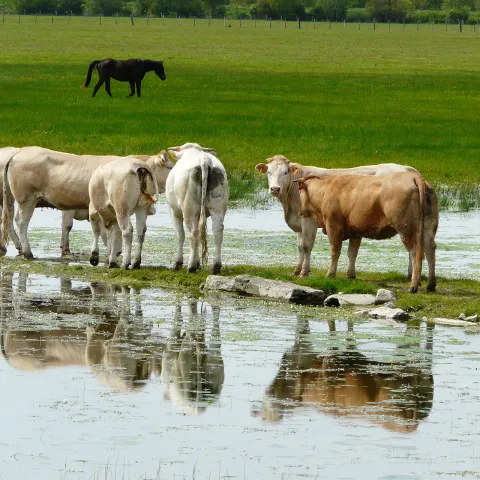
Located in Pays de la Loire and Nouvelle-Aquitaine, the Marais Poitevin is France’s second-largest wetland. About 2,148 ha of municipal flood meadows (“marais communaux”) are collectively grazed and managed, delivering flood storage, groundwater recharge and pollutant removal. Management agreements launched in 1989 and renewed in 2003 and 2017 sustain traditional, low-intensity mixed grazing and biodiversity. Since the 2010s, hydraulic governance has been reinforced by EPMP’s “Contrats de marais”, which define seasonal water-level bands and fund small hydraulic works, habitat restoration and monitoring within territorial contracts (CT 2023–2025). Real-time hydrometric tracking is provided through the SIEMP portal. Today, 23 communal marshes across 23 municipalities host roughly 3,600 cattle and horses each season; in 2019, 121 farmers grazed 2,113 ha. In November 2023 the wider Marais Poitevin (69,034 ha) was designated a Ramsar Site, and since October 2024 the LIFE “Maraisilience” project (2024–2029) has been mobilising stakeholders to co-design climate adaptation and a climate observatory. These updates confirm the flood-meadow system’s continued role in water regulation and nature conservation under modern, multi-partner governance.
Photo gallery
Overview
| Authority type | Authority name | Authority role | Comments | Authority responsibility |
|---|---|---|---|---|
| Nature park | Parc naturel régional du Marais poitevin | Implementation | The Parc naturel régional du Marais poitevin is a public organisation bringing together local authorities (93 municipalities, 3 Départements and 2 Régions) of Marais Poitevin. All these authorities are co-signatory of a Territory Agreement which defines strategic guidelines and missions of the Parc. Current areas of activities of the Parc are: natural ressources (agri-environment, protection of biodiversity and ecosystems...), economy and land planing (tourism, architecture, urbanism...), culture and heritage, education. The park is involved in technical supports (management of breading and health issues on the common floodmeadows...) | Responsible |
| Local water authority | Municipalities | Other | 23 Municipalities | Responsible |
| NGO | Environmental associations (LPO and WWF) | Financing | The LPO (Ligue pour la Protection des Oiseaux) and WWF-France (World Wild Founds - France) are two environmental associations. They are involved in the support of municipalities (15 €/ha/year of common floodmeadow, that is to say 450 000 € for 15 years) They also bring technical support to municipalities (for environmental issues such as biodiversity for instance) | Supporting |
| NGO | LPO, association de Défense de l'Environnement en Vendée, l'Union des Marais Mouillés, Conservatoire des Espaces Naturels Poitou-Charentes, WWF-France | Other | They are public or private organisations (sometimes local) working on environmental issues. They are all involved in the Life programme with the PIMP. | Supporting |
Site Information
Design and Implementation
Responsibility of farmers (administrative procedures for farmers in order to avoid problems in the common meadows).
Common meadows should provide incomes to municipalities.
Financing
Farmers benefit from the CAP subsidies (including agro-environmental measures) in exchange for respect of agri-environmental and climate good practices.
Policy and Governance
Biodiversity and gene-pool conservation in riparian areas,
Natural assimilation (purification) of effluents through dilution, dispersion, and physicchemical processes,
Flood control and flood risk mitigation.
| Directive | Relevant impact |
|---|---|
| Floods Directive identified pressure | Economic Activity |
| Floods Directive identified pressure | Rural Land Use |
| Floods Directive identified pressure | Property |
| Floods Directive identified pressure | Other environmental impacts |
| Wider plan focus | Name | Comments |
|---|---|---|
| Environment & Biodiversity | Life Nature | Life Nature Project for "the conservation of the most remarkable habitats and species of Marais Poitevin" for the period 2004-2008. In the framework of this project, one action on common floodmeadows has been developed (partnership between the PIMP, LPO, WWF and 16 municipalities). The objective of this action was to maintain and develop floodmeadows in order to ensure the hydrological equilibrium of Marais Poitevin, to improve its role of water purification and to preserve biodiversity and landscapes. Partners supported municipalities (technical and financial supports) for: - Carrying out management plans in order to plan future development and maintenance projects. - Ecological maintenance of floodmeadows in order to improve their ability to welcome remarkable species. - Ecological inventories and scientific monitoring in order to assess the relevance of projects and their benefits for the society. - Awareness actions for inhabitants and users about floodmeadows, their management and their richness. |
| Environment & Biodiversity | Natura 2000 | Since 1993 |
| Agriculture | Common Agricultural Policy | Launched in 1962, the EU’s common agricultural policy (CAP) is a partnership between agriculture and society, and between Europe and its farmers. The meadows are managed in compliance with the agri-environmental and climate measures of the CAP. |
| Activity stage | Activity type | Comments |
|---|---|---|
| Screening phase | Awareness actions | Awareness actions (for example in the framework of the Life programme) for inhabitants and users. |
| Name | Comments |
|---|---|
| Agreement for an agri-environmental management | Since 1989, 18 municipalities have undertaken to maintain common meadows and to respect environmental clauses. In compensation, municipalities receive financial and technical supports. |
| agri-environment commitment | Since 1993, common floodmeadows are subject to agri-environmental measures (2nd pillar of the CAP) |
Impacts and Monitoring
Monitoring System
Maintenance
Impact Assessment Methodology
Socio-economic Impacts
- For municipalities: source of incomes
- For farmers: common meadows are used as pastures
- For inhabitants: increase of the value of neighboring goods (houses…) - Tourism, etc.
Social benefits:
- Very important for creating social links between stakeholders (farmers, managers, elected representatives, inhabitants, NGOs…)
Biophysical impacts: Hydrology
Biophysical impacts: Biodiversity
Amenities (associated to habitat protection): fish and plants, tourism, recreation, and others.
Biophysical impacts: Water & Soil Quality
Lessons Learned
It seems very important to establish a relationship of trust between stakeholders (particularly between farmers, municipalities and the Parc Interrégional du Marais Poitevin). This is time- and energyconsuming (many dialogues, to make sure that everybody can give its opinion…) but it helps anticipating problems and finding solutions and it improves the acceptability of the measure through time and through difficulties which may occur. Building and maintaining social links (also with inhabitants and other stakeholders) should not be neglected.
| Driver type | Comments |
|---|---|
| Other | Common floodmeadows are used as a pasture for 10 centuries. Pasture by multi-specific herds (cattle, horses, gooses) went on because it is a good way to valorize the produced biomass and to maintain ecosystems and landscapes. Soil structure (micro relief) prevented from using machinery for mowing and ecosystem services (flood protection, water purification, role in water circle...) would have been lost if such areas were used for cropping. They are common land owned by municipalities. |
| Success factor type | Success factor role | Comments |
|---|---|---|
| Successful coordination between authorities | Main factor | Close relationship and trust between farmers, municipalities and the Parc. This is helped by the governance scale (important role of municipalities, direct interaction between municipalities and farmers…) |