
Summary
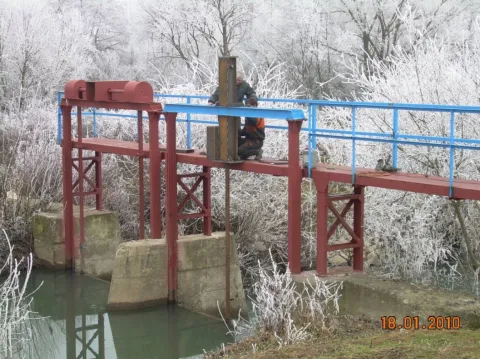
Originally implemented under the UNDP/GEF Tisza MSP, the measure rebuilt an existing floodgate at the confluence of a drying bypass channel and the Žiarovnický stream in the Senné depression (Bodrog basin). The gate enables gravity supply to the Senné fishponds NNR in dry periods and during floods, and reduces discharges to the Stretávka pumping station. It was financed by the Global Environment Facility and delivered by Global Water Partnership Slovakia with local authorities.
Since then, complementary works have expanded upkeep and control of the small-hydraulic network. A LIFE project for the Senné & Medzibodrožie SPAs restored water-level control via gates/sluices and dyke repairs, improving the hydrological regime around the ponds and Ostrovik meadows.
Most recently (2020–2023), SOS/BirdLife Slovakia repaired/maintained ~1.69 km of dikes and ~2.17 km of supply canals and improved the water regime across ~814 ha; managers now manipulate existing stavidla annually to sustain wetland habitats. These actions and targets are embedded in the 2022 Care Programme for the SPA.
Photo gallery

Overview
Rebuild and operate a floodgate at the confluence of a drying bypass channel with the Žiarovnický stream to supply the Senné wetlands (NNR/fishponds) in dry periods and during floods.
Reduce flood risk locally by decreasing discharges to the Stretávka pumping station and retain water on the designated floodplain/within the NNR (“make space for water”).
Contribute to the Bodrog basin flood-risk strategy by testing a small, quickly deliverable intervention as part of the UNDP/GEF Tisza MSP demo actions.
| Authority type | Authority name | Authority role | Comments | Authority responsibility |
|---|---|---|---|---|
| NGO | Global Water Partnership Slovensko (GWPS) | Implementation | — | Supporting |
| Local water authority | Slovak Water Management enterprise (SVP) | Implementation | Involvement in the preparation of the strategy, cooperation in implementation of restoration activities | Supporting |
| Research institute / University | Slovak hdrometeorological Institute (SHMU) | Monitoring | Provision of data for drafting the strategy | Supporting |
| Local water authority | Municipalities in the Bodrog river Basin | Other | Beneficiaries of the project activities and particpants/active involvement when the strategy will be prepared. Public meetings with local people and frequent contacts with stakeholders | Supporting |
| Other | Daphne | Determination of design details of the measure | Proposals for measures of integrated landscape management, discussions with local stakeholders, especially farmers | Supporting |
| National water authority | Ministry of Environment | Financing | — | Supporting |
| National water authority | Hydromelioration Authority | Implementation | — | Responsible |
| NGO | Slovak Bird Protection Society - SOVS | Other | Organising summer camps, brigades and other similar activities | Supporting |
| Farmers | Farmers and farmer associations | Implementation | Negotiations, definition of mutual profits. | Supporting |
| Research institute / University | UNDP | Monitoring | — | Supporting |
Site Information
Design and Implementation
Financing
Policy and Governance
| Wider plan type | Wider plan focus | Name | Comments |
|---|---|---|---|
| National | Water | UNDP/GEF MSP project Component 1, activity 1(ii) | Component 1 of the Project: Making space for water in the Bodrog river Basin |
| National | Water | Program of Flood Protection Measures of the Slovak Republic until 2010 | The program has declared the restoration of original function of water courses and the improvement of aquatic and terrestrial environment, especially in lowland areas by a long-term flood protection plan oriented predominantly at water retention measures with the aim to decrease surface runoff and maximum discharges. |
| National | Water | National mitigation strategy and plan focused on flood management and flood prevention. | Each country (SK-HU-UA) within the Tisza catchment has developed it |
| National | Water | Related Iniciatives | Project "MOSES - Improvement of flood management in Slovakia and Ukraine"; Project UNDP/GEF"Integration of Ecosystem Management Principles and Practices into Land and Water Management of Laborec-Uh region"; Project LIFE "Conservation of Senne and Medzibodrozie SPAs in Slovakia". |
| Activity stage | Activity type | Key issues | Comments |
|---|---|---|---|
| — | Common Meetings | — | Organised by the project |
| Design phase | Coordination meetings | Activities at national level | Organised by the project partners or participation of the project expert on the events at national level |
| Other | Dissemintaion activities | To achieve replication on national levels and to other basins | This activities included: meetings with international stakeholders, inforamation materials and interview for informing the media, articles for local newspapers and presentations about the results of the project at local and international meetings |
| Arrangement type | Name | Role | Comments |
|---|---|---|---|
| Contractual agreement | Committes for transboundary water | Establish the bases of the transboundary cooperation. | Bilateral agreement between Slovakia and Hungary. Main force to arrange the flood prevention in Bodrog River Basin. |
| Other | Towards a River Basin Management Plan for the Tisza River supporting sustainable development of the region | — | Memorandum of Understanding between the riparian ministries |
| Contractual agreement | Contracts | — | Signed by GWP and each partner on undertaking specific tasks |
Impacts and Monitoring
Monitoring System
Maintenance
Impact Assessment Methodology
Socio-economic Impacts
The project team promoted agri-environment schemes (AES) throughout implementation, offering free advisory services; 33 land users attended AES training, and farmers in the area entered AES during the programming period.
Biophysical impacts: Hydrology
Subsequent works (2020–2023, LIFE IPORSEN) repaired/maintained ~1,690 m of dikes and ~2,170 m of supply canals, improving the water regime over ~814 ha (NNR + production ponds + Ostrovik meadow). Managers manipulate existing sluices annually to keep levels. A 600 m dike on Ostrovik now enables simulated inundation.
Biophysical impacts: Biodiversity
In 2023, a new breeding bird species for Slovakia (glossy ibis) was recorded at Senné; works are cited as improving conditions for rare waterbirds.
Biophysical impacts: Others
Lessons Learned
Design flexibility was essential. An intended reconstruction on the Cibavka channel had to be dropped after some farmers objected; the team pivoted to refurbish the floodgate at the main drainage channel/Žiarovnica confluence instead. That low-tech fix (by SVP in Dec 2009) came with an operational manual and still achieved the goals of supplying the reserve during dry periods and reducing discharges to the Stretávka pumping station.
Plan works around ecology. During the 2023 LIFE IPORSEN phase, dyke repairs and inlet-canal cleaning were scheduled after the breeding season to limit disturbance, with the expected benefit of improving the water regime across “over a thousand hectares” of wetlands while also protecting adjacent farmland from unwanted flooding.
Ownership and governance matter. The area mixes a state nature reserve, a privately operated fishpond complex (privatised in 2000), and many small landowners—creating real coordination challenges. The NWRM case flags fragmented ownership as a barrier, and the CHVÚ management plan documents the fishpond operator’s role and intensification since privatisation—underscoring the need to align nature protection, water management and aquaculture.
Make the most of existing infrastructure. The local melioration network—once built to drain wetlands—can be run “in reverse” to hold water, and modest gate/levee fixes plus channel cleaning can deliver catchment-scale ecological gains. Recent municipal micro-projects (e.g., “Čierna voda ožíva”: reconstructing a levee culvert to re-wet 1.9 ha by gravity) show how these small interventions can keep adding value.
Finally, continuity breeds impact. The 2009–2011 pilot (GEF/UNDP, ICPDR) set the template; subsequent LIFE IPORSEN works (2021–2023) and parallel cross-border “BirdTour” investments in visitor infrastructure built local support and helped sustain wetland management.
| Driver type | Driver role | Comments |
|---|---|---|
| Past flooding events | Main driver | Yearly in the Bodrog catchment area which have negative consequences on inhabitants. Most serious one was in 2004 when floods affected 75% of the area in Eastern lowlands, managed by Water Management enterprise and also inhabitants had to be evacuated. |
| Availability of subsidies | Secondary driver | Without the UNDP/GEF support, the coordination among the Bodrog River Basin countries and the national plans and their implementation on the local level would be very limited and thus the idea of flood prevention through the integrated land and water management would not be implemented. |
| Success factor type | Success factor role | Comments |
|---|---|---|
| Attitude of relevant stakeholders | Secondary factor | The measures can be done in a short period of time (within 12 months) |