
Summary
The Ministry-coordinated programme in Šumava National Park restores natural (pre-drainage) water regimes to mires, stabilising water tables, reducing fluctuations, and re-starting peat-forming vegetation and processes while engaging the public. Design has been refined around the Target Water Table (TWT) and a micro-catchment approach to size/space peat and wooden dams, infill drains, and return small streams to near-natural courses; public outreach and monitoring are integral.
Since 1999 the programme has expanded far beyond early pilots: by 2024, 65 locations in the Šumava region had been hydrologically restored, totaling 2,718 ha, with ~296 km of drainage channels blocked, 36 km of streams and 28 spring areas restored.
Within LIFE for MIRES (2018–2024), the project delivered ~2,181 ha of restored wetlands, 212 km of ditches blocked, 35 km of restored streams, and 28 springs, supported by 1,840 volunteers, strengthening habitat for flagship species such as black grouse and improving landscape water retention.
Overall, Šumava’s mire restoration now couples targeted hydrological design with long-term monitoring and public involvement to secure biodiversity gains and climate-relevant water storage at landscape scale.
Photo gallery
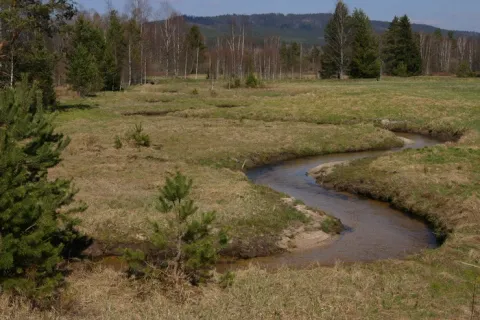


Overview
LIFE for MIRES phase (2018–2024): restore near-natural hydrology on ~2,059 ha across ~47 sites (43 on the Czech side), targeting the removal/closure of ~80 km of drainage channels and ~13 km of streams, with additional goals for springs and black grouse habitat. Delivery ultimately exceeded several targets: by late-2024 the programme reports ~196 km of ditches blocked, ~30–36 km of streams restored, 28 spring areas restored, and a cumulative ~2,718 ha of hydrological restoration across 65 locations (1999–2024).
| Authority type | Authority name | Authority role |
|---|---|---|
| National water authority | Czech Ministry of Environment | Financing |
| — | Administation of Sumava National Park | — |
| — | PLA Authority | — |
Site Information
Design and Implementation
Financing
LIFE for MIRES (2018–2024) : total eligible budget of €5,845,002
Policy and Governance
| Name |
|---|
| Landscape management programmes |
| Activity type | Comments |
|---|---|
| Environmental Education | Both visitors and local people regularly attend †œMire Days†, which have been organised in the Å umava NP since 2008. In the ,rst half of such a mire day, people help with mire restoration a-er which they can visit undisturbed mires during the a-ernoon excursion. Similar †œMire Weeks† have also been organised in collaboration with NGOs for already 8 years. *ese †œMire Weeks† are attended mainly by young people and students. In this way several hundred people from the whole Czech Republic have taken part in mire restoration |
Impacts and Monitoring
Monitoring System
Maintenance
Impact Assessment Methodology
Socio-economic Impacts
Biophysical impacts: Hydrology
Example of hydraulic reconnection: the Hučina stream section was re-meandered, lengthened from 1.2 km to 1.7 km, old drains were infilled and several pools created.
Restoration raised the water table toward near-natural levels and reduced its fluctuations across restored mires; ditch blocking on slopes “did not result in flooding” but returned WT to the Target Water Table (TWT) for each habitat.
Biophysical impacts: Water & Soil Quality
Monitoring shows hydrochemistry responds to rewetting, with changes most pronounced in minerotrophic mires; water quality outcomes depend on the share of mire types within a catchment.
Biophysical impacts: Others
Lessons Learned
Long-term monitoring, including several years pre-restoration, is essential to judge success in mires and adjacent habitats, understand processes, and see whole-ecosystem responses. Šumava’s network of permanent plots and wells underpins this approach.
When assessing hydrochemistry at catchment scale, responses differ between minerotrophic mires and bogs; interpretation must account for mire type and local conditions.
A micro-catchment strategy suits mountainous terrain: combine ditch infilling with wood/peat dams on slopes, and re-naturalise headwater streams. Results show raised WT and reduced fluctuation, without broad overflooding.
Public engagement (volunteers, outreach) strengthens delivery and stewardship at scale across many localities.
| Driver type | Driver role | Comments |
|---|---|---|
| Organisation committed to it | Main driver | Authority of the Natural Park |
| Availability of subsidies | Secondary driver | — |
| Legal obligations | Secondary driver | Strategy programes |
| Success factor type | Success factor role | Comments |
|---|---|---|
| Financing possibilities | Main factor | Strong, multi-year funding & partnerships (incl. LIFE). |
| Available support tools | Main factor | Proven techniques: ditch infilling + woody/peat dams; stream re-naturalisation. Clear hydrological design using TWT and micro-catchments. |
| Conducted assessments (incl. economic) | Secondary factor | Long-term monitoring network guiding adaptive management. |
| Public participation | Secondary factor | Volunteer involvement building capacity and social licence. |