
Summary
Summary
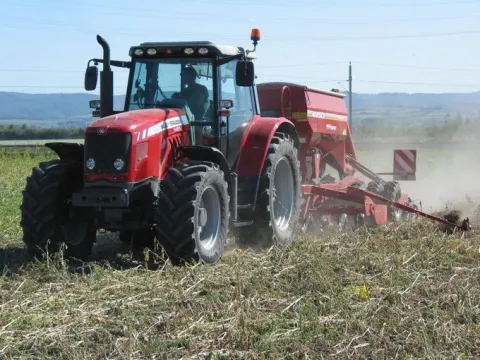
In the framework of a research programme, no tillage field trials have been installed in lower Austria. They showed a significant reduction of runoff, as well as a reduced loss of nutrients. In addition, reduced or no tillage leads to less loss of soil, and an increased content of organic carbon in the soil.
Photo gallery


Overview
Year of issue
2025
Project
NWRM
Implementation status
Ongoing
Contact
Sabine Tutte, ACTeon
Location of the project
The pilot sites are both respectively in Tulln an der Donau and Mistelbach an der Zaya, two munipialities of lower Austria.
Country
Austria
NUTS2 Code
Niederösterreich
Sponge measures implemented in the case study
Minimum tillage
Cover crops
Mulching
Involved partners
| Authority type | Authority name | Authority role | Comments |
|---|---|---|---|
| Other | Lower Austrian State Government | Other | Regulatory frame work as the law on soil protection and the environmental programme ÖPUL (subsidies) |
| — | local communities | Initiation of the measure | Supprot research on alternative soil treatment techniques since less erosion means less maintenance costs for drainage and sewage water systems |
| Farmers | local farmers | Implementation | Soil is their most valuable good. Protection of soil means cost savings for fertilizers and constant yield |
Site Information
Climate Zone
Warm temperate dry
Precipitation
550.00 mm
Temperature (°C)
9.20 °C
Slope range
5-16%
Vegetation class
Agricultural fields, where corn, wheat, barley and sugar beet are grown.
Design and Implementation
Project scale
Micro
Project scale specifications
Limited to pilot sites on fields.
Project area
0,00600000005215406
Size
60.00
Size unit
m2
Basis of design
Testing fields for different soil treating techniques (no tillage, reduced tillage and conventional tillage).
Constraints
Green bridge of volunteer cereals is able to transfer pathogens, with less soil treatment there is a higher risk that there is a higher amount of mykotoxins.
Favourable preconditions
medium-heavy soils, few weeds
Financing
Total cost
119.00 €
Total cost information
These are the "costs for doing work". With direct seeding the farmer saves 37 €/t compared to conventional tillage. When mulchseeding is done in an cooperation savings are 19 €/t and mulchseeding with own machines leads to an saving of 10€/t.
Costs investment
14.00 €
Costs investment information
Biedermann made its economical monitoring for 100 ha agricultural holding with different crops: winter wheat, winter barley, winter canola, corn, sugar beet and cover plants. He calculated the "cost for doing work" that means: salary (12 €/h), variable costs for machines (fuel, maintenance), fixed cost for machines (interest, depletion, assurance) and means of production (fertilizer, herbicides). When tillage is reduced the farmer should consider selling some of his tractors and increase the operating grade of his machines. The seeding machine is very expensive and in the same time a key element. The farmer should consider to buy it either used, to outsource the seeding or to use it in cooperation with other farmers. As an example, the costs are given here for direct seeding of wheat with a corn yield of 6t/ha.
Costs capital
5.00 €
Costs capital information
Salary of the farmer
Costs land acquisition information
Normally no land needs to be purchased
Costs operation maintenance
33.75 €
Costs operation maintenance information
In his calculations, Biedermann considered an additional consumption of herbicides (18 € per ha) and fertilizers (15 kg N/ha í 1,05 €/kg) for direct seeding.
Costs operational
32.00 €
Costs operational information
Variable machine costs
Costs maintenance
68.00 €
Costs maintenance information
Means of production (including the additional consumption of herbicides and fertilizers).
Policy and Governance
Policy description
Reducing tillage in order to decrease erosion, loss of nutrients and pesticides and increase the amount of humus.
Policy targets
Runoff control
Erosion Control
Improved Biodiversity
Part of a wider plan
No
Public consultation
No
Consultation activities
| Activity stage | Activity type | Key issues |
|---|---|---|
| Other | Tillage demonstration events | alternative tillage machines were demonstrated to farmers, sensibilisation for erosion problems |
Has contractual arrangements
No
Impacts and Monitoring
Monitoring System
Monitoring parameters
Quantity of soil eroded, runoff (seasonally), composition of the eroded material, runoff (N, herbicides...).
Impact Assessment Methodology
Performance impact assessment method
Laboratory
Performance impact estimation information
Three different testing fields: direct comparison of no tillage, reduced tillage and conventional tillage.
Socio-economic Impacts
Direct benefits
416
Direct benefits information
Biedermann calculated for corn possible savings of 416 €/ha, which means 43€/t. By reducing tillage, a farm can save up to 10 000 €. When tillage is completely abandoned, savings up to 24 000 € are possible. Reasons for this are: less working hours (5 €/t wheat for salary instead of 14), less fuel consumption (40 l/ha instead of 96), less fixed machine costs. The additional consumption of herbicides and fertilizers is easily compensated and included in the calculations.
Ecosystem impact, reduced energy use
90
Information on ecosystem impact, reduced energy use
90
Biophysical impacts: Hydrology
Information on increased water storage
Depending on the testing site, 16% more in Mistelbach, 56% more in Pixendorf and 95% more in Tulln (close to Pixendorf).
Biophysical impacts: Biodiversity
Improved biodiversity
Yes
Information on improved biodiversity
When no tillage is applied, the number of earthworms is multiplied by 5. The symbiosis between roots and rhizobiaceae is improved as well. Moreover, the plant roots are able to create a more complex horizontal and vertical network.
Increased permanent biomass
500
Information on increased permanent biomass
More earthworms
Biophysical impacts: Water & Soil Quality
Water quality overall improvements
Positive impact-WQ improvement
Information on water quality overall
When tillage is reduced or completely abandoned, the loss of nitrogen and sprayed herbicides decreases.
Water quality improvements - Nitrogen (N)
88.00
Water quality improvements - Nitrogen (N) - Unit
% reduction pf pollutant
Soil quality overall improvements
Positive impact-SQ improvement
Information on soil quality overall improvements
Due to reduced / no tillage, there is less soil loss, more organic carbon in the soil, less CO2 emission and more CH4 uptake in the soil.
Soil quality, overall soil pollution
50.00
Soil quality, overall soil pollution - Unit
% Reduction
Information on soil quality, overall soil pollution
CO2 emission
Information on soil quality, overall soil carbon
32 % more CH4 uptake in the soil.
Soil quality, overall soil nutrients
88.00
Soil quality, overall soil nutrients - Unit
% Reduction
Information on soil quality, overall soil nutrients
Soil loss
Soil quality, overall soil physical properties
84.00
Soil quality, overall soil physical properties - Unit
% Reduction
Information on soil quality, overall soil physical properties
Loss of organic carbon
Ecosystem erosion control
Yes
Ecosystem erosion control impact
88
Information on ecosystem erosion control
Per ha and year
Biophysical impacts: Others
Ecosystem impact climate regulation
Impact on GHGs (net emissions and storage) including soil carbon
Information on ecosystem impact climate regulation
Increase of soil carbon, less CO2 emissions.
Ecosystem impact Green House Gas (GHG) soil carbon
50
Information on ecosystem impact GHG soil carbon
CO2 emission from soil
Ecosystem impact other GHG
32.00
Information on ecosystem impact other GHG
More CH4 uptake
Lessons Learned
Key lessons
Significant reduction of runoff, loss of nutrients, soil and pesticides is possible.
Mulch and direct seeding practices are fully developped and work well in practice.
The economic benefits must not ignore erosion, nutrient and pesticide movement.
Volunteer plants can be a bridge for plant diseases.
Cover crops should be sown immediately after harvesting for building up a green manure.
Cost reduction is possible.
Drivers
| Driver type | Driver role | Comments |
|---|---|---|
| Legal obligations | Main driver | The law of soil protection of Lower Austria encourages reduced tillage practices. |
| Organisation committed to it | Main driver | They are constantly searching for new soil treatment techniques and try to introduce them in agricultural practice. |
| Availability of subsidies | Main driver | Austrian Environmental Programme: Farmers receive the more subsidies the longer they have a green cover on the field. Moreover, mulchseeding and CO2 storage in soil are awarded as maximum soil protection measures. |
Success factors
| Success factor type | Success factor role | Comments |
|---|---|---|
| Attitude of decision makers | Main factor | Support and encouragement for soil protecting agriculture. |
| Attitude of the public | Main factor | Support of innovative techniques. Less erosion means less sediments in villages and drainage systems, and hence less costs for cleaning. |
| Attitude of relevant stakeholders | Main factor | Soil is their most valuable good. As a consequence, there is an interest to conserve soil and limit erosion. |
Sources
Sources