
Summary
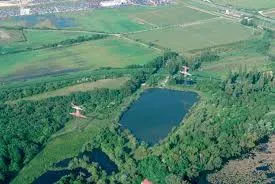
Reconstruction of dams and sluice gates, blocking of drainage ditches and creation of a hydrological network to route water from the Little Carpathians through the Šúr Fen National Nature Reserve (near Svätý Jur), funded by the LIFE programme (LIFE03 NAT/SK/000096). The works were prepared and initiated in 2003–2007 and complemented the intake built in 2001 on the Šúrsky Canal (rkm 10.197), which diverts water into the reserve when canal flow exceeds Q5 (up to ~7.4 m³/s). The Danube Flood Risk Management Plan (2015) describes a system of inverted siphons, canals and an aqueduct enabling year-round supply and water level management inside the fen. Project materials detail the refurbishment of control structures (e.g. on the Blahutov Canal), conversion of a drainage canal to irrigation, and raising water levels in the Čierna Voda to limit peat drawdown; interpretation and a nature trail were also delivered.
Since 2017–2018, management has reintroduced wood-pasture grazing in the Panónsky háj (southern part of the reserve) with local partners. Recent monitoring (2023–2024) reports marked increases in wild bee abundance in restored areas, indicating positive ecological response.
Photo gallery


Overview
Prepare key planning tools: elaborate a Rescue & Management Plan with management prescriptions, and enlarge the reserve (zoning/boundary update).
Rebuild and build water-control works to route Carpathian water through the reserve: reconstruction of dams/sluice gates, blocking drainage ditches, and creation of a hydrological network (incl. inverted siphons, an aqueduct, gates, supply canals and culverts).
Provide year-round water supply to internal habitats by complementing the Šúrsky Canal intake (rkm 10.197), which releases water into the reserve when canal flow exceeds Q5 (technically allowing up to ~7.4 m³/s).
Raise awareness and support acceptance: produce information/education materials, set up an exhibition, and build a nature trail.
| Authority type | Authority name |
|---|---|
| NGO | APOP Association of Indutry and Nature Conservation |
| Local water authority | Municipality of Svaty Jur |
| — | Slovak Water Managemtn enterprise SVP-OZ |
| — | Slovak Land Fund SPF |
| — | State nature Conservancy of the Slovak republic SOP SR |
Site Information
Design and Implementation
Financing
Policy and Governance
| Activity type | Comments |
|---|---|
| Publications | APOP has published postcards, leaflets, stickers and posters arround the municipal information centers |
| Education trail | The main purpose is to show the treasure of the Sur |
Impacts and Monitoring
Monitoring System
entomological survey (Coleoptera) in 2021 assessed effects of grazing, and a Within the reserve’s pasture-forest : an entomological survey (Coleoptera) in 2021 and a 2023 study on ant communities evaluated response to restoration management - tracking species composition, richness and assemblage changes as performance indicators.
Maintenance
Socio-economic Impacts
A marked nature trail (built 2006 under LIFE) provides 4.1 km/6 stops and is explicitly meant to regulate visitation and support field teaching; it’s promoted by the Bratislava Region’s tourism board. Some panels have suffered wear, with plans for renewal.
Traditional livelihoods reintroduced. From 2017, partners restarted cattle grazing in the Panónsky háj with a local farmer (Vladimír Pažitný) - a visible return of a historic silvopastoral practice that also underpins ongoing site management.
Risk reduction for adjacent land. Project materials state the right bank of the Čierna Voda was lowered/strengthened so surplus water would not endanger surrounding parcels - a local safety benefit.
Biophysical impacts: Hydrology
Biophysical impacts: Biodiversity
A conservation bulletin notes more beetle species and significantly more individuals of bark beetles on the grazed site compared with ungrazed reference, indicating a rapid assemblage shift after management restart. Quantitative counts are not provided.
Biophysical impacts: Water & Soil Quality
Biophysical impacts: Others
Lessons Learned
Planning must analyse cross-sector consequences. The case stresses that water decisions affect other economic sectors and that these interactions should be assessed during planning—another stated lesson from the original case documentation.
Stakeholders need to know each other to align concepts and expectations. Early opposition and low acceptance were linked to weak public involvement; the case warns that initiatives without active engagement risk failure.
Technically, piggybacking on existing hydraulic infrastructure and clarifying operations helped. The outlet on the Šúrsky Canal (built 2001) and the LIFE measures (2003–2007) were later described as implemented and operated by the Slovak Water Management Enterprise—showing the value of integrating new works with existing assets and duty holders.
Communication matters. An interpretation trail and brochure were created to channel visitors and build understanding - simple tools that supported awareness and acceptance over time.
Hydrology alone is not enough; long-term habitat management is required. Re-introducing grazing in the Panónsky háj from 2018 onward illustrates how ecological outcomes depend on sustained, locally supported management partnerships.
Monitoring should serve both ecology and spatial development. The EIA recommended a robust groundwater monitoring system to inform decisions on urban expansion; in parallel, hydrometric monitoring of the Šúrsky Canal (water level and temperature) provides operational data for water management.
| Driver type | Driver role |
|---|---|
| Organisation committed to it | Main driver |
| Success factor type | Success factor role | Comments |
|---|---|---|
| Successful coordination between authorities | — | The proposed zoning of the Sur Fen National Nature Reserve and identification of conservation measures in each protected zone and buffer zones provides a solid basis for transparent determination of competencies of public institutions and private landowners as well. |
| — | Main factor | — |