
Summary
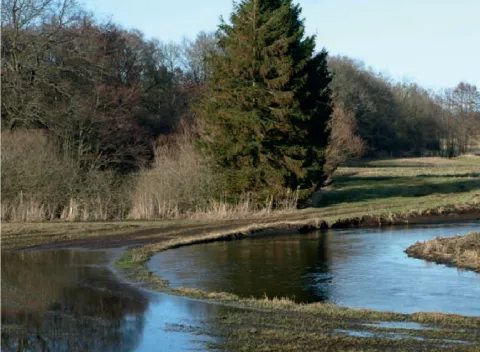
The Odense is a river in southern Denmark. It was channelized and deepened in the late 1940s to improve agriculture. The NWRM consists of a series of measures to restore floodplain connectivity along a 17 km section of the river. The measures will prevent flooding in downstream towns and cities. This will have a number of effects on the pressures relevant for the WFD. Reduced risk for flooding of urban environment reduces the risk for storm overflows from sewers as well as diffuse pollution resulting from flooding in general. Re-meandering reduces the pressure from previous physical alterations for flood protection and agricultural purposes. It will also potentially have a positive effect on ground water recharge in temporarily flooded areas.
Since 2004, ~12 km of Odense River have been remeandered and 350 ha of wetlands restored under LIFE REGAIN. Recent actions include removal of migration barriers, and mussel habitat restoration.
In 2024, two artificial stone reefs (4500 tonnes) were established in Odense Fjord to enhance marine biodiversity. The project was led by SDU in partnership with Odense and Nordfyn municipalities and Aage V. Jensen Naturfond. The reefs aim to improve conditions for fish fry, seagrass, and aquatic invertebrates, and contribute to the ecological recovery of the fjord.
Photo gallery
Overview
Flood control and flood risk mitigation
Biodiversity and gene-pool conservation in riparian areas
| Authority type | Authority name | Authority role | Comments | Authority responsibility |
|---|---|---|---|---|
| Regional / sub-national water authority | Fyn County | Implementation | The former Fyn County actually carried out the project. After the county decommissioning in 2006 the municipality took over. | Responsible |
| Local water authority | Faaborg-Midtfyn Municipality | Implementation | Faaborg-Midtfyn Municipality is the current responsible authority for the project. | Responsible |
Site Information
Design and Implementation
Financing
The whole LIFE REGAIN project had a total eligible budget of 3,852,367 €. The more recent UC LIFE Denmark project (for mussel habitat restoration) has a total eligible budget of 2,077,261 €
Policy and Governance
| Directive | Relevant pressure |
|---|---|
| WFD identified pressure | 4.1.2 Physical alteration for agriculture |
| Floods Directive identified pressure | Natural Exceedance |
| Directive | Relevant impact |
|---|---|
| WFD identified pressure | Altered habitat due to hydrological change |
| Floods Directive identified pressure | Waterbody status |
| Requirement directive |
|---|
| WFD-achievement of good ecological status |
| Floods Directive-mitigating Flood Risk |
| Wider plan type | Wider plan focus | Name | Comments |
|---|---|---|---|
| National | Environment & Biodiversity | National action plan II for the aquatic environment | 1998 plan. The objective was to restore 16.000 ha of wetlands in Denmark to retain nitrogen. The application was finaced by a state program under the Danish Nature Agency. |
| Name | Role | Comments |
|---|---|---|
| Grazing agreements. | Land management based on voluntary agreements. | Signed for ~150 ha. |
Impacts and Monitoring
Monitoring System
Maintenance
Impact Assessment Methodology
Socio-economic Impacts
Biophysical impacts: Hydrology
Biophysical impacts: Biodiversity
Biophysical impacts: Water & Soil Quality
Biophysical impacts: Others
Lessons Learned
| Driver type | Driver role | Comments |
|---|---|---|
| Other | Main driver | The financial support of the Danish Nature Agency through the national plan for the aquatic environment together with the initiative from the former Danish Counties played a cruicial part for enabling the project. |
| Success factor type | Success factor role | Comments |
|---|---|---|
| Specific incentives for stakeholder involvement | Main factor | The "toolbox" offered contained several measures (including land consolidation). The project succeded in establishing voluntary agreements with and among the landowners in this project. |