
Restoration of river Hermance, France

Summary

Summary

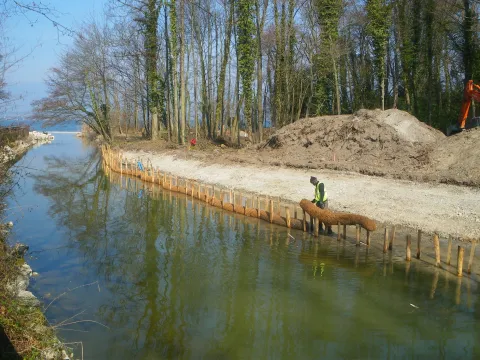
Hermance is a French–Swiss transboundary river. Since 2006, within a cross-border river programme led by SYMASOL with support from the Canton of Geneva, restoration has re-meandered the channel, widened the mouth, renaturalised the bed and banks, replanted riparian vegetation, and used the Mermes marsh as flood-storage via a retention pond ; reducing flood risk for ~100 homes and reconnecting people to their river with a riverside path (opened in 2017). More recent records show the programme extended in phases through 2016–2017, reaching ~3 km of restored river in Veigy-Foncenex, with a total budget reported at €2.5 M (excl. tax). Cross-border works included the 2010 renaturation of the Pont-Neuf–Pont-des-Golettes reach and the 2011 revitalisation of the river mouth. Complementary lacustrine actions created/reinforced reedbeds on the French shore at Chens-sur-Léman (2012, 2016). Flood-risk management was strengthened upstream by a ~12,000 m³ flood-retention basin. Ongoing follow-up includes a 2021 hydrological/hydraulic review of the Hermance dams in Veigy-Foncenex to check performance and safety. Overall, the project combines flood protection, ecological recovery and public amenity at a transboundary scale.

Photo gallery
Overview
Year of issue
2025
Project
NWRM
Implementation status
Completed
Contact
Anaí¯s HANUS, ACTeon
Location of the project
Veigy-Foncenex reach between Pont des Soupirs and Pont de l’Hermance, plus the Lake Geneva delta between Chens-sur-Léman (FR) and Hermance (CH) at the river mouth.
Country
France
NUTS2 Code
Rhône-Alpes
Sponge measures implemented in the case study
Re-meandering
Stream bed re-naturalisation
Natural bank stabilisation
Objectives
The objectives are renaturing 4,4km of artificialised river, improving water retention capacity of a 5ha marshland.
Involved partners
Authority typeAuthority nameAuthority roleComments
Local water authoritySYMASOLImplementationLocal water authority created to manage weter in the concerned watershed and impelement the River contract
——Monitoring—
OtherCanton de Genève DIAEFinancingswiss Canton of Geneva
Site Information
Climate Zone
Cool temperate moist
Precipitation
1150.00 mm
Temperature (°C)
10.00 °C
Elevation range
441 m
Vegetation class
Agricultural land and forests along much of the corridor; extensive reedbeds (roselières) on the Chens-sur-Léman lakeshore between Hermance and Port-de-Tougues; riparian woodland near the mouth.
WFD Ecological status
Poor
WFD Chemical status
Good
Water quality status
Historic sewage discharges and misconnected wastewater, diffuse agri pollution, low summer flows; past chlorination at Hermance STEP sterilized the lower reach. STPs at Hermance (CH) & Veigy (FR) were later removed.
Design and Implementation
Project scale
Meso
Project scale specifications
Multi-kilometre river reach across communes and a transboundary delta; basin-level retention basins; coordinated via a cross-border River Contract rather than a single site.
Project area
4320
Area subject to Land use change or Management/Practice change (ha)
7.50 ha
Size
13.50
Size unit
km
Principles
Multifunctionality: flood-risk reduction, ecological restoration, public access (pathways).
Give room to the river: widening, re-meandering/renaturalization, bank softening, fish passage.
Storage/retention: two flood-retention basins upstream, incl. a ~12,000 m³ basin formed by an earthen barrage; additional structure at Marais des Mermes. (Return period not specified in accessible docs.)
Constraints
Biophysical: low gradients and historical canalization; wetlands (Mermes, etc.); lake-delta dynamics; summer low flows; space constraints in urban sections; utilities relocations.
Constraints: very fragmented land tenure (~65 riparian owners); lengthy land negotiations.
Favourable: presence of marshes enabling retention; available widening room in some reaches.
Favourable preconditions
Areas relevant to retain water have been identified; the Mermes marshland appeared as an interesting retention place.
Financing
Total cost
1831600.00 €
Costs investment
357800.00 €
Costs investment information
343800€ have financed the creation of retention areas along the Hermance river
Costs land acquisition
64000.00
Costs land acquisition unit
€ (total value)
Costs operation maintenance
237300.00 €
Costs operation maintenance information
About 96000€ have been spent for restoring the banks of the Hermance river and 1000800€ have been spentto restore and renature the riverbed. 134331€ have been spent for widenning a discharge section. 5128€ have been spent for implementing grass buffer strips in the vineyards above the river, 10 000e/year are spent on haying in retention ponds.
Costs operational
211300.00 €
Costs operational information
About 96000€ have been spent for restoring the banks of the Hermance river (9,63€/m), corresponding to about 16 000€/year during six years. 166800€ have been spent per year during six years to restore and renature the riverbed. 134331€ have been spent for widenning an discharging section, that is to say 22400€ per year. About 100€/year have been spent on supporting grass buffer implementation in the vineyards above the river
Costs maintenance
26000.00 €
Costs maintenance information
About 96000€ have been spent to manage the newly planted vegetation along the Hermance riverbanks. Moreover, haying in retention ponds require about 10 000€/year.
Information on Economic costs - income loss
Famers have received indemnisations for yield losses
Financing authorities
Authority nameType of fundingFinancing share
Agence de l'EauSub-national funds97 %
Conseil régional rhône AlpesSub-national funds97 %
conseil général Haute SavoieSub-national funds97 %
SYMASOLLocal funds97 %
Canton of GenevaLocal funds97 %
Thonon municipalityLocal funds97 %
European UnionEU-funds: Rural development funds3 %
European UnionEU-funds: Cohesion and regional development funds3 %
Compensations annual
2500.00 €
Compensations annual information
About 14000€ have been received by farmers for income losses
Compensations number of beneficiaries
3.00
Compensations number of beneficiaries information
Farmers
Policy and Governance
Policy description
Implemented under the Transboundary River Contract “Sud-Ouest Lémanique” (2006–2012) led by SYMASOL, with the Canton of Geneva as a key partner. Aimed to reduce downstream flood risk, address morphological degradation and water-quality issues, and restore public river access; aligned with SDAGE Rhône-Méditerranée. Geneva reports the Hermance mouth among embouchures renatured (2011).
Land ownership
Mixed. The river corridor crosses many private parcels (formal agreements signed). Works at the mouth involved public/communal areas near Chens-sur-Léman; cross-border stretch includes cantonal/public domains on the Swiss side.
Policy targets
Peak-flow reduction
Increase Water Storage
Erosion Control
Improved Biodiversity
Oher Societal Benefits
Target remarks
Renature ~4.4 km of artificialized channel; enhance retention capacity of ~5 ha marshland; reduce flood risk for ~100 houses; re-meander/renaturalize ~2.3 km; widen the mouth; plant riparian vegetation.
Part of a wider plan
Yes
Wider plan
Wider plan typeWider plan focusNameComments
LocalWaterContrat de rivière transfrontalier Sud Ouest LémaniqueThe plan defines water maagement strategy on rivers located in a watershed
RegionalWaterSDAGE Rhône MéditerranéeThe SDAGE defines the main objectives and strategies necessary to reach the good status for water bodies in 2021
Public consultation
Yes
Consultation activities
Activity stageActivity type
Design phaseInformation letters
Screening phasePrivate interviews
Screening phasePublic meeting
Implementation phasePublic meeting
Has contractual arrangements
Yes
Contractual arrangements
Arrangement typeNameComments
Contractual agreementContracts with private ownersContractual arrangements have been signed with private owners about banks management
Impacts and Monitoring

Monitoring System

Monitoring parameters
Water quality (pesticides, nitrogen and metals) is monitored. Water flow and ecological quality are measured punctually.
Upstream station
A monitoring station was built in 2024, in order to follow flow rate and water quality.
Downstream station
HER 379 and HER380

Impact Assessment Methodology

Performance impact assessment method
Catchment outlet
Performance impact estimation information
Comparison to the state before the implementation of the measure

Socio-economic Impacts

Direct benefits information
The main benefit is social: people walk along the river and walkaways enable them to link the two sides of the city. People seem to make again the river their own and to became more aware of river management issues.

Biophysical impacts: Hydrology

Information on retained water
Flood: storage basins (incl. ~12,000 m³) and marsh restoration reduce peak flows; Geneva reports households/school moved out of medium-danger zone at Hermance.
Hydromorphology: widened mouth restored partial alluvial dynamics; re-meandering/bed diversifications increased habitat heterogeneity.
Connectivity & low flows: fish passage improved; marshes support baseflow during drought periods.

Biophysical impacts: Biodiversity

Improved biodiversity
Yes
Information on improved biodiversity
The river renaturation, banks restoration and riverbed works have benefited to natural habitats; fish population status have improved along the river: it passed from disturbed to excellent in one station, and to good in another one, between 2002 and 2011. Moreover, new plants can now be observed along the river.

10 years after the restoration work, if a clear return of fauna and flora has been observed, there is still no population of fish of fishing interest; further waiting is required.

Biophysical impacts: Water & Soil Quality

Water quality overall improvements
Negative impact-WQ deterioration
Information on water quality overall
Water quality has decreased during the implementation of the measure, but his can be linked to other factors (pressures...). Only hydrobiological quality (downstream) and metals (mouth) have stayed at the same level.
Soil quality overall improvements
Not relevant for this application
Ecosystem erosion control
Yes

Biophysical impacts: Others

Ecosystem impact climate regulation
No information available
Lessons Learned
Key lessons
The case study provides an example of a bundle of measures which can be implemented to achieve several purposes; it does not gives much facts on biophysical impacts but provides interesting elements about succes and barrier factors; in this case as in many others, dealing with private owners in order to implement the measures on their properties have been the main difficulty.

Barriers
Barrier typeBarrier roleComments
Attitude of relevant stakeholdersMain barrierThe main barrier has been dealing with land property; private owners were not ready to give away constructible lands and even in the case of existing regulations, they would not take away their fences. Negociations with private owners had to be done.
Attitude of the publicSecondary barrierAt the beginning of the project, people were not convinced; after several achievements, they understand better.
OtherSecondary barrierThe property issue has been considered to late; it needs to be anticipated.
Limited staff and consultant knowledgeSecondary barrierThe design consultant was not aware of the local context in terms of vegetation for instance; it proposed to plant trees which were not adapted to the local climate
Drivers
Driver typeDriver roleComments
Balancing different objectivesMain driverLocal authorities decided to deal with their rivers management after some studies that showed the pressure of urbanisation and the need to restore water quality. They made a first preliminary dossier that led them to implement a River contract and create the SYMASOL.
Legal obligationsSecondary driverObjectives fixed by the SDAGE asked for implementing a management strategy
Success factors
Success factor typeSuccess factor roleComments
Successful coordination between authoritiesMain factorcoordination between stakeholders, particularly in a transboundary watershed, was essentiel to guarantee the success of the implementation
Financing possibilitiesMain factorExisting financing posibilities, including one from Geneva Canton, was a main succes factor
OtherMain factorContractors change for the different works; the SYMASOL considers that it is a good thing
Transferability
Highly transferable to small cross-border or peri-urban rivers, but expect protracted land negotiations, multi-jurisdictional permitting, and the need to couple morphology with wastewater fixes and wetland management; plan O&M for created retention areas.
Sources