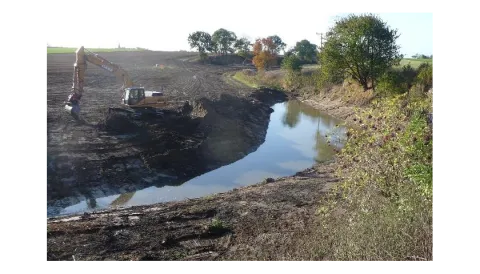
Tullstorpsån rural development project in Sweden

Summary

Summary

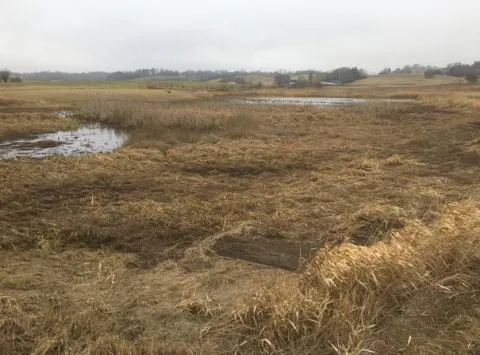
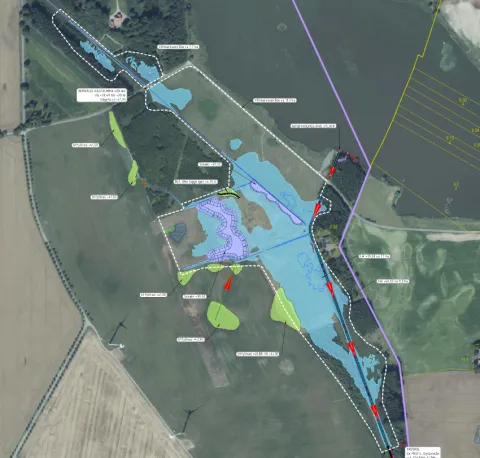
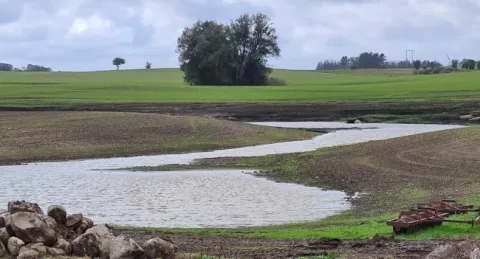
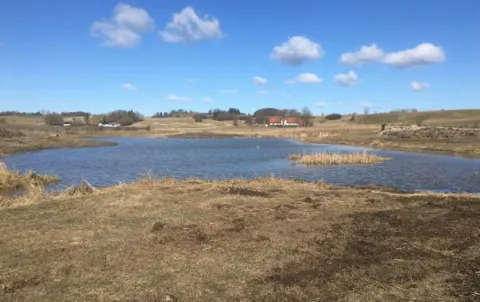
The Tullstorpsån Rural Development Project is a long-term, landowner-driven initiative implementing multiple Natural Water Retention Measures to improve aquatic and terrestrial biodiversity, retain nutrients, and enhance recreation. Since 2009, the project has restored over 25 km of river channel and created or restored more than 50 wetlands (> 200 ha), combined with riparian vegetation planting and riverbed re-meandering. These measures, supported by local landowners, regional authorities and consultants, have reduced nitrogen loads by about 30 % and phosphorus by about 50 %, improved the ecological status of the stream, and increased fish and bird populations.

Recent developments under “Tullstorp Stream 2.0” focus on multifunctional wetlands for both nutrient retention and water storage, enabling irrigation during dry periods. Since 2021, the project has also piloted large-scale controlled drainage systems (48 ha) to further reduce nutrient leakage while supporting crop yields. Continuous monitoring of water quality, hydrology, and biodiversity underpins adaptive management and knowledge transfer across the Baltic Sea region.

Photo gallery
Overview
Year of issue
2025
Project
NWRM
Implementation status
Ongoing
Contact
Martyn Futter SLU
Location of the project
Tullstorpsån is a river in Skåne, southern Sweden. The 30km long river drains a 57400 ha catchment. Land use is predominantly agricultural.
Country
Sweden
NUTS2 Code
Sydsverige
Sponge measures implemented in the case study
Re-meandering
Buffer strips and hedges
Wetland restoration and management
Stream bed re-naturalisation
Forest riparian buffers
Controlled Drainage
Objectives
The goal of the project was to reduce loading of nutrients from the catchment to the Baltic Sea with a target of 30% reduction in N loads and 50% reduction in P loads without reducing the economic value and returns for farmers and other property owners.
Involved partners
Authority typeAuthority nameAuthority roleCommentsAuthority responsibility
Private property ownersTullstorpsån Economic Association (TSEA)Initiation of the measureLandowner-led association responsible for planning, coordination, stakeholder engagement, and on-the-ground implementation. Also oversees maintenance and monitoring in cooperation with partners.Responsible
Local water authorityTrelleborg MunicipalityOtherPromoted Tullstorpsån as part of sustainability project “Kretsloppet” and hired a project managerSupporting
National water authoritySwedish Board of Agriculture (Jordbruksverket)FinancingProvide grants (e.g., LOVA) for nutrient reduction measures.Supporting
OtherEuropean UnionFinancing—Supporting
Architects / EngineersNaturvårdsingenjörerna ABDetermination of design details of the measureProvides engineering designs, environmental assessments, and technical guidance for wetland construction, channel restoration, and controlled drainage.Supporting
Regional / sub-national water authorityCounty Administrative Board of SkåneOtherRegulatory oversight & permitting. Issues necessary permits and supports alignment with regional water management objectivesSupporting
National water authoritySwedish Agency for Marine and Water Management (HaV)FinancingProvide grants (e.g., LOVA) for nutrient reduction measures.Supporting
OtherBaltic Sea Action Plan Fund (NEFCO & Nordic Investment Bank)FinancingSupported the prestudy and implementation of controlled drainage systems.Supporting
Site Information
Climate Zone
Cool temperate moist
Temperature (°C)
6.00 °C
Runoff coefficient
0.50
Elevation range
49
Slope range
1-2%
Soil type
Cambisols
Vegetation class
The catchment is ~85% agricultural land (arable with some pasture/meadow). For vegetation class, this corresponds primarily to cropland with managed grass/pasture in parts of the riparian/wetland network.
WFD Ecological status
Moderate
WFD Chemical status
Failing to achieve good
Water quality status
The main water quality pressures are high nutrient loads, particularly nitrogen and phosphorus from intensive agriculture, leading to eutrophication and moderate ecological status, with additional signs of organic pollution.
Design and Implementation
Project scale
Meso
Project scale specifications
It covers the Tullstorpsån catchment in southern Sweden and implements coordinated measures along the main river and its tributaries. Actions span multiple municipalities and involve catchment-wide planning, wetland creation, and channel restoration, making it regional in scope but not at national scale.
Project area
57400 ha
Project area specifications
Measures were applied throughout the catchment, which has a total area of 57400 ha. Key activities included remeandering of the stream channel, which had been shortened by approximately 300m over the past 200 years, and restoration of wetlands, of which more than 85% had been lost during more intensive agricultural production.
Principles
The design of this application was conducted in close collaboration with local landowners and other stakeholders. The involvement of the 90 landowners in the planning and implementation of the measures at Tullstorpsån was a unique factor contributing to the success of the project.
Factor constraints
The main factor influencing the selection and design of measures in the catchment was land owner support for the project. Measures were designed which restored the natural water holding capacity of the landscape. Measures were not designed for their water retention function per se, but for their contribution to nutrient retention, biodiversity and amenity values.
Financing
Total cost
1300000.00 €
Financing authorities
Authority nameType of fundingComments
European UnionEU-funds: Rural development fundsEU funds, not clear as to which funding source
Swedish StateNational fundsSwedish Board of Agriculture (Jordbruksverket) and Swedish Agency for Marine and Water Management (HaV) via LOVA grants and Rural Development Programme funds.
Baltic Sea Action Plan FundPrivate fundsBaltic Sea Action Plan Fund (managed by NEFCO and Nordic Investment Bank) financed the prestudy and construction of controlled drainage systems.
Municipality of TrelleborgLocal funds—
County Administrative Board of Skåne.Local funds—
Compensations
Yes
Compensations basis information
According to project documentation, landowners who host wetlands or restored river stretches receive financial compensation for the loss of productive land. This is typically covered through Swedish agri-environmental support schemes (e.g., LOVA grants, rural development programme funds) and project-specific agreements managed by the Tullstorp Stream Economic Association.
Policy and Governance
Policy description
The altered hydrological regime in Tullstorpån has negative effects on biodiversity and nutrient fluxes to the Baltic. Restoring the natural hydrologic behavior of the catchment will contribute to alleviating these effects.
Land ownership
Most of the land in the Tullstorpsån catchment is privately owned by farmers. Participation in the project is voluntary, with landowners agreeing to host measures such as wetlands or re-meandered channels.
Policy targets
Pollutants Removal
Improved Biodiversity
Oher Societal Benefits
Increase Water Storage
Policy pressure
DirectiveRelevant pressure
WFD identified pressure2.2 Diffuse Agricultural
WFD identified pressure4.1.2 Physical alteration of channel/bed/riparian area/shore of water body for agriculture
Other EUHabitats directive
Policy impact
DirectiveRelevant impact
WFD identified pressureNutrient Pollution
WFD identified pressureAltered habitats due to morphological change
Requirement directive
Requirement directiveSpecification
WFD-achievement of good chemical statusReduction in N and P export
WFD-achievement of good ecological statusHabitat restoration
Policy challenges requirements
The overall goal of the project was for the farming community and responsible authorities to work together to develop, test and implement solutions and actions that will provide as large as possible a reduction in flows of agricultural nutrients from the catchment to the sea.
Part of a wider plan
No
Public consultation
No
Has contractual arrangements
No
Impacts and Monitoring

Monitoring System

Monitoring requirements
Monitoring is led by TSEA under national protocols, tracking nutrient levels, flow, and ecological indicators.
Monitoring parameters
The project undertakes long-term, systematic monitoring of water chemistry (total nitrogen, total phosphorus, sometimes nitrate and ammonium), water flow/discharge, and biological indicators such as benthic invertebrates, diatoms, and fish populations. Water quality sampling points are located along the main channel and in key wetlands to measure nutrient loads entering and leaving the system. Biological surveys follow Swedish environmental monitoring standards, allowing classification of ecological status (e.g. “moderate” for recent years). In the 2.0 phase, monitoring also extends to controlled drainage systems to evaluate their effect on nutrient leakage and water storage.

Maintenance

Maintenance requirements
The measures have been designed to be maintenance-free, but TSEA and local partners keep vegetation, hydraulic connections, and structures in working order.

Socio-economic Impacts

Benefits and co-benefits
One of the key benefits of this project is a raised societal awareness of the importance of water bodies in the southern Swedish agricultural landscape, and the importance of local stakeholder involvement in their management.
Direct benefits information
not specified
Ancillary benefits information
improved social welfare asociated with amenity ecosystem services

Biophysical impacts: Hydrology

Information on retained water
Installation of 48 ha of controlled drainage systems (2022) allows temporary water storage in the field drains, reducing peak runoff and nutrient losses.
Information on runoff reduction
Modelling studies suggest that the construction of wetlands can help to mitigate peak flows and sustain low flows.
Information on Restoring hydraulic connection
There have been qualitative improvements in river connectivity. Creation/restoration of >50 wetlands (> 200 ha) and 25 km of re-meandered channel increases water retention capacity in the catchment.

Biophysical impacts: Biodiversity

Information on improved biodiversity
The VIX fish status index improved in most stretches of the river between 2009 and 2013. Significant increases in fish populations, notably brown trout, linked to restored habitats and improved channel structure.
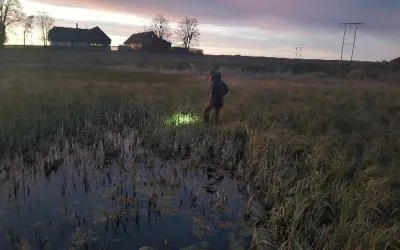
Bird diversity and abundance have increased around wetlands; several new species recorded in the catchment.
Re-meandering and riparian vegetation planting have enhanced habitat heterogeneity for aquatic invertebrates and plants.

Biophysical impacts: Water & Soil Quality

Water quality overall improvements
Positive impact-WQ improvement
Information on water quality overall
Average total phosphorus and inorganic nitrogen concentrations showed slight declines between 2009 and 2012. Long-term monitoring shows ~30 % reduction in nitrogen and ~50 % reduction in phosphorus loads at the catchment scale.
Despite nutrient load reductions, ecological status remains “moderate” (based on diatom index), with persistent high nutrient enrichment and signs of organic pollution.
Wetlands and vegetated riparian zones also trap sediments, improving water clarity locally (qualitative observation in project reports).
Water quality improvements - Phosphorus (P)
50.00
Water quality improvements - Phosphorus (P) - Unit
% reduction pf pollutant
Water quality improvements - Nitrogen (N)
30.00
Water quality improvements - Nitrogen (N) - Unit
% reduction pf pollutant

Biophysical impacts: Others

Information on ecosystem impact climate regulation
not specified
Lessons Learned
Key lessons
One key lesson from the Tullstorpsån project is that a landowner-driven approach can greatly accelerate implementation and acceptance of measures. By giving farmers a leading role through the Tullstorp Stream Economic Association, the project built trust, ensured voluntary participation, and aligned environmental goals with agricultural interests. Riparian land owners, farmers and other stakeholders must be involved in the decision making process if measures aimed at restoring the natural water retention capacity of agricultural landscapes are to be successful.

Another lesson is the value of multifunctionality. Designing wetlands not only for nutrient retention but also for water storage and irrigation has increased their relevance to farmers, especially under changing climate conditions. This has strengthened local engagement and broadened the benefits beyond biodiversity alone.

The project also shows the importance of long-term monitoring and adaptive management. Continuous data collection on water quality, hydrology, and biodiversity has provided evidence of successes and areas needing improvement, such as the persistent high nutrient levels despite significant load reductions. This information is essential for refining measures and justifying ongoing investment.

Finally, Tullstorpsån demonstrates the benefits of diversified funding and partnerships. Combining national grants, municipal support, and international funding sources like the Baltic Sea Action Plan Fund has allowed the project to evolve from initial restoration into innovative measures such as controlled drainage. The mix of technical expertise, local knowledge, and sustained financial backing has been critical to its resilience and scalability.
Drivers
Driver typeDriver roleComments
Legal obligationsSecondary driverWFD and Baltic Sea nutrient reduction commitments
Organisation committed to itMain driver—
Success factors
Success factor typeSuccess factor roleComments
Attitude of decision makersMain factorgovernance framework supported discussion and consensus
Attitude of the publicMain factorCommitment of the local farmers and riparian land owners. 
Attitude of relevant stakeholdersMain factorinvolving landowners, farmers and other businesses was key to success
Cost effectiveness
As “traditional/structural” measures cannot achieve the goals of the measures implemented at Tullstorpsån, these measures must be seen as being more cost-effective.
Flexibility / Adaptability
While it seems self-evident that the success of these measures are very dependent on the biophysical regime in which they are implemented, the social environment is even more important.
The Tullstorpsån project has shown that land conversion to restore the natural water retention capacity of the landscape can succeed when farmers and other land owners play an active role in the decision making process and feel a sense of ownership of the project.
Transferability
The Tullstorpsån approach is highly transferable to other agricultural catchments if strong local leadership, stakeholder trust, and diversified funding are in place. Success depends on aligning environmental goals with farmers’ interests, offering fair compensation, and ensuring long-term monitoring. Care is needed to adapt designs to local hydrology, land use, and nutrient pressures, and to secure sustained engagement beyond initial implementation.
Sources