
Summary
The short term project objectives were to create 250 ha of wetland by raising the water level of the embanked area with a regulating water outlet structure, creation of a variety of habitats -from dry land to spots with deep water- by digging and opening up of old river meanders that had been filled up.
The project is a good experience in the field of ecological restoration, involving purchase of land, participatory planning and co-operation with other organizations, including NGO’s.
The project also had long term objectives related to the creation of a network of wetlands, integration and nature and water policies, the implementation of European directives and the strengthening environmental NGOs and education. The project was implemented by a Romanian regional water authority with the support of Dutch partners.
The Ciobarciu project was evaluated at the end of the project by the project team and by a Romanian University, who interviewed 55 inhabitants of villages where the (previous) owners lived. After a period of five years, the project was evaluated again.
Photo gallery
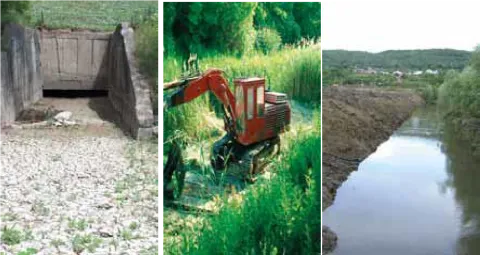
Overview
Restore flow connectivity to the Old Jijia and reconnect floodplain habitats; works length noted as ~5,500 m in project summaries.
Design parameters included ponds with ~0.5–1 m water depth in two units and staged drawdown over summer; one unit can receive Prut water during floods.
Long-term aims: build a network of wetlands, integrate nature & water policies, support EU Birds/Habitats/WFD implementation, and strengthen NGO/education roles.
| Authority type | Authority name | Authority role | Comments | Authority responsibility |
|---|---|---|---|---|
| Regional / sub-national water authority | Apele Romane (Prut Directorate) | Implementation | — | Responsible |
| Research institute / University | Institute for Inland Water Management and Waste Water Treatment (RIZA) | Monitoring | national institue | Supporting |
| Regional / sub-national water authority | Regional Water Board Hunze and Aa†™s | — | — | — |
| NGO | Het Drentse Landschap (NGO for nature management) | Other | — | Responsible |
Site Information
Design and Implementation
Social conditions, including the acceptance of the project by the people and authorities in the area and the willingness of the about 425 landowners to sell their land.
buildings and the decline of agriculture. Plus it had a low economic value.
Financing
2) development Restoration Plan Ciobarciu wetland (evaluation of the land in the project area; inventory of landowners and agreement, acquisition of land, field works: channel 1, breach in the dikes between comparts 1 and II and II and III);
3) stakeholder involvement, communication and participation at village level as well as at county level and beyond
Policy and Governance
In order to prevent flooding and to extend agricultural surfaces, the common floodplain of Prut and Jijia was embanked. Jijia river course was deviated by digging a channel to the Prut at Chiperesti. The last 56 km of the Jijia River (Old Jijia), which is parallel to the Prut, has been cut-off and it can be supplied with water from the Jijia by the hydrotechnical knot at Chiperesti when needed. Otherwise, the old Jijia is only supplied from its own river basin by four small tributaries with intermittent flow. In the floodplain an irrigation and drainage system has been developed, which, however, was never finished completely. In the same area two fishing ponds were built which now have been abandoned for financial reasons (Osoi and Gorban fishing ponds). The land from the floodplain was intensively used as cropland. Starting with the political changes from 1989, the agricultural activity in this area has been reduced pastures took the place of the crops. The irrigation system was no longer in use and the drainage system worked only partially. Agriculture in this former wetland area now suffers from lack of water and locally the soil is getting brackish.
| Directive | Relevant pressure |
|---|---|
| WFD identified pressure | 4.1.2 Physical alteration of channel/bed/riparian area/shore of water body for agriculture |
| WFD identified pressure | 4.2.2 Dams, barriers and locks for flood protection |
| Floods Directive identified pressure | Natural Exceedence |
| Directive | Relevant impact |
|---|---|
| WFD identified pressure | Altered habitats due to morphological changes |
| WFD identified pressure | Altered habitats due to hydrological changes |
| Floods Directive identified pressure | Waterbody status |
| Requirement directive | Specification |
|---|---|
| WFD-achievement of good ecological status | Mitigation of physical/hydrological alterations and flow diversions of the river |
| Floods Directive-mitigating Flood Risk | Room for the Rivers |
| The Birds and Habitat Directives | Habitats Directive and Bird’s Directive |
| Wider plan type | Wider plan focus | Name | Comments |
|---|---|---|---|
| Catchment-based | Water | A œstring of pearls a concept for ecological restoration | and Environment and Biodiversity |
| Activity stage | Activity type | Key issues | Comments |
|---|---|---|---|
| — | Setting up of an Advisory Committe | 7 members | there was 1 meeting, following which Romanian project team fowund that working bilaterally with the committee members was more effective |
| Implementation phase | Personal visits to the landowners | information on the benefits of the restoration and agreement on land purchase | 400+ |
| Other | Information to the local people (meetings with villagers, posters, articles, media campaign, colouring contest in the school) | — | Design of the area, implementation of the plan and management of the area |
| Name |
|---|
| Memorandum of Understanding (MoU) between the governments of Romania and the Netherlands (renewed in 2000) |
| MOU ecological reconstruction signed: - County council - Environmental Prot. Insp. - Romanian Waters - Romanian Ornithological Soc. - Romanian Scouts |
| Agreement with almost all land owners for selling the land (12 oppose) |
Impacts and Monitoring
Monitoring System
“water regime monitoring” and “water quality” monitoring are implemented.
Maintenance
Impact Assessment Methodology
Socio-economic Impacts
Increased possibility of non-comercial fishing Increased possibilities for horticulture along the Old Jijia Increased natural values (more birds and animals) Increased underground water.
Increased tourism, leading to potential economical benefits originating from the interest of investors
Biophysical impacts: Hydrology
Biophysical impacts: Biodiversity
1 year after the flooding :
During field observations different aquatic and terrestrial invertebrates groups, amphibians, reptiles and some small mammals were observed.
Birds : 105 species recorded in 2007–2008, including 29 Annex I Birds Directive and 19 in the Romanian Red Book; site used heavily during migration, with initial breeding noted for several waterbirds/terns.
Fishes : 8 fish species observed about one year after flooding.
Negative episode (2008). The water-level drop from outlet failure disrupted the 2008 breeding season; caused the wetland to nearly dry, with severe impacts on birds.
Biophysical impacts: Others
Lessons Learned
Where land purchase is unavoidable, map ownership early and plan time and budget for transactions. Ciobarciu mixed purchases with long leases; this reduced conflict but added administrative complexity that needs managing from the outset.
Increased water availability is a tangible livelihood gain. Continuous flow in the Old Jijia enabled kitchen-garden irrigation (and even some larger parcels), livestock watering, non-commercial fishing, and reed use—benefits that help keep local support.
The functional wetland strengthened an international migratory route for waterbirds. Monitoring confirmed high bird richness soon after flooding, but also showed sensitivity to water-level fluctuations—success depends on stable spring–early summer levels.
Operations and maintenance are critical. The 2008 drawdown caused by an outlet malfunction disrupted the breeding season; clear operating rules, reliable structures, and seasonal targets (keeping adequate water through at least May–mid-July) are essential.
Monitoring should be built in and shared. Universities in Iași joined planning, monitoring, and evaluation, creating local capacity and a feedback loop for adaptive management (birds, water regime, water quality).
The project contributed to the development and implementation of sound nature and water policy. Embedding the site within wider Jijia floodplain planning and protected-area frameworks helps sustain outcomes and facilitates future reconnection works.
Financing remains a constraint. Even strong early results can stall without long-term budgets for O&M, monitoring, and follow-up works; replication requires predictable funding and institutional commitment.
| Driver type | Driver role | Comments |
|---|---|---|
| Balancing different objectives | Main driver | To develop ecological restoration measures which can lead to a win-win situation, profitable not only for nature, but also for the population in the area and what is socially acceptable |
| Success factor type | Success factor role | Comments |
|---|---|---|
| Financing possibilities | Main factor | Without funding from the PIN-MATRA program. the project would have been financially not feasible. If no subsidy would have been received, Apele Romane would have tried to restore water flow in the Old Jijia, but the Costuleni Wetland Project would have not been carried out.Situation after 5 years showed that there were no funds for creating other wetlands. |
| Attitude of decision makers | Main factor | The mayors have been very much involved, both in the meetings and also in bilateral visits. They also participated in the Advisory Committee meeting. |
| Public participation | Main factor | local people have been invovled in different ways and at different stages |
| Existing staff and consultant knowledge | Secondary factor | personal motivation and dedication of all the team members contributed to the success |
| Communication activities | Secondary factor | — |
Conditions :
Technical conditions (e.g. availability of water for the wetland),
Social conditions (acceptance of the project by the people and the authorities);
Organisation conditions (willingness of authorities, sufficient capacity available for implementation, an organization capable to manage the wetland in the future)
Financial conditions (for the purchase of land, planning of the project and implementation of the works)