
Mulching as best management practice to reduce surface runoff and erosion in steep clayey olive groves in Locri, Southern Italy
Résumé
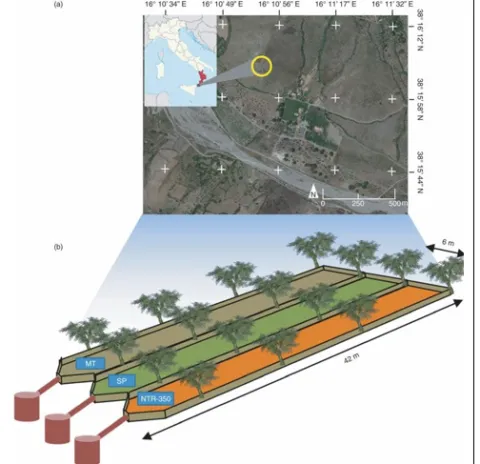
This study assessed saturated hydraulic conductivity (Ksat), surface runoff (SR) and soil erosion (SL) under rainfed conditions, at plot scale, over two years, under four different management practices: total soil cover with netting (SP), mechanical tillage (MT) and mulching with plant residues at doses of 3.5-10³ and 17.5-10³ kg ha-¹ of dry matter (NTR350 and NTR1750), in an olive grove in Calabria (Southern Italy). Overall, the results quantified the impact of mulching with pruning residues, applied at different doses, providing useful guidelines to control and mitigate the hydrological response of clay and sloping soils in Mediterranean olive groves, analysing the environmental benefits and associated economics.
Hypothesis – that not working the soil and mulching with pruning residues can significantly reduce runoff and water erosion and improve soil properties compared to conventional tillage – has been confirmed.
Photo gallery


Vue d'ensemble
| Authority type | Authority name | Authority responsibility |
|---|---|---|
| National water authority | Government agencies | Responsible |
Site Information
Design and Implementation
• SP (full cover with netting)
• MT (mechanical tillage)
• NTR350 (mulch at 3.5 t/ha)
• NTR1750 (mulch at 17.5 t/ha)
Key sponge measures included the use of locally available olive pruning residues as mulch. Soil infiltration was enhanced and runoff reduced, especially under NTR1750.
• Slope and high clay content were constraints
• Favourable conditions: available mulch, structured experimental plot, consistent rainfall patterns
Favourable conditions: Sufficient pruning residues and simple plot access
Financing
Policy and Governance
When olive growing is practised on soils with a high clay content, runoff and erosion rates can become unsustainable.
To reduce erosion and improve the water retention capacity and physical properties of soils in olive groves, less impactful agricultural practices such as cover crops or mulching with pruning residues can be successful.
These alternative management methods are inspired by the paradigm of conservation agriculture, a system of principles and practices that can integrate sustainability into the agricultural production system to protect soil, water quality and biological resources.
water quality and biological resources.
Impacts and Monitoring
Monitoring System
Runoff and soil loss measured directly post-rainfall
Saturated hydraulic conductivity measured with double-ring infiltrometer
Lab analysis of soil and water samples
Maintenance
Impact Assessment Methodology
Socio-economic Impacts
Low-tech implementation
Biophysical impacts: Hydrology
Enhanced soil moisture retention.
Biophysical impacts: Biodiversity
Biophysical impacts: Water & Soil Quality
This practice has significantly improved water infiltration and soil organic matter (OM) content. The average organic matter content of the soil was:
• 2.01% for NTR1750,
• 1.69% for NTR350,
• 1.34% for SP,
• 0.82% for MT.
Lessons Learned
However, one question remains open: the evaluation of the maximum slope length beyond which pruning residues retain their efficacy against
erosion, before being swept away by concentrated runoff downstream.
Future studies may answer this question, preferably conducted on clay olive groves with different slope profiles and with varying mulching doses and frequencies, in order to identify the optimal doses, using only the pruning residues produced within the olive grove, without resorting to external sources.
| Driver type | Driver role | Comments |
|---|---|---|
| Other | Main driver | Climate change in terms of increasing rainfall magnitude |
| Success factor type | Success factor role | Comments |
|---|---|---|
| Other | Main factor | Availability of pruning and mowing residues from the grass layer |
Requires slope-length adaptation to avoid runoff concentration