
Résumé
Summary
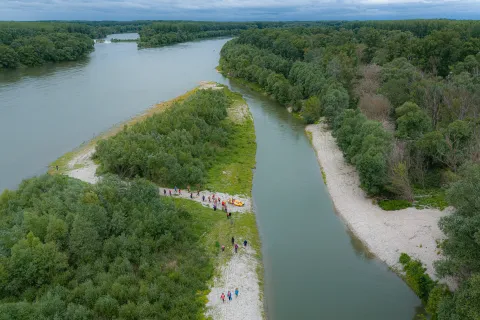
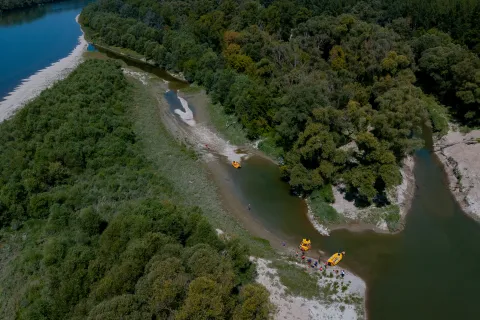
The Foki side arm is a historic Danube branch in the Inland Delta about 40 km from Bratislava. Sediment accumulation reduced water flow and disconnected it from the river. The pilot restored 350 m of the branch by removing sediments to improve water circulation and support floodplain ecosystem stability.
Photo gallery

Vue d'ensemble
Year of issue
2026
Project
NWRM
Implementation status
Completed
Location of the project
Gabčíkovo, Slovak-Hungarian Border
Country
Slovakia
NUTS2 Code
Západné Slovensko
Sponge measures implemented in the case study
Floodplain restoration and management
Restoration of natural infiltration to groundwater
Involved partners
| Authority type | Authority name | Authority role | Comments | Authority responsibility |
|---|---|---|---|---|
| NGO | WWF Slovakia | Implementation | WWF Slovakia was in charge of the implementation. | Responsible |
| National water authority | Water Reserach Institute | Determination of design details of the measure | Water Reserach Institute (Výskumný ústav vodného hospodárstva) was a project partner; they did the modelling and provided technical documentation for the field work. | Supporting |
Site Information
Climate Zone
Warm temperate dry
Precipitation
500.00 mm
Temperature (°C)
10.80 °C
Design and Implementation
Project scale
Micro
Project scale specifications
While the Small Foki itself in about 350 m long, it is a part of a larger system - the Foki side arm of about 2km lenght.
Project area
0.9 ha
Project area specifications
The Foki side arm is a historic Danube branch in the Inland Delta about 40 km from Bratislava.
The area was negatively affected by the hydrological alteration caused by the construction and operation of the Gabčíkovo Waterworks.
Sediment accumulation reduced water flow and disconnected it from the river. The pilot restored 350 m of the branch by removing sediments to improve water circulation and support floodplain ecosystem stability.
- the side‑arm disconnected from the Danube, led to changes in water regime,
- the ecological stability declined,
- the water retention capacity decreased.
The surrounding area’s ability to cope with floods and droughts also weakened.
The Foki side arm, incl. Small Foki is not directly connected to the Danube Inland delta; therefore, they cannot benefit from simulated floods through the Dobrohost inlet. The Danube is the only source of water for the Foki side arm, and its connection to the Danube is crucial to the improvement of the water regime in the side arm.
Size
350.00
Size unit
m
Basis of design
The intervention was designed as maintenance-free - the river processes will modify the area naturaly.
Design capacity
8790 m³ at peak water levels in the Danube
Principles
The main principle is to support natural processes in the area.
Financing
Total cost
70612.66 €
Total cost information
Interreg Danube Region Programme - RESTORIVER = 49484.01 EUR infrastructure costs
Interreg Danube Region Programme - RESTORIVER = 738 EUR construction supervisor
Private donor = 19898.65 EUR infrastructure costs
Private donor = 492 EUR construction supervisor
Interreg Danube Region Programme - RESTORIVER = 738 EUR construction supervisor
Private donor = 19898.65 EUR infrastructure costs
Private donor = 492 EUR construction supervisor
Costs land acquisition
0.00
Costs land acquisition unit
€ (total value)
Costs land acquisition information
The landowner agreed to allow the intervention to be done on the lots without any acquisition/lease costs.
Costs operation maintenance
0.00 €
Costs operation maintenance information
designed as maintenance-free
Costs maintenance
0.00 €
Costs maintenance information
designed as maintenance-free
Policy and Governance
Land ownership
The land is owned by a nature conservancy NGO.
Part of a wider plan
Oui
Public consultation
Non
Has contractual arrangements
Non
Impacts and Monitoring
No information provided for this section.
Lessons Learned
Key lessons
The crucial factor of success was coordination and smooth cooperation between the Water Reseach Institute, BROZ - the landowner, and WWF Slovakia.
Success factors
| Success factor type | Success factor role |
|---|---|
| Successful coordination between authorities | Main factor |
| Attitude of relevant stakeholders | Main factor |
Sources
No information provided for this section.