
Résumé
The project was implemented in 2009 by the Russenski Lom Nature Park Directorate, Club “Friends of Russenski Lom” and WWF, with the support of the Ministry of Culture, and was funded by WWF and the German Federal Ecological Foundation (DBU). Applying the principle “more space for the river – more safety for people”, it aimed to open sections of the dykes, allowing water to re-enter the floodplain, reducing road flooding risk, and restoring river–floodplain connectivity.
Since then, the intervention has been embedded in the park’s long-term management framework. In 2022, an updated 10-year Management Plan for the park was formally adopted, prepared under the Interreg V-A Romania–Bulgaria “GreenManagement” project. This plan integrates the earlier floodplain restoration into a wider strategy for Natura 2000 site conservation, hydromorphological monitoring, sustainable tourism, and cross-border cooperation. WWF has also reported complementary river restoration measures within the park, including barrier removals and the installation of a fish pass to improve longitudinal connectivity and support protected fish species. These actions consolidate the ecological and hydrological benefits initiated in 2009, now supported by structured governance, mapping tools, and systematic monitoring.
Photo gallery
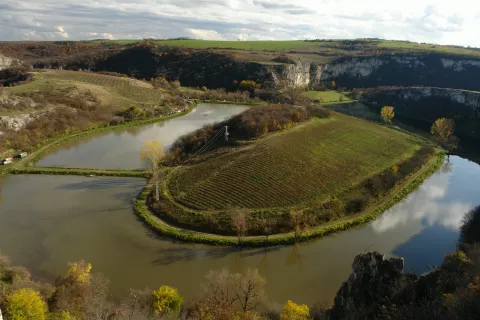
Vue d'ensemble
Flood risk reduction: Reduce flooding on nearby roads by allowing water to spread into the floodplain rather than being constrained by dykes.
Hydrological restoration: Reconnect the Russenski Lom river with its natural floodplain to improve flow dynamics.
Biodiversity support: Enhance habitats for riparian and aquatic species by increasing lateral connectivity.
Community benefit: Improve safety and reduce damage from high water events.
| Authority type | Authority name | Authority role | Comments | Authority responsibility |
|---|---|---|---|---|
| Local water authority | Russenski Lom Nature Park Directorate | Implementation | — | Responsible |
| NGO | Club "Friends of Russenski Lom" | Implementation | — | Supporting |
| NGO | WWF | Initiation of the measure | — | Supporting |
| Other | Ministry of Culture | Implementation | Culture national authority | Supporting |
| NGO | WWF Gemany | — | — | Supporting |
| Other | German Federal Ecological Foundation DBU; Deutsche bundesstiftung umwelt (DBU) | Financing | German environmental fundation | Supporting |
Site Information
Design and Implementation
Financing
Policy and Governance
| Name |
|---|
| Management plan of Rusenski Lom Nature park |
Impacts and Monitoring
Monitoring System
Species presence and abundance: especially target species under the Habitats and Birds Directives (e.g., otter Lutra lutra, certain bird species, protected fish).
Pressures: evidence of pollution (wastewater inflow, agricultural runoff), illegal waste deposits, and hydromorphological changes.
Hydrological regime: qualitative assessment of flow connectivity between river and floodplain, presence of blockages or erosion.
Maintenance
Impact Assessment Methodology
Socio-economic Impacts
Biophysical impacts: Hydrology
Biophysical impacts: Biodiversity
Biophysical impacts: Water & Soil Quality
Biophysical impacts: Others
Lessons Learned
| Driver type | Driver role | Comments |
|---|---|---|
| Other | Main driver | Continuous flooding during heavy rainfall ??? |
| Success factor type | Success factor role |
|---|---|
| Attitude of decision makers | Main factor |
| Existing staff and consultant knowledge | Main factor |
| Financing possibilities | Secondary factor |
| Available support tools | Secondary factor |