
Résumé
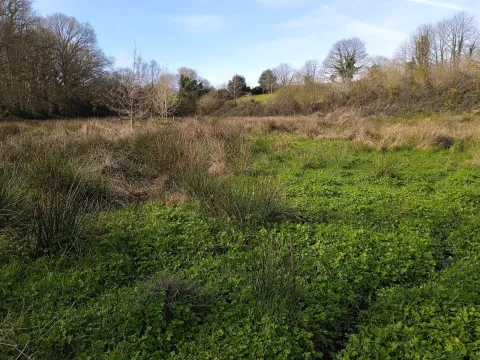
Headwater wet meadow (Saint-Évarzec, Finistère) where two drainage ditches short-circuited a hillside spring and routed nitrate-rich flows directly to the stream. In 2014, the ditches were infilled (north ditch partly to keep upstream runoff entering the meadow) and a small berm removed, with protected-species precautions. The short-circuit was eliminated: all slope water now crosses the wetland, maintaining high N removal; soil saturation increased and low-water levels rose slightly near the former ditch. Agricultural operability decreased (bearing capacity), so mowing is now feasible only in very dry years; the plot is used within a Brittany “pie-noir” grazing circuit.
However, the potential for agricultural exploitation since implementation is not as high as hoped, unlike the very satisfying hydrological effect : the meadow remans wet even during very dry years like 2022. The peaty wet part of the site is intentionally left to natural woodland succession (hoping for future understorey grazing), as it is not suitable for agricultural use otherwise.
The project owner/operator is the Communauté de communes du Pays Fouesnantais with RERZH technical support and monitoring. The costs were very low, an excavator hire for ~€560 and the rest of the works costs were included in the collectivity's budget (studies/monitoring covered by RERZH).
More recently, after the initial over-excavation and reuse of oxidised berms diverted part of the spring toward the southern sector, increasing waterlogging and limiting mowing, a corrective package created a small pond at the spring with overflow toward the peatier/northern side, resumed brush-cut mowing to restore a haying dynamic, and reinforced invasive nutria control in 2024.
Photo gallery


Vue d'ensemble
| Authority type | Authority name | Authority role | Comments | Authority responsibility |
|---|---|---|---|---|
| Local water authority | Communauté de communes du pays Fouesnantais (CCPF) (federation of municipalities of Pays Fouesnantais) | Initiation of the measure | Project owner; technical operator on site; regulatory files; monitoring support. | Responsible |
| Other | Réseau expériemental de rehabilitation de zones humides (RERZH) | Initiation of the measure | Wetland rehabilitation experimental network ; technical support; design; monitoring & evaluation; reporting. | Responsible |
| NGO | Bretagne Vivante | Monitoring | Faunal surveys (amphibians, invertebrates). | Supporting |
| NGO | Groupe Mammalogique Breton (GMB) | Monitoring | On-site supervision for protected water vole (Arvicola sapidus) during works. | Supporting |
| NGO | Conservatoire Botanique National de Brest (CBNB) | Monitoring | Botanical inventories and vegetation mapping. | Supporting |
Site Information
Design and Implementation
Method: excavator on wide tracks; re-use of historic spoil berms for core; curates/”vases” placed on top; sod/horizon replaced; pre-felling of vegetation; stepwise topsoil removal from downstream to upstream to let small mammals escape; culverts blocked but kept for machinery passage.
Partial infill of the northern ditch to allow upstream parcel runoff to reach the meadow; small embankment removed; sensitive micro-habitats (Triton palmé) avoided.
2024 corrective measure: small pond created at the spring with overflow directed to the peatier/northern side to restore intended flow partition; coypu control; brush-cutting (gyro-mowing) to re-enable haying dynamics on part of the site.
Financing
Policy and Governance
Originally a light peat bog (thin layer of peat), the plot was drained to reduce hydromorphy and thus allow the entry of machinery to exploit the meadow by mowing. Drainage is provided by two ditches 80 to 120 cm deep that collect water from a spring and drain the groundwater from the hillside. The groundwater level is relatively high despite this drainage, due to the double supply from the hillside and from the accompanying groundwater of the river.
As a result, the prairie vegetation is hydrophilic. Botanical inventories carried out in 2014 by the National Botanical Conservatory of Brest made it possible to obtain a mapping of habitats and a list of 72 taxa present. The Soft Rush (Juncus effusus) is present in large quantities.
Faunal inventories carried out by Bretagne Vivante and the Breton Mammological Group have revealed the presence of Palmate Newt (Lissotriton helveticus), Common Toad (Bufo spinosus) and Grass Frog (Rana temporaria). Five odonata species have been observed, including the Golden-ringed Dragonfly (Cordulegaster boltonii), a key species at the departmental level. Eleven species of orthopterans have been observed on the site, as well as the Mole Cricket (Gryllotalpa gryllotalpa), rare in Bretagne. Two protected semi-aquatic mammals are using the site: the Southern Water Vole and the Eurasian Water Shrew.
The watershed is subject to nitrogen pressure. The water reaching the meadow by resurgence at the foot of the hillside can reach concentrations of 44 mg/l of nitrates upstream of the plot. These decrease significantly as they flow into the plot, indicating that nitrogen has been reduced in the wetland. As a result of prairie drainage, some of the water enters the stream without passing through the wet meadow and its purification capacity is therefore partially short-circuited.
- optimize nitrogen abatement processes by denitrification by raising the groundwater level;
- to improve forage quality by controlling the diffuse rush with appropriate management;
- to promote a fauna and flora typical of wetlands;
- to demonstrate to the stakeholders of the territory the interest of this type of restoration for the improvement of water quality.
| Arrangement type | Role |
|---|---|
| Other | Agreement with the farmer and landowner, to allow the measure implementation. The land is supposed to remain usable for the farmer's activities. |
Impacts and Monitoring
Monitoring System
Piezometric monitoring : 3 transects of 5 piezometers each placed in the direction of the steepest slope of the site, with a water level reading every 15 days.
Physico-chemical monitoring : The evolution of nitrogen concentrations in the water table across the wetland was measured by taking water from the piezometers.
Ecological monitoring : Two transects were carried out on the plot to monitor the evolution of the flora. A mapping of the vegetation of the plot is also carried out. Qualitative inventories of amphibians, lepidoptera, orthoptera and odonates have been carried out.
Control site : Monitoring is also carried out on a similar control site in a good state of conservation. The control plot is located upstream on the same watercourse.
Maintenance
Impact Assessment Methodology
Biophysical impacts: Hydrology
Piezometric levels at low water level after work are slightly higher (10 centimetres on average) in the piezometers closest to the filled ditch, but this observation is not statistically significant. In addition, the same phenomenon can be observed at the control site, showing a variation more related to meteorology. However, on the restored site, there is an increase in the restoration date and a decrease in the discharge period, showing an increase in the saturation time of the wetland soil.
In the absence of a piezometer in the area where a groundwater rise was observed visually, it could not be quantified.
Biophysical impacts: Biodiversity
The work begun in the summer of 2014 seems to have been favourable to the Grass Frog, which immediately exploited the new temporary puddles available. The second year of prospecting confirms this colonization of the site by the species.
Orthopteran processions linked to wetlands (Conocephalus dorsalis, Gryllotalpa gryllotalpa, Chorthippus albomarginatus, Stethophyma grossum, Tetrix ceperoi...) are well preserved with little evolution between before and after work because the vegetation already had a very marked wet grassland character before work.
The Southern Water Vole is still present in high density on the site in 2015. By 2016, the occupation of the northern ditch had decreased significantly, especially in the area between the former central ditch and the watercourse, where the nutria has become well established. A nutria control campaign launched by the CCPF in 2016 should make it possible to avoid the continuation of the replacement of the Vole by this species.
There is no detected impact on the Eurasian Water Shrew. Vegetation trending to more hygrophilous/peaty assemblages 2014→2016; 2020 notes reduced cover of Juncus acutiflorus and rise of J. effusus linked to lack of management access.
Nutria proliferation required control campaigns.
Biophysical impacts: Water & Soil Quality
Main gain from works: elimination of the short-circuit : now all hillside flows traverse the wetland and benefit from its full purification capacity; slight rise in orthophosphate still within “good” WFD thresholds and also seen at control.
These results show that the wetland was already functional before restoration in terms of nitrogen purification.
Lessons Learned
Removing ditch short-circuits can be decisive for water quality even when pre-existing purification is high; quantify ditch flows and loads if a more “demonstrative” N-removal gain is required. Manage the trade-off between hydrologic restoration and agricultural operability; plan for adaptive corrections and for invasive species control.
| Driver type | Driver role | Comments |
|---|---|---|
| Availability of subsidies | Main driver | The subsidies helped convincing the local community to invest in the project. |
| Other | Main driver | The land owner was willing to include the meadow in the grazing path of his herd and was therefore interested in improving the fodder quality by reducing the Juncus effusus and not too sensitive to a loss of bearing capacity of the meadow. |
| Success factor type | Success factor role | Comments |
|---|---|---|
| Existing staff and consultant knowledge | Main factor | Subsidies and programme support (technical + monitoring) lower barriers and provide evidence |
| Successful coordination between authorities | Secondary factor | Alignment with farmer’s grazing goals helps acceptance |