
Résumé
More than half of the territory of the regional natural park of the Millevaches in Limousin (PNR) is covered with forest, some of which is the subject of intensive forestry exploitation. A peat bog restoration project in the headwater sector of the catchment area was initiated between the PNR (project manager) and the forestry cooperative Bourgogne Limousin (technical partner). The goal was to remove the softwood stand from the single-species plantation on the plot in order to restore the hydrological functioning of the peat bog. The work was carried out by aerial skidding using a cable mast. In addition to initiating collaboration between forestry and environmental management, the project has made it possible to restore the natural hydrological functioning of the bog and the associated specific habitats.
Photo gallery
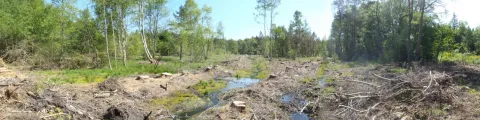
Vue d'ensemble
• Increase sediment retention by the bog to improve the hydromorphology of the watercourse (la Vergne).
Others objectives from the project manager:
• Work in collaboration with the silvicultural community.
• Restore the environmental functionalities of heritage wetland habitats.
• Promote the avifauna targeted by the Millevaches plateau Special Protection Zone (SPZ) (including Short toed Eagle).
• Improve the landscape in the municipality.
• Promote the exemplarity of the approach.
| Authority type | Authority name | Authority role | Comments | Authority responsibility |
|---|---|---|---|---|
| Nature park | Regional Nature Reserve of the Millevaches plateau | Initiation of the measure | Project owner. | Responsible |
| Architects / Engineers | Forestry cooperative Bourgogne Limousin (CFBL) | Implementation | — | Supporting |
Site Information
Design and Implementation
Aerial skidding (cable-mast) to avoid soil/peat disturbance; no heavy machinery in the wetland.
Keep a few tall “perch” trees for raptors (ZPS objective).
Hydro & habitat outcomes assessed by annual CEN monitoring; IAM checks downstream.
No design storm/capture volume or hydraulic capacity is specified in sources.
Financing
Policy and Governance
| Wider plan type | Wider plan focus | Name | Comments |
|---|---|---|---|
| Regional | Water | Sources en Action | The “Sources en Action” Territorial Contract - a local environmental agreement aimed at protecting water sources and natural habitats. |
Impacts and Monitoring
Monitoring System
Monitoring of hydromorphology (IAM protocol: morphodynamic attractiveness index) was carried out by the PNR in 2016 and 2019 immediately downstream of the bog, in order to monitor the evolution of the substrates of the river Vergne and to evaluate the effect of the restoration of the bog on fine sediments.
Impact Assessment Methodology
• Monitoring of hydromorphology (IAM protocol: morphodynamic attractiveness index)
• Visual observations of the zone after the work
Biophysical impacts: Hydrology
Biophysical impacts: Biodiversity
• A strong regeneration of peaty habitats, and an expansion of sphagnum development over a large part of the plot in 2017.
• The appearance of 4 species of odonata, 5 species of orthopterans and one species of lepidoptera specific to peatlands.
• On some parts of the plot, a dynamic of closure (implantation of birch trees and willows) and drying (appearance of molinia turds).
• Due to the incision of the bed of the Vergne, the lack of hydrological reconnection of the associated wetlands with the watercourse.
Biophysical impacts: Water & Soil Quality
Lessons Learned
| Success factor type | Success factor role | Comments |
|---|---|---|
| Attitude of decision makers | Main factor | The low quality of the wood (due to the hydromorphic nature of the soil) and the environmental and regulatory constraints of the site made the forest manager consider the site of low interest both for timber harvesting and for planting new afforestation, and thus facilitated their involvement in the project. It also made it easier to obtain the derogation from the simple forest management plan. The financing of the work proved to be an obstacle, but the owner unblocked the situation by agreeing to transfer the wood to the PNR, which was able to generate revenue from the sale. In addition, the total cost of the project was relatively low, which helped convince the financial partners. |