
Résumé
Summary
Restoration of the length of the Borova stream, increased by 6.3 km a shallow meandering stream bed, where sections of speedily running water alternated with sections of a slow stream were created, financed by the Ministry of Environment of Czech Republic.
Today this project is still relevant and effective, although it would need reconstruction in places.
Photo gallery
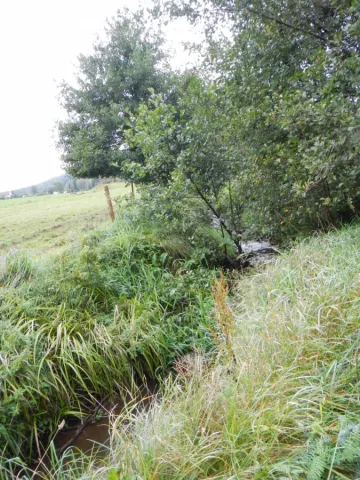

Vue d'ensemble
Year of issue
2025
Project
NWRM
Implementation status
Completed
Contact
Jovanka Ignjatovic
Location of the project
Borova river in Czechia
Country
Czechia
NUTS2 Code
Jihozápad
Sponge measures implemented in the case study
Re-meandering
Stream bed re-naturalisation
Forest riparian buffers
Wetland restoration and management
Objectives
the complex revitalization of Borová Stream basin including:
- renewal of the natural character of the stream as well as renewal of its original function
- increasing the accumulative possibilities of the land and retarding the surface water, flood protection
run-off
- increasing the variety of species
- dividing the area into smaller sections by planting alleys and groups of greenery
Involved partners
| Authority type | Authority name | Authority role | Authority responsibility |
|---|---|---|---|
| Local water authority | Blanský les Protected Landscape Area Authority | Implementation | Responsible |
| National water authority | Ministry of Environment | Financing | Supporting |
Site Information
Climate Zone
Cool temperate moist
Precipitation
2062.00 mm
Temperature (°C)
8.60 °C
Runoff coefficient
0.17
Elevation range
640 m
Slope range
1-2%
Vegetation class
grass turf
WFD Ecological status
Good
WFD Chemical status
Good
Design and Implementation
Project area
450
Area subject to Land use change or Management/Practice change (ha)
450.00 ha
Size
3307.00
Size unit
m
Principles
cancellation of the old regulated stream bed and creation of a natural meandering stream
Factor constraints
The project benefited as much as possible from the specificities of the basin.
Constraints
The drainage tubing at the surrounding pastures had to remain undisturbed except for the spring area where a small wetland was established.
Favourable preconditions
It was a former meanders channel which was straightened in the 70s
Financing
Total cost
275600.00 €
Total cost information
6 890 000 CZK including project documentation, engineering work, construction of revitalization in total length of 3.307 km (year 2000)
Compensations
Non
Policy and Governance
Policy description
Large scale regulation of water regime in the landscape was carried out by the consequences of industrial, agricultural, and urban development during the last century.
Land ownership
stream corridor : state ; other lands : private farmers
Policy targets
Increase Water Storage
Improved Biodiversity
Part of a wider plan
Oui
Wider plan
| Name |
|---|
| Program for revitalization of river systems |
Public consultation
Oui
Consultation activities
| Activity stage | Activity type | Key issues |
|---|---|---|
| Design phase | communication with owners before construction | distrust in the project, concern about the deterioration of surrounding land |
Has contractual arrangements
Oui
Contractual arrangements
| Arrangement type | Name |
|---|---|
| Contractual agreement | contracts with owners before construction |
Impacts and Monitoring
Monitoring System
Monitoring parameters
Comparison of composition of macro-invertebrate samples focusing on species richness, species composition, and representation of rare Ephemeroptera and Plecoptera species
In 2008, an exhaustive study of the geological, hydrogeological, hydrobiological, entomological, zoological, botanical and landscaping aspects of the revitalized Borová stream was conducted and a comparison was made with the state in 1995 (before the revitalization)
In 2008, an exhaustive study of the geological, hydrogeological, hydrobiological, entomological, zoological, botanical and landscaping aspects of the revitalized Borová stream was conducted and a comparison was made with the state in 1995 (before the revitalization)
Maintenance
Maintenance requirements
Management and maintenance are carried out by the stream administrator - the state organization Forests of the Czech Republic.
Impact Assessment Methodology
Performance impact assessment method
Catchment outlet
Performance impact estimation information
Benthic macroinvertebrates were sampled using the semiquantitative kick and sweep technique and by hand-picking of specimens from stones and macrophytes.
Socio-economic Impacts
Direct benefits information
Stream increased by 6.3 km alternated with sections of slow stream
Biophysical impacts: Hydrology
Information on retained water
The stream provide enogh flood storage during the flooding time
Information on increased water storage
Creation of lentic sites, increasing the ammount of water retained per timestep
Information on runoff reduction
N/A info
Biophysical impacts: Biodiversity
Improved biodiversity
Oui
Information on improved biodiversity
Results show that the macroinvertebrate assemblage of the restored section of a small stream contained higher species richness in comparison to channelized conditions that preceded the restoration, especially prominent shortly after the restoration intervention. However, the restoration did not increase abundances of rare Ephemeroptera and Plecoptera species.
Biophysical impacts: Water & Soil Quality
Water quality overall improvements
Not relevant for this application
Information on water quality overall
Not relevant for this application
Soil quality overall improvements
Not relevant for this application
Information on soil quality overall improvements
Not relevant for this application
Biophysical impacts: Others
Ecosystem impact climate regulation
Not relevant for the specific application
Information on ecosystem impact climate regulation
Not relevant for this application
Lessons Learned
Key lessons
Morphologically degraded stream sections are typically characterized by low habitat heterogeneity and consequently lower biodiversity compared to more natural sections. These measures certainly increase morphological heterogeneity and mimic the pre-disturbance state. On the other hand, the intervention included substantial disturbance and the use of heavy technique which have seriously affected the biota.
Drivers
| Driver type | Driver role | Comments |
|---|---|---|
| Organisation committed to it | Main driver | As part of the Blanskí Les Protected Landscape Area, willingness to create as much of a natural watercourse bed as possible |
| Past flooding events | Main driver | — |
| Availability of subsidies | Secondary driver | — |
Success factors
| Success factor type | Success factor role | Comments |
|---|---|---|
| Financing possibilities | Main factor | Thanks to the ministry of environment |
| Attitude of relevant stakeholders | Main factor | willingness to successfully complete the project |
Cost effectiveness
the project was effective at the time of implementation (assessed according to costs per unit of flow length)