
Résumé
Oroklini Lake lies near Larnaca within Oroklini village. The wetland was modified in the mid-1940s to promote desiccation for health reasons. NWRM actions aimed to retain water and restore habitats for two key breeding species (Black-winged Stilt, Spur-winged Lapwing) and wider biodiversity, including small hydraulic works in the upper basin.
In 2012–2014 the LIFE “Oroklini” project restored and managed the site (water-level management, nesting islets, fencing and visitor facilities), and it was later recognised as a Best LIFE project (2018).
Since 2014, After-LIFE management continues: monthly waterbird counts and nesting surveys, predator monitoring, reed control, and operation of water-control structures to release excess water during floods; bird-collision “diverters” were also installed on power lines.
Recent science characterises Oroklini as a brackish lake (mean salinity ~7.4‰, ≤20‰) with occasional high phytoplankton abundance, influenced by catchment dominated by artificial and agricultural land uses, nformation valuable for water-level and vegetation management.
Under LIFE IP “Pandoteira” (2023–2029), measures relevant to Oroklini include access management to reduce disturbance, water-level plans, reed management and control of non-native predators.
A local issue flagged in late-2023 concerns an upstream runoff channel to the lake that has not been cleaned for decades, raising flood-risk and maintenance needs.
Photo gallery
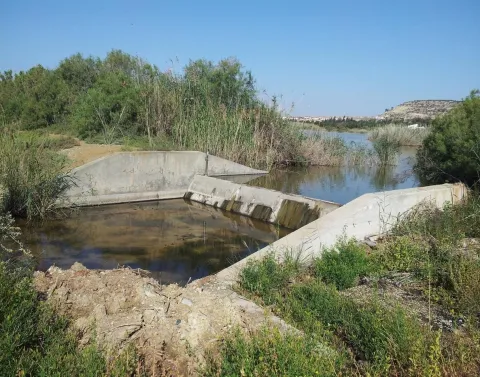


Vue d'ensemble
Species targets (FRVs) set in the management plan: Spur-winged Lapwing Vanellus spinosus: 15 breeding pairs; Black-winged Stilt Himantopus himantopus: 60 breeding pairs.
Habitat target: maintain ~53 ha of halophytic communities in favourable condition (SCI 53.47 ha; SPA 56.43 ha).
Works & measures: water-management (sluice repair/re-connection of basins), creation of nesting islets, fencing, removal of invasives and planting natives, plus visitor facilities (two hides, information kiosk) and awareness actions.
| Authority type | Authority name | Authority role | Comments | Authority responsibility |
|---|---|---|---|---|
| NGO | BirdLife Cyprus | Determination of design details of the measure | — | Responsible |
| Other | Game Fund Department | Monitoring | Dept of Ministry of Interior | Supporting |
| Local water authority | Oroklini Community Board | Implementation | Local Authority | Responsible |
| National water authority | Department of Environment | Monitoring | Dept of Ministry of Agriculture, Natural resources and Environment | Supporting |
Site Information
Design and Implementation
- 6 hectares of the upper basin were water is retained
- 31.5 hectares of the lower basin
- 257.5 hectares the catchment basin of the lake
Financing
Policy and Governance
As part of the wetland restoration, water retention measures were aiming at secure water availability in the upper basin of the lake and maintain high water level in order to facilitate the needs of avifauna, instead of flowing and spreading in the lower, larger basin, thus creating small ponds that would dry up in a short time.
Regulation of the chemical status of freshwater
Natural assimilation (purification) of effluents through dilution, dispersion, and physic-chemical processes
Restore ecosystem habitats, functions and support biodiversity.
| Directive | Relevant pressure |
|---|---|
| WFD identified pressure | Degradation of physicochemical and ecological status of the water body. |
| Other EU | Habitats directive : Important habitats degradation |
| Other EU | Birds Directive: Species and their habitats degradation |
| Directive | Relevant impact |
|---|---|
| WFD identified pressure | Alteration of ecological and physicochemical status |
| WFD identified pressure | Altered habitats due to morphological changes |
| Other EU | Habitats directive : degradation of important habitats |
| Other EU | Birds’ directive: degradation of bird species populations and their habitats. |
| Requirement directive | Specification |
|---|---|
| WFD-achievement of good ecological status | — |
| WFD-achieving objectives for Protected areas | Enforce the community mandates for protected areas |
| Other EU | Habitats directive : Preservation of important habitats |
| The Birds and Habitat Directives | Birds directive: Preservation of important bird species and their habitats |
Impacts and Monitoring
Monitoring System
Maintenance
Impact Assessment Methodology
Socio-economic Impacts
Elevated amounts of water and for a greater period have resulted in increased biodiversity in the area and especially increased numbers of wading birds. This has raised the public interest for the wetland and mild tourist activity has been observed.
Biophysical impacts: Hydrology
Biophysical impacts: Biodiversity
Nesting Spurwinged Lapwing and Stonecurlew were recorded on the restored field. First record of Little Egret nesting. Kentish Plover nests. The last breeding record was in 2007. Cattle Egrets nested for the first time. On nesting islets created Spurwinged Lapwings nested. Eels were observed in the lake for the first time.
Hydrology & plankton: 2018–2019 monitoring across Cyprus’s natural lakes found Oroklini is brackish (salinity ~3–20.4‰) and had the highest phytoplankton richness (27 taxa) among the lakes studied; abundance varied widely seasonally. This refines lake functioning post-works.
Biophysical impacts: Water & Soil Quality
Biophysical impacts: Others
Lessons Learned
Small, targeted water-management and habitat works can rapidly restore breeding conditions for priority waders in an urban fringe wetland, provided governance and long-term management are in place.
Quantified conservation targets (FRVs) & a binding Action Plan help keep focus after LIFE funding ends.
Monitoring shows progress and gaps: while bird/habitat targets are structured, water-quality pressures at catchment scale persist and need cross-sector action beyond the site fence.
People & access matter: facilities and outreach increased the site’s profile and support, but surrounding development and drainage infrastructure must be actively managed to avoid undermining gains.
| Driver type | Driver role | Comments |
|---|---|---|
| Organisation committed to it | Main driver | Dept. of Environment, BirdLife Cyprus, Game Fund, Local Village Council |
| Success factor type | Success factor role | Comments |
|---|---|---|
| Attitude of decision makers | Main factor | Insistence and pressure by Department of Environment , BirdLife Cyprus and Game Fund |
| Financing possibilities | Main factor | Financial support by LIFE under the project LIFE10 NAT/CY/716 |