
Résumé
The project applied an eco-remediation methodology at the Dobrava landfill (Municipality of Ormož, Slovenia) in the Pannonian lowlands. It aimed to demonstrate a green technology that reduces landfill impacts through a closed hydrological and pollution cycle, complementing and exceeding legislation. The Limnotop approach combines a dense, high-evapotranspiration woodland cover as a water barrier with recirculation and a constructed wetland for leachate treatment, to protect surface and groundwater.
Since project completion, the landfill has been permanently closed to additional landfilling and reconstructed; the constructed wetland remains in operation for leachate treatment (as confirmed by site managers). Post-LIFE, the site has been under operational monitoring by the authorities. In 2019 the environmental permit required additional leachate treatment, and a 2020 municipal plan considered routing leachate to the Ormož wastewater treatment plant to complement the wetland. A separate collection/transfer center now operates adjacent to the closed landfill. Overall, the case shows long-term use of nature-based treatment integrated with closure works, with upgrades pursued to meet current standards.
Photo gallery
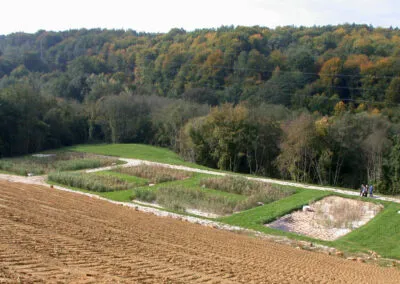
Vue d'ensemble
| Authority type | Authority name | Authority role | Comments | Authority responsibility |
|---|---|---|---|---|
| Other | Municipality Ormož | Initiation of the measure | Project beneficiary | Responsible |
| Other | University of Ljubljana | Monitoring | Faculty for Chemistry and Chemical Technology, Department for chemistry and biochemistry, Laboratory for inorganic chemistry | Supporting |
| Architects / Engineers | LIMNOS, Company for applied Ecology | Implementation | Private company, subcontractor | Supporting |
| Architects / Engineers | Communal company Ormož | Implementation | Municipal communal service provider - public institute | Supporting |
| Research institute / University | Institute for physical biology | Monitoring | Private company | Supporting |
Site Information
Design and Implementation
Financing
Policy and Governance
| Comments |
|---|
| The need for the reclamation of landfill sites to avoid long-term contamination is widely recognized in the EU countries. According to Slovene and EU Directives, old landfill sites have to be rehabilitated and there is a strong need for the protection of drinking water sources near landfill sites. |
Impacts and Monitoring
Monitoring System
Maintenance
Impact Assessment Methodology
Socio-economic Impacts
Revenue potential from biomass: Establishment of woodland/energy crops was intended to generate income to offset maintenance & construction costs (target: ~25%); the Layman report also lists “renewable energy (wood biomass) 10–25%” among direct benefits.
Operational efficiencies: The approach reduces the need to maintain airtight caps and shortens the time needed for after-care and for required environmental monitoring, Public acceptance & secondary use: Rehabilitation with vegetated cover improves landscape acceptance and enables secondary/public uses of revitalised landfill land; the project also included guided site visits for dissemination.due to faster waste stabilisation.
Biophysical impacts: Biodiversity
Biophysical impacts: Water & Soil Quality
No accumulation of heavy metals found in the landfill cover material; metals largely retained in the anaerobic landfill body, with part removed via plant uptake (notably Cd, Zn).
Boron (site study on leachate reuse): Leachate B = 0.8–3.83 mg/L; bioavailable B in soil increased over the 10-month study; leaf B (mean) clover 23.9 mg/kg, grasses 4.5 mg/kg, willow (new cover) 41.3 mg/kg, willow (old cover) 81.8 mg/kg; vegetation showed no visible toxicity in the monitoring period. (Notes that continued inputs could risk accumulation over longer terms.)
Biophysical impacts: Others
Lessons Learned
Nature-based treatment can remain part of after-care but may need to be complemented. After the landfill closed (end-2015), the 2023 permit records that leachate is now routed to the public sewer and treated at Ormož WWTP, with the constructed wetland kept as pre-treatment; a 2020 municipal investment paper had already noted the wetland alone was not sufficient.
Long-term performance depends on structured monitoring and maintenance. The 2023 decision sets 30-year after-care obligations (groundwater status monitoring, leachate monitoring at the outlet to sewer, gas/air checks, regular site inspections) and quantifies the associated monitoring/O&M cost items.
Where leachate is reused for irrigation, some constituents (e.g., boron) can accumulate in soil/plant tissue - even without short-term phytotoxicity - so targeted parameters must be tracked over time.
The eco-remediation elements are durable: managers confirm the constructed wetland remains in operation post-closure, illustrating persistence of NBS infrastructure alongside conventional upgrades. (Site managers, 2025, pers. comm.) See also the operator’s listing of the Dobrava constructed wetland.
| Driver type | Driver role |
|---|---|
| Legal obligations | Main driver |
| Success factor type | Success factor role | Comments |
|---|---|---|
| Existing staff and consultant knowledge | Main factor | — |
| Attitude of decision makers | Main factor | Strong local ownership and operator capacity (Municipality of Ormož; Komunalno podjetje Ormož) with clear permit responsibilities. |
| Other | Main factor | Appropriate plant choices and demonstrated cover performance enabling nutrient uptake and ET. |