
Establishing connectivity in the Ljubljanica river, Slovenia

Résumé

Summary

Removing barriers to fish migration, enhancing and restoring habitats, improving water-management infrastructure, and establishing a monitoring system. Funded by LIFE+ and implemented by Purgator Engineering Ltd. under the responsibility of the University of Ljubljana (UL FGG), the 2012–2016 “Ljubljanica connects” project rebuilt two dysfunctional fish passes (Fužine weir and Ambrožev trg), modernised the lifting gates at Ambrožev trg, and raised the Zalog sill by 20 cm to improve levels and oxygenation in upstream oxbows. A low-cost IR “fishcam” system was installed in both passes, providing continuous, online monitoring and confirming passage of 12 fish species, including the target Hucho hucho, Rutilus pigus and Leuciscus souffia. An After-LIFE plan maintains monitoring and knowledge transfer. While urban-section connectivity improved, full longitudinal continuity to the Sava remains constrained: the paper-mill weir at Vevče is the first impassable barrier upstream from the confluence, and the Gruber Canal sluice lacks a fish pass; national planning documents list measures to establish passability at Gruber. Coordinator: University of Ljubljana; partners: Purgator and Geateh.

Photo gallery
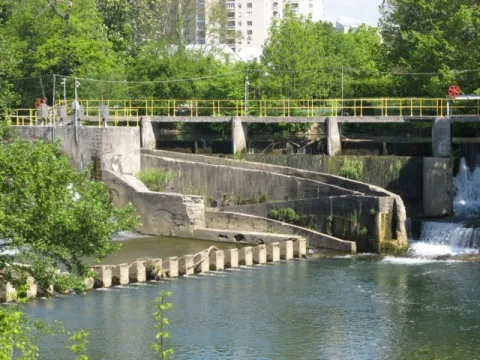
Vue d'ensemble
Year of issue
2025
Project
NWRM
Implementation status
Completed
Contact
REC
Location of the project
This project is located on the Ljubljanica river, in Ljubljana.

Country
Slovenia
NUTS2 Code
Zahodna Slovenija
Sponge measures implemented in the case study
Removal of dams and other longitudinal barriers
Objectives
Restore the Ljubljanica River’s corridor function to improve Natura 2000 coherence, specifically linking Ljubljansko barje (SI3000271) with Sava–Medvode–Kresnice (SI3000262).
Enable fish migration of 3 target species: Danube salmon (Hucho hucho), Danube roach (Rutilus pigus), and striped chub (Leuciscus souffia).
Remove/mitigate barriers to fish movement and improve water-management infrastructure along the urban reach.
Carry out an eco-hydrological survey and develop hydrological/hydraulic models as the basis for a management plan; identify threats and implement river restoration and habitat conservation actions to support WFD objectives.
Establish monitoring systems for fish passage and river conditions (video/IR “fishcam” and eco-hydrological logging envisaged in the project design).

Involved partners
Authority nameAuthority roleComments
University of Ljubljana, Fakulteta za gradbeništvo in geodezijoInitiation of the measure—
Purgator Engineering Ltd.Determination of design details of the measureCompany for Engeneering Constructions
Geateh d.o.o.ImplementationCompany for Engeneering Constructions
Site Information
Climate Zone
Cool temperate moist
Precipitation
1339.00 mm
Temperature (°C)
12.00 °C
Elevation range
277
Vegetation class
In-channel (project reaches): Aquatic macrophytes dominate (e.g., Sparganium emersum, Callitriche spp.; invasive Elodea canadensis documented along the Ljubljanica).
Wider floodplain upstream (Ljubljana Marsh / Natura 2000): Wet grasslands/meadows with hedges, shrubs and waterways are the characteristic matrix.
WFD Ecological status
Good
WFD Chemical status
Failing to achieve good
Water quality status
Hydromorphological alterations, faecal indicator bacteria downstream of the CČN outfall as the plant discharges to the Ljubljanica just before the Sava confluence.
Design and Implementation
Project scale
Micro
Project scale specifications
Localised hydromorphological interventions at specific structures within Ljubljana: reconstruction of two fish passes (Ambrožev trg sluice and Fužine weir), modernisation of the Ambrožev trg lifting system, and raising the Zalog sill to improve upstream oxbows - i.e., site-specific works along a short urban reach rather than basin-wide actions.
Financing
Total cost
1168765.00 €
Total cost information
Total eligible budget: €1,168,765.
EU (LIFE) contribution: €584,382.
Financing authorities
Authority nameType of fundingCommentsFinancing share
European UnionEU-funds: LIFE+€ 584,382~50%
Ministry of Agriculture & Environment of SloveniaNational funds—20 %
UL FGGSub-national fundsProject coordinator19.7%
Purgator d.o.o. & Geateh d.o.o.Private funds0.11111.1%
Compensations
Non
Policy and Governance
Policy description
Heavy degradation of the ecological functioning of the Ljubljanica River corridor “upstream and downstream of the Ljubljana urban area“ towards the confluence with the Sava, and further upstream along the Sava.
Land ownership
Publicly owned by the Republic of Slovenia
Policy targets
Improved Biodiversity
Part of a wider plan
Non
Public consultation
Non
Has contractual arrangements
Non
Impacts and Monitoring

Monitoring System

Monitoring requirements
Continue year-round fish-pass video monitoring (IR, image archiving/analysis for species and size) and continuous logging of water level and temperature at established stations.
Monitoring parameters
Monitoring covers two strands. (1) Biotic passage at the Ambrožev trg and Fužine fish passes via IR-capable video; footage is analyzed to identify species, count individuals, and estimate fish length, with >200,000 images archived by the beneficiary; 12 fish species were confirmed moving through the passes during/after the project. (2) Eco-hydrological context via continuous water-level and water-temperature loggers at multiple sites (~17) along the corridor to inform models and management. Supplementary evaluation included VIE tagging reported in conference materials.

Maintenance

Maintenance requirements
The UL FGG keeps the fish-pass camera system and website in operation in line with the project’s After-LIFE plan; no separate municipal O&M scheme is documented in the sources.

Socio-economic Impacts

Benefits and co-benefits
Recreation & angling. The local anglers’ society gained members thanks to strengthened fish populations (notably Danube salmon). Other recreational activities along the river are expected to increase.
Adding debris-deflectors at fish-pass exits reduced ingress of floating material and thereby reduced damage and maintenance costs for the structures.
Risk management co-benefit. Modernised lifting gates at Ambrožev trg allow precise level control, highlighted as important for flood protection and climate-change adaptation.

Biophysical impacts: Hydrology

Information on retained water
Precise water-level regulation, cited as important for flood protection and climate-change adaptation.
At Zalog, the sill was raised by 20 cm, which increased upstream oxbow water levels.

Biophysical impacts: Biodiversity

Improved biodiversity
Oui
Information on improved biodiversity
Two fish passes reconstructed (Fužine, Ambrožev trg). Monitoring confirmed passage of 12 fish species, including the three targets (Hucho hucho, Rutilus pigus, Leuciscus souffia). >200,000 photos archived; ~20% used for species determination.
However the Vevče paper-mill weir remains the first impassable barrier from the Sava into the Ljubljanica, interrupting full longitudinal continuity.

Biophysical impacts: Water & Soil Quality

Water quality overall improvements
Positive impact-WQ improvement
Information on water quality overall
Increase in river water quality, especially via slowed heating and higher dissolved oxygen in the oxbows after the Zalog action.
Lessons Learned
Key lessons
Targeted, small-scale works at key urban barriers can reopen passage and measurably improve local conditions when paired with monitoring. In Ljubljana, rebuilding the Ambrožev trg and Fužine fish passes and raising the Zalog sill (+20 cm) restored movement at those sites and improved oxbow water quality by increasing water level, slowing heating, and raising dissolved oxygen. Continuous, low-cost IR video monitoring confirmed use by 12 fish species and created an engaging, public data stream. Modernising the Ambrožev trg lifting system also delivered precise level control valued for flood protection and climate-adaptation operations.
However, site-level fixes alone did not achieve full longitudinal continuity. The Vevče paper-mill weir remains the first impassable barrier from the Sava into the Ljubljanica, as shown by tagged Hucho hucho movements; functionality at the Fužine pass was also intermittently interrupted during the project, underscoring the importance of downstream bottlenecks and O&M reliability for corridor-scale outcomes.
Barriers
Barrier typeBarrier roleComments
OtherMain barrierOperational reliability: intermittent interruptions at the Fužine fish pass during the project.
OtherSecondary barrierUrban river pressures: a historically degraded corridor with multiple modifications, making basin-scale recovery harder than site-scale fixes.
Success factors
Success factor typeSuccess factor roleComments
OtherMain factorClear, focused scope on two dysfunctional fish passes plus the Zalog sill (doable, high-leverage fixes).
Available support toolsSecondary factorInnovative IR “fish-cam” system providing continuous evidence and public outreach at low cost.
Successful coordination between authoritiesSecondary factorEffective partnership led by UL-FGG with Purgator and Geateh 
Cost effectiveness
The "fish cam" device to monitor the effectiveness of the fish pass is considered as a cost effective technology.
Transferability
Highly transferable to urban rivers with legacy barriers: rebuilding fish passes, modest sill tweaks and gate modernisation can restore local passage and improve level control, especially when paired with low-cost fish-cam and eco-hydrological monitoring. But scrutinise corridor bottlenecks (e.g. downstream impassable weirs/sluices), species-specific design and O&M (debris, outages), and secure capacity for long-term monitoring.
Sources