
Résumé
Dimitrovgrad Municipality restored, protected and promoted the sustainable development of the “Zlato pole” protected area by securing additional water to maintain its hydrological regime and constructing a hydraulic intake and supply channel. Water is diverted from the Martinka River, via a small intake and settling basin, then conveyed ~580 m in a buried 600-mm pipe and ~520 m in an open canal with control gates; the scheme was completed in 2013. The 84.79-ha site overlaps the Natura 2000 SPA BG0002103 “Zlato pole”, for which the Ministry adopted site-specific conservation objectives in June 2024, including targets for key birds such as Pygmy Cormorant and Ferruginous Duck and for wetland habitats. Management is overseen by RIEW Haskovo, with an information centre in Raynovo supporting education and visitors. Post-project actions have included nest boxes, aquatic plantings (white waterlily) and safeguarding of Leucojum aestivum. Current pressures reported on site are recurrent fires, illegal hunting/fishing and occasional flooding along the Martinka. Overall, the restoration sustains wetland hydrology, enhances habitat mosaics on the Maritsa floodplain and underpins ongoing Natura 2000 commitments, while requiring continued local engagement and enforcement.
Photo gallery
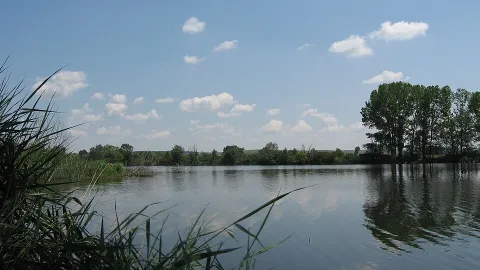


Vue d'ensemble
Recover floodplain riparian forests typical of the site through afforestation on ~60 decares (~6 ha) with local willow and poplar species; establish a black poplar mother stock/nursery and control Amorpha (invasive).
Reintroduce and reinforce rare plants: Leucojum aestivum and Nymphaea alba (e.g., municipal news reported >20 water-lily rhizomes planted; Green Balkans reported 30 new water lilies).
Education, access and anti-disturbance measures: create an Information/Visitor Centre in Raynovo, build two birdwatching towers, three gazebos, 15 litter bins, update zoning/marking and install interpretive signage.
| Authority type | Authority name | Authority role | Comments | Authority responsibility |
|---|---|---|---|---|
| Local water authority | Municipality Dimitrovgrad | Initiation of the measure | — | Responsible |
| NGO | Green Balkans | Implementation | Federation of Nature conservation | Supporting |
Site Information
Design and Implementation
Financing
Policy and Governance
Impacts and Monitoring
Monitoring System
Maintenance
Socio-economic Impacts
Biophysical impacts: Hydrology
Biophysical impacts: Biodiversity
Pygmy Cormorant (winter roost): the site (Zlatopole/Raynovo) is a regular roost within the Maritsa valley network. A 23-year study (1996–2019) covering 7 roosts including Zlatopole & Raynovo found 3,065–8,180 wintering birds annually across the valley and an increasing trend overall; it does not isolate the Zlato pole project’s specific contribution.
Local maxima cited in management texts: older official material for the site mentions up to ~2,000 Pygmy Cormorants in winter (contextual importance; not a project effect evaluation).
Habitat features added: c. 100 nest boxes for cavity-nesters were installed at Zlato pole (conservation action; no quantified breeding response published).
Biophysical impacts: Water & Soil Quality
Lessons Learned
Municipal leadership was decisive. Dimitrovgrad Municipality was the project beneficiary and operator, coordinating design, tendering, construction and subsequent operation—exactly the governance model that enabled a small, site-level intervention to happen.
Technical simplicity plus clear O&M matters. A modest intake on the Martinka River, a settling basin, and ~1.1 km of conveyance were paired with an operations plan (gate management, sediment flushing; normal vs. emergency modes). This pairing is a transferable lesson for similar floodplain wetlands.
Build partnerships for stewardship. The project design includes seasonal guarding of the heron colony and fishing restrictions, while NGO actors contribute monitoring and outreach—showing how agency–municipality–NGO roles can be complementary.
Invest in public engagement infrastructure. The Information/Visitor Centre in Raynovo and attendant amenities created a focal point for education, ecotourism and community programming, which helps sustain local support beyond the construction phase.
Plan for risks and enforcement. Post-project fires inside the protected site and recurring poaching pressures underline the need for prevention, surveillance and rapid response baked into management.
Align restoration with current Natura 2000 objectives. In 2024, Bulgaria adopted site-specific conservation objectives for SPA BG0002103 Zlato pole; tying management to these measurable targets strengthens accountability and provides a framework for long-term monitoring.
Close the evidence gap on outcomes. Publicly available documents emphasise actions and species aims, but provide little quantified before/after evidence for hydrology or water quality at Zlato pole; meanwhile, nearby Zlatopolska River monitoring registers nutrient exceedances—arguing for future projects to budget dedicated, site-level monitoring from the outset.
| Driver type | Driver role | Comments |
|---|---|---|
| Organisation committed to it | Main driver | Commitment of Dimitrovgrad municipality and support by Green Balkans NGO |
| Success factor type | Success factor role | Comments |
|---|---|---|
| Attitude of decision makers | Main factor | Good cooperation between local authorities and NGO |
| Existing staff and consultant knowledge | Main factor | — |
| Financing possibilities | Secondary factor | — |
| Available support tools | Secondary factor | — |