
Résumé
This is a traditional practice in the Baixo Vouga Lagunar Area (Aveiro District, Vouga River Estuary, Portugal), since 19th century in order to protect BVL from the tidal floods. Baixo Vouga Lagunar represents a man-shaped landscape working in a dependent relationship between agricultural activities, wildlife and water regulation. BVL includes three main landscape units: bocage (smallholdings bounded by living-hedges and water ditches supplying water for crop and livestock production and also assure the drainage when there is water in excess in the fields), wetlands and open-fields.
In recent years, BVL has become a living lab for climate adaptation and resilience strategies, studied through projects such as ADAPT-MED and Man and Nature in the BVL. Local stakeholders recognize the protective role of tidal defense structures, though awareness of climate impacts remains limited. Efforts continue to promote synergies between nature conservation, agriculture and water management. The area is part of the Ria de Aveiro Natura 2000 site and hosts over 170 bird species, reinforcing its ecological value within a multifunctional landscape.
Photo gallery
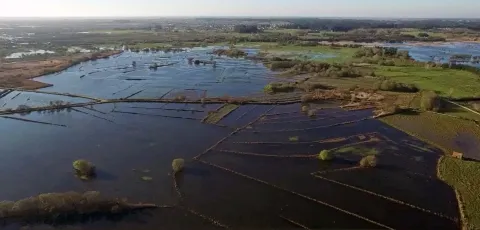

Vue d'ensemble
Enhance flood protection : Protect the area from tidal and fluvial flooding.
Promote multifunctional land use.
Improve biodiversity status : Conserve habitats within the Ria de Aveiro Natura 2000 site, which supports over 170 bird species.
| Authority type | Authority name | Authority role | Comments | Authority responsibility |
|---|---|---|---|---|
| Research institute / University | CESAM – University of Aveiro | Monitoring | CESAM – University of Aveiro | Supporting |
| Research institute / University | — | Monitoring | Coordinates field research and ecological monitoring in the region, particularly in BVL. | Supporting |
| Local water authority | Municipality of Estarreja | Initiation of the measure | Territorial authority concerned with land use, water management, and local development in BVL. Involved in EU adaptation projects and public awareness campaigns. | Responsible |
| National water authority | ICNF (Instituto da Conservação da Natureza e das Florestas) | Monitoring | National agency managing Natura 2000 sites in Portugal, including Ria de Aveiro | Supporting |
| NGO | Associação Portuguesa de Educação Ambiental (ASPEA) | Other | Participated in awareness and community-based activities within BVL during past EU-funded initiatives | Supporting |
Site Information
Forming the living hedges we can fine trees, shrubs and herbaceous vegetation (http://www.biorede.pt/)
The tree community, part of the living hedges, is characterized by alder (Alnus glutinosa), willows (Atrocinerea salix), oak (Quercus robur), silver or white poplar (Populus alba) and laurel (Laurus nobilis).
The shrub layer is represented by hawthorn (Crataegus monogyna), the butcher's broom (Ruscus aculeatus), elderberry (Sambucus nigra), buckthorn (Frangula alnus), roses (Rosa pouzini, Rosa sempervirens) elmleaf blackberry (Rubus ulmifolius).
Regarding the herbaceous community there are standing out climbing plants such as honeysuckle (Lonicera periclymenum), the Bryonia dioica, Morning Glory (Calystegia sepium), and Senecio mikanioides, among others. Vegetation influences the rate and efficiency of storm-water infiltration and filtration.
Design and Implementation
Financing
Policy and Governance
- Water Policy - Floods Directive.
- Climate change adaptation policy.
- Regional Policy: Cohesion Funds, ERDF
- Agricultural Policy: CAP, EAFRD
Impacts and Monitoring
Monitoring System
Hydrological conditions : Seasonal flooding in bocage fields, Water levels affecting wetlands and ditches.
Stakeholder perception / adaptation readiness : Awareness and perception of climate risk, evaluation of the effectiveness of tidal defense infrastructure.
Maintenance
Impact Assessment Methodology
Socio-economic Impacts
- Reared animals and their outputs , namely Marinhoa cattle for meat; other cattle breeds for meat (Charolais, Limousine, crossbreed); Holstein Friesian cattle for dairy products like milk.
The area has a high intrinsic value due to its biodiversity and also due to its representativeness of a sustainable land use type and water management and it could be explored in the future for ecotourism.
Biophysical impacts: Hydrology
The traditional bocage network (hedges + drainage ditches) functions as a water retention and drainage system, reducing flood propagation across ~1,200 ha of farmland.Dike and ditch interventions, including flood bank extension, are intended to prevent tidal and saline intrusion, though they have also generated altered submersion regimes for wetlands.
Biophysical impacts: Biodiversity
The Baixo Vouga Lagunar is integrated in Ria de Aveiro Special Protection Area (SPA – with the Natura 2000 code PTZPE0004). This SPA regularly supports over 1 % of the population of the pied avocet (Recurvirostra avosetta) and 60 % of the population of the purple heron (Ardea purpurea).
Baixo Vouga Lagunar is an important for 173 species of birds, such as the fish-hawk (Pandion haliaetus), the purple heron (Ardea purpurea), the black kite (Milvus migrans), the mallard duck (Anas platyrhynchos) and the white stork (Ciconia ciconia). It is also an important habitat for mammals like the least weasel (Mustela nivalis), the hedgehog (Erinaceus europaeus) and the European otter (Lutra lutra), for amphibians like the common toad (Bufo bufo), the tree frog (Hyla arborea), the fire salamander (Salamandra salamandra), the marbled newt (Triturus marmoratus) and the Iberian Painted Frog (Discoglossus galganoi), for reptiles, namely the Iberian emerald lizard (Lacerta schreiberi) and the viperine water snake (Natrix maura), and for several fish species including the eel (Petromyzon marinus) and the lamprey (Lampetra planeri). According to the EU Directive 92/43/EEC some of these species are classified as "strictly protected" (e.g. the otter and the tree frog). Also for IUCN (International Union for Conservation of Nature), the otter is in the “red list”, classified as “Near Threatened” as well as the Iberian Emerald Lizar
Biophysical impacts: Water & Soil Quality
Soils ranged from moderately to strongly acidic (pH 4.4–5.8), with organic matter up to 34%.
Arsenic (As), Lead (Pb), Uranium (U) in some sites exceeded Portuguese thresholds for agricultural soils.
Cultivated fields had similar copper (Cu) levels; abandoned fields showed elevated As, Pb, U - possibly due to saline intrusion or geogenic sources.
However, porewater and irrigation water carried low PTE concentrations, and rice grains (white, brown, wild) showed PTE levels well below EU food-safety limits.
Biophysical impacts: Others
Lessons Learned
Infrastructure interventions can have unintended ecological impacts : Engineering works like floodbank extensions and dredging (2018–2019) altered tidal flow regimes, leading to negative impacts on saltmarshes and estuarine habitats. These interventions, while aiming at flood protection, created hydrological imbalances and stress for sensitive biodiversity (e.g. over-submersion of marshes). Even well-intentioned interventions require thorough ecosystem-based impact assessments to avoid degrading key habitats and ecosystem functions.
Awareness and engagement of local stakeholders remain limited : Surveys (ADAPT-MED) show that only 39% of stakeholders felt aware of climate change impacts. There is still low social appropriation of adaptation planning, and many local actors do not perceive visible changes despite ecological data showing otherwise. Long-term adaptation success depends not only on technical solutions but also on social learning, trust-building, and participatory planning.
Multiscale coordination is needed for coherent outcomes : The BVL lies within a Natura 2000 site, under local, regional, and EU-level environmental regulations. Fragmented land ownership and jurisdictional overlap challenge coherent implementation of measures. Aligning local actions with regional and EU-level objectives is key to achieving durable outcomes, especially in multifunctional landscapes.
| Driver type | Driver role |
|---|---|
| Past flooding events | Main driver |
| Success factor type | Success factor role | Comments |
|---|---|---|
| Attitude of decision makers | Main factor | This is a success factor for the maintenance of the infrastructure. Note that some of these infrastructures were built in the 19th century. |
| Public participation | Main factor | This is a success factor for the maintenance of the infrastructure. Note that some of these infrastructures were built in the 19th century. |
| Communication activities | Secondary factor | This is a success factor for the maintenance of the infrastructure. Note that some of these infrastructures were built in the 19th century. |