Holter-Hammrich Area - Flood Protection and Nature Conservation, Germany

Year of issue
2025
Summary

The Holter-Hammrich project combined several natural water retention measures: floodplain restoration, meadow and pasture rehabilitation, and reduced tillage. Located in north-west Germany within the Weser river basin (DE4000), it supports Lower Saxony's otter and wetlands protection programs and contributes to WFD goals. Since its implementation, the 240 ha flood retention polder—activated in 2011—has enhanced flood protection and become a key habitat for over 60 bird species and other wildlife, including the returning European otter. It now also serves educational and recreational purposes, with a 7 km nature trail and observation points. The project stands out for its integration of ecological, hydraulic, and public engagement goals, achieved through multi-stakeholder cooperation involving environmental agencies, water managers, local authorities, and farmers.
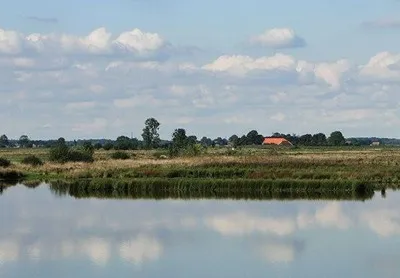
Photo Gallery
Location
53.1982, 7.6115
Project
NWRM
National ID
Germany-01
Sector
Hydromorphology
Installation Date
2011-05
Implementation status
Completed
Contact
Tamer Fawzy, BEF DE

Overview

Location of the project
The Leda-Jümme area is a flat, broad valley of the lower Ems river.
Country
Germany
NUTS2 Code
Weser-Ems
Sponge measures implemented in the case study
Wetland restoration and management
Cover crops
Meadows and pastures
Floodplain restoration and management
Minimum tillage
Involved partners
Authority type Authority name Authority role Comments Authority responsibility
Regional / sub-national water authority Lower Saxony Water Management, Coastal Defense and Nature Conservation Agency (NLWKN) Implementation Promoter, developer, supervisor Responsible
Documents
Document

Site Information

Climate Zone
Cool temperate moist
Temperature (°C)
9.00 °C
Slope range
0%-1%
Vegetation class
Grassland

Design and Implementation

Project scale
Micro
Project scale specifications
Subarea "Leysser Hammrich" (143 ha), Habitat for grassland birds
- landuse with different requirements (extensification)
- use of controlled water level increase in winter and spring
Subarea "Altes Tief" (80 ha) diverse mosaic of shallow water zones, shrubs, reeds and wet grassland - Mostly free vegetation development (succession)
- use of ca 40 ha year-round wet areas of shallow water
Project area
223
Area subject to Land use change or Management/Practice change (ha)
223.00 ha
Size
223.00
Size unit
ha
Design capacity
3800000
Principles
Integration of demands, integrative planning, functionality
Factor constraints
For the present area an independent concept has been developed that fitted the local requirements of nature conservation and flood protection.
Favourable preconditions
natural site conditions, in particular the height variations of the area

Financing

Total cost
12600000.00 €
Costs land acquisition
4000000.00
Costs operational information
€ 80,000 Technical constructions
€5,500,000 Specially prepared trail for nature information and experience
€3,000,000 New Roads for farmers
Information on Economic costs - income loss
Actual income loss: Lease Agreements are given out for free, due to heavy regulations for farming
Financing authorities
Authority name Type of funding Comments
State of Lower Saxony Sub-national funds Land acquisition
European Union EU-funds: Cohesion and regional development funds The cost for a specially prepared trail with nature information were covered by European funds.
various National funds Other measure were financed from different sources due to the various goals. NWRM unrelated constructions of dykes and technical facilities were paid from water management sources, whereas reconstructions of roads were paid by rural development funds.

Policy and Governance

Policy description
Due to the natural site conditions, in particular the height variations of the area, the Holter Hammrich serves common goals of flood protection and nature conservation.
The closure of the last dike breaches, and the further expansion of pumping stations for drainage of the area led to new problems: After heavy rainfalls flood loads led to higher water levels, dykes were threatened to breach leading to floods at unpredictable places. More storage space was needed and finally built for excessive headwater.
Extensification or abandonment of agricultural use and high water levels in spring support an increase of characteristic breeding birds for example.
Amphibians benefit from standing water bodies.
Policy targets
Improved Biodiversity
Target remarks
Flood control and flood risk mitigation
Nutrient Pollution
Biodiversity and gene pool protection in meadow areas
Habitat restoration
Policy pressure
Directive Relevant pressure
WFD identified pressure Nutrient pollution
Floods Directive identified pressure Natural exceedance
Requirement directive
Requirement directive Specification
Other EU Habitat Directive: Otter protection, habitat restoration
Policy challenges requirements
The Lower Saxony otter protection programme and the Lower Saxony wetlands protection programme were aimed to be addressed.
Part of a wider plan
Oui
Wider plan
Name
Lower Saxony otter protection programme
Lower Saxony wetlands protection programme
Public consultation
Non
Has contractual arrangements
Non

Impacts and Monitoring

Monitoring System

Monitoring requirements
Regularly

Maintenance

Maintenance requirements
Maintenance schemes have not been set up. The state of Lower Saxony is contractual responsible for any maintenance required.

Impact Assessment Methodology

Performance impact assessment method
Unknown
Performance impact estimation information
N.A.

Socio-economic Impacts

Ancillary benefits
Biomass production, recreation, and information.

Biophysical impacts: Hydrology

Information on retained water
3.8 million m3
Information on increased water storage
N.A.
Information on runoff reduction
N.A.

Biophysical impacts: Biodiversity

Improved biodiversity
Oui
Information on improved biodiversity
Extensification or abandonment of agricultural use and high water levels in spring support an increase of characteristic breeding birds for example. Amphibians benefit from standing water bodies.

Biophysical impacts: Water & Soil Quality

Water quality overall improvements
N/A info
Information on water quality overall
N.A.
Soil quality overall improvements
N/A info
Information on soil quality overall improvements
N.A.

Biophysical impacts: Others

Ecosystem impact climate regulation
No information available
Information on ecosystem impact climate regulation
N.A.

Lessons Learned

Key lessons
A continuous and open discussion between all involved groups led to a high acceptance of the overall process. It was a key lesson of this measure that cooperation between different sectors (flood protection, nature conservation etc.) as well as different stakeholder groups (government agencies, NGO†™s) are able to cooperate in effective networks, when a consistency of goals is given.
Barriers
Barrier type Comments
Other There were no major implementation barriers, although the benefit for nature conservation aspects were doubted by nature conservation NGO†™s. It was argued that the use of the structure as a flood protection and water storage facility would counteract the habitat restoration means in extreme cases of floods. By a continuous and open discussion these uncertainties were resolved.
Drivers
Driver type Driver role Comments
Organisation committed to it Main driver The NLWKN is the Nature Protection Agency of Lower Saxony
Availability of subsidies Secondary driver —
Success factors
Success factor type Success factor role Comments
Communication activities Main factor A continuous and open discussion between all involved groups led to a high acceptance of the overall process.  
Attitude of relevant stakeholders Main factor Willing stakeholders and a positive public perception were the major enabling factors. 
Financing possibilities Main factor The availability of financial resources and cooperation between all stakeholders led to a smooth implementation of all measures.
Flexibility / Adaptability
For the present area an independent concept has been developed that fitted the specific requirements of nature conservation and flood protection as well as the specific landscape. In similar settings, the technical dimension of the measure is adaptable.
Transferability
The most important precondition for a similar applications is a consistency and cooperation between different stakeholders, so that various financial instruments can be activated to achieve a common goal.

Sources