
Summary
Since 2003 the city of Vienna supports financially the implementation of green roofs with 8-25 € per m². The maximum subsidy can be 2200 €. Until 2010 16000 m² roof were transformed and 150 000 € invested.
Since then in Vienna, there has been plenty of new programs and strategies for funding green roofs and facades, also de-sealing measures and framework has changed as well. Of course, greening roofs is part of the sponge city program. Therefore, in Vienna new buildings and in case of renovation and extensions, roofs of more than 12 m² are to be designed as flat roofs and intensive green according to the standard”. The obligation of green buildings in the zoning- and building plans (binding!) is regulated by Vienna Building Regulation code §5.(1+4) k), amendment 2024. Further relevant for the retention in the Vienna Building Regulation code §79.(6) amendment 2024, that areas to be landscaped (Gardens) must remain unsealed (at least 2/3) and have ground-based greenery. And Vienna Building Regulation § 99 (1): Rainwater must be drained away or fed into the natural water cycle or used in another way. Exceptions: no suitable natural conditions or economically or technically disproportionate effort.
Some of the most important strategic frameworks:
• Urban Heat Islands Strategy Vienna
• Climate Guide "Vienna is climate neutral by 2040"
• Vienna Climate Law: be passed in spring 2025. The aim of the law is to make the city climate-neutral by 2040 and is based on three central pillars: climate protection, climate adaptation, and the circular economy.
Photo gallery
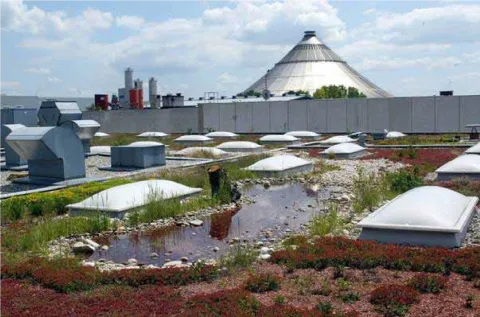
Overview
| Authority type | Authority name | Authority role | Comments | Authority responsibility |
|---|---|---|---|---|
| Local water authority | Wiener Umweltschutzabteilung (city's authority for environmental protection) | Other | Initiation of the project, subsidies for house owners | Responsible |
| Other | Die umweltberatung | Other | Facility of Vienna's adult education center. Consulting office for a near-natural life style. Publicity and information material | Responsible |
| NGO | Verband fûr Bauwerksbegrünung (Association for greening buildings) | Determination of design details of the measure | Austrian section of the European Federation of Green Roof Associations | — |
Site Information
Design and Implementation
Intensive green roofs: soil layer of 20 - >50cm thickness, layer for filtration, layer for water retention and drainage, protection layer, layer for separation from the roof
Financing
Policy and Governance
| Directive | Relevant pressure |
|---|---|
| WFD identified pressure | Diffuse - Urban run off |
| WFD identified pressure | Diffuse atmospheric deposition |
| Floods Directive identified pressure | Defense or infrastructural failure: here failure of the sewage system |
| Directive | Relevant impact |
|---|---|
| WFD identified pressure | Chemical pollution |
| WFD identified pressure | Elevated temperature |
| Floods Directive identified pressure | Human health |
| Floods Directive identified pressure | Community |
| WFD identified pressure | Altered habitats |
| Other EU | Property, infrastructure |
| Requirement directive | Specification |
|---|---|
| WFD-mitigation of significant pressure | Retention of funoff |
| WFD-achievement of good chemical status | Adsorption of air pollutants, purification of rain water |
| Other EU | Bird and Habitat directive - Creating new habitats and connections of living space |
| Floods Directive-mitigating Flood Risk | Less risk of failure of the sewage water system. |
2. Negative ecological effects have to be minimized, ecological functioning has to be ensured
3. RIWA-T (technical guidelines for flood protection): One general principle is the preferential use of near-natural building methods that correspond to the latest development in technology.
4. Improvement of Vienna’s living quality
| Activity stage | Activity type | Key issues |
|---|---|---|
| Implementation phase | information material | in general the publicity for the project is not sufficient. It is criticised that people already have to know the term "green roof" to find information. The public don't know about the manifold advantages of green roofs. It is just reduced to a garden |
Impacts and Monitoring
Monitoring System
Maintenance
Impact Assessment Methodology
Socio-economic Impacts
Longer lifespan of the roof due to balancing environmental impacts (heat, cold, UV rays…)
Biophysical impacts: Hydrology
Biophysical impacts: Biodiversity
Biophysical impacts: Water & Soil Quality
Biophysical impacts: Others
Lessons Learned
Green roofs cause only little additional costs compared to a traditional flat roof. These costs are often compensated by the longer lifespan of the roof and energy savings
The most economically effective are (intensive) green roofs on multifamily houses. The additional costs of extensive green roofs are quickly compensated by energy savings and the other benefits.
| Driver type | Driver role | Comments |
|---|---|---|
| Legal obligations | Main driver | Technical standard for building green roofs. The technical code of Vienna gives the legal framework for green buildings. |
| Availability of subsidies | Main driver | The local authorities support the construction of green roofs with 8-25€/m² and with a maximum of 2200€. |
| Organisation committed to it | Main driver | Both organisations inform the public about the advantages of green roofs. Moreover the Verband für Bauwerksbegrünung is composed of planers, architectures and specialised firms. They developed a certification system for green roofs and consult house owners and planners. |
| Success factor type | Success factor role | Comments |
|---|---|---|
| Attitude of relevant stakeholders | Secondary factor | Many firms specialised on the construction of green roofs. They organised together with architects on national and european level to support the implementation of green roofs |
| Attitude of decision makers | Main factor | Adaptation of the building code, information of the public. |
| Existing technical standards | Main factor | Legal framework for the construction of green roof and liabilities of firms, architectures and house owners. |
| Financing possibilities | Secondary factor | The local authorities support the construction of green roofs with 8-25€/m² and with a maximum of 2200€. |
A slope over 45° is unsuitable for green froof conversion.