
Green roofs in Vienna, Austria

Résumé

Summary

Since 2003 the city of Vienna supports financially the implementation of green roofs with 8-25 € per m². The maximum subsidy can be 2200 €. Until 2010 16000 m² roof were transformed and 150 000 € invested.

Since then in Vienna, there has been plenty of new programs and strategies for funding green roofs and facades, also de-sealing measures and framework has changed as well. Of course, greening roofs is part of the sponge city program. Therefore, in Vienna new buildings and in case of renovation and extensions, roofs of more than 12 m² are to be designed as flat roofs and intensive green according to the standard”. The obligation of green buildings in the zoning- and building plans (binding!) is regulated by Vienna Building Regulation code §5.(1+4) k), amendment 2024. Further relevant for the retention in the Vienna Building Regulation code §79.(6) amendment 2024, that areas to be landscaped (Gardens) must remain unsealed (at least 2/3) and have ground-based greenery. And Vienna Building Regulation § 99 (1): Rainwater must be drained away or fed into the natural water cycle or used in another way. Exceptions: no suitable natural conditions or economically or technically disproportionate effort.

Some of the most important strategic frameworks:

• Urban Heat Islands Strategy Vienna

• Climate Guide "Vienna is climate neutral by 2040"

• Vienna Climate Law: be passed in spring 2025. The aim of the law is to make the city climate-neutral by 2040 and is based on three central pillars: climate protection, climate adaptation, and the circular economy.

Photo gallery
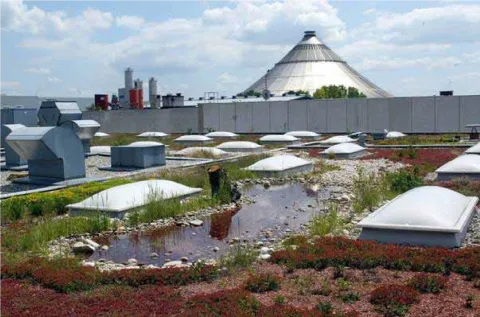
Vue d'ensemble
Year of issue
2025
Project
NWRM
Implementation status
Ongoing
Contact
Sabine Tutte, ACTeon
Location of the project
In the municipality of Vienna
Country
Austria
NUTS2 Code
Wien
Sponge measures implemented in the case study
Green Roofs
Objectives
The recent updates on green roofing Vienna are part of a bigger strategy that aims for climate neutrality by 2040.
Involved partners
Authority typeAuthority nameAuthority roleCommentsAuthority responsibility
Local water authorityWiener Umweltschutzabteilung (city's authority for environmental protection)OtherInitiation of the project, subsidies for house ownersResponsible
OtherDie umweltberatungOtherFacility of Vienna's adult education center. Consulting office for a near-natural life style. Publicity and information materialResponsible
NGOVerband fûr Bauwerksbegrünung (Association for greening buildings)Determination of design details of the measureAustrian section of the European Federation of Green Roof Associations—
Site Information
Climate Zone
Cool temperate dry
Precipitation
500.00 mm
Temperature (°C)
11.50 °C
Runoff
300.00 mm
Slope range
gentle (2-5%)
Vegetation class
Depends on the individual project for intensive green roofs. Extensive green roofs consist of mosses and grass.
Design and Implementation
Project scale
Meso
Project scale specifications
Recording to the city government 20% of the roofs shall be transformed to green ones.
Project area
1,6
Area subject to Land use change or Management/Practice change (ha)
1.60 ha
Design capacity
Depends on : intensity of precipitation event, annual precipitation, amount of precipitation events, individual design of the roof (plant composition, soil type and thickness of soil layer
Principles
Extensive green roofs: soil layer of 2-10 cm thickness, layer for protection, drainage and filtration, layer for separation from the roof
Intensive green roofs: soil layer of 20 - >50cm thickness, layer for filtration, layer for water retention and drainage, protection layer, layer for separation from the roof
Factor constraints
The lack of useable land in big cities such as Vienna and the ongoing sealing force responsible authorities and citizens to think in a third dimension. Green recreational areas are created now on roofs. Due to sealing the amount of rainwater increases. It has to be treated in sewage water plants and pipe systems have to be adapted. During storm-floods critical amounts of waters can be reached. By taking up 50% of rain water and retaining peak flows for a certain time green roofs contribute to reduce flooding risk and ensure the purification standards in sewage water treatment plants.
Constraints
Green roofs can be installed up to a slope of less than 45°. Intensive green roofs require an adaptation of the statics of the roof.
Favourable preconditions
Lack of land, increasing sealing and thus in creasing amount of rain water.
Financing
Total cost information
0,5 Euros/m2 Extensive green roof with a slope <10° on a multi-family house with 7 floors
Costs investment information
0,31 Euros/m2 for extensive green roof with a slope less than 10° on a multi-family house with 7 floors.
Costs capital information
0,31 Euros/m2 for the implementation of the green roof, without potetntial adaptation of the roof's statics.
Costs land acquisition unit
€ (total value)
Costs operation maintenance information
0,19 Euros/m2 for an inspection twice a year, removal of growing trees, cutting grass.
Costs maintenance information
0,19 €/m² Inspection twice a year, removal of growing trees, cutting grass
Financing authorities
Authority nameType of fundingCommentsFinancing share
Vienna municipalityLocal fundsSubsidiesdepends on the roof
OwnersPrivate fundsFortune of the house owner.depends on the roof
Compensations
Oui
Compensations annual information
Financial support given by the city's authorities only once: 8-25€/m² up to 2200€.
Compensations basis information
The house owner installs the green roof and sends bills to the authority. The work has to be done after ÖNORM 1131. The project mustn’t supported by other official funds.
Policy and Governance
Policy description
The more people are moving to cities, the more surface needs to be sealed and green areas are disappearing. In Austria 15 to 25 ha of usable ground get sealed every day. However green areas are important for recreation, mood lifting and health. Green roofs are a possibility to regain green areas and offer a manifold of advantages. A cadastre of potential roofs was developed. It proved that 20% of Vienna's roofs could become green roofs.
Policy targets
Runoff control
Peak-flow reduction
Groundwater Recharge
Pollutants Removal
Oher Societal Benefits
Target remarks
Due to sealing 15 – 25 ha get lost as potential habitats every day in Austria. Green roofs therefore have the potential to serve as replacement habitats and support biodiversity in strongly urbanized areas. With reference to Swiss investigations those responsible for the Viennese project act on the assumption that the installation of green roofs provides habitats and food/nesting material for the following birds: Northern lapwing (peewit), Eurasian skylark, Little ringed plover, Crested lark (endangered), Black redstart, Common redstart, Sparrow and Tit. It is moreover possible to create an animal food chain. Green roofs incorporate a variety of plants that attract different kinds of insects. In combination with solar panels a variety of habitats with different light intensity is achievable. Moreover green roofs are able to buffer “electro smog” by 99.4%, a climate regulation for the underlying rooms is achieved, in combination with solar cells a power increase of 4% is achievable
Policy pressure
DirectiveRelevant pressure
WFD identified pressureDiffuse - Urban run off
WFD identified pressureDiffuse atmospheric deposition
Floods Directive identified pressureDefense or infrastructural failure: here failure of the sewage system
Policy impact
DirectiveRelevant impact
WFD identified pressureChemical pollution
WFD identified pressureElevated temperature
Floods Directive identified pressureHuman health
Floods Directive identified pressureCommunity
WFD identified pressureAltered habitats
Other EUProperty, infrastructure
Requirement directive
Requirement directiveSpecification
WFD-mitigation of significant pressureRetention of funoff
WFD-achievement of good chemical statusAdsorption of air pollutants, purification of rain water
Other EUBird and Habitat directive - Creating new habitats and connections of living space
Floods Directive-mitigating Flood RiskLess risk of failure of the sewage water system.
Policy challenges requirements
1. National Water Act: Any intervention which might have a significant effect on water quality/ecology (hydropower, flood protection, water abstraction, waste water discharges, …) needs authorization
2. Negative ecological effects have to be minimized, ecological functioning has to be ensured
3. RIWA-T (technical guidelines for flood protection): One general principle is the preferential use of near-natural building methods that correspond to the latest development in technology.
4. Improvement of Vienna’s living quality
Part of a wider plan
Non
Public consultation
Non
Consultation activities
Activity stageActivity typeKey issues
Implementation phaseinformation materialin general the publicity for the project is not sufficient. It is criticised that people already have to know the term &quot;green roof&quot; to find information. The public don&#039;t know about the manifold advantages of green roofs. It is just reduced to a garden
Has contractual arrangements
Non
Impacts and Monitoring

Monitoring System

Monitoring parameters
During the project the retained amount of rain water was measured. Moreover, the pollutants removal was documented as well as the composition of plant and animal population. The temperature was recorded in the surroundings of the green roofs

Maintenance

Maintenance requirements
Extensive green roofs: inspection twice a year, removal of tree seeds and shooting trees

Impact Assessment Methodology

Performance impact assessment method
Catchment outlet
Performance impact estimation information
Collection of the runoff from a green roof and a traditional roof during a precipitation event.
Cost assessment method
First of all only the installation of an extensive roof is seen. Adaptation of statics and the planning of intensive green roofs depend on the individual project and can’t be generalized. Moreover the costs are broken down to the gross-floor-surface (sum of the surfaces of the single floors). The actual prices were gained by asking architects and firms specialized to green roofs.

Socio-economic Impacts

Benefits and co-benefits
Air condition for underlying rooms
Longer lifespan of the roof due to balancing environmental impacts (heat, cold, UV rays…)
Direct benefits information
Energy savings and a longer lifespan compared to a traditional flat roof. Savings meet the additional costs of implementation and maintenance.
Ancillary benefits information
A combination of green roofs and solar power should be considered. During summer the cooling effect of green roofs increases the power of photovoltaic modules by 4%.

Biophysical impacts: Hydrology

Information on retained water
The microclimate improves. That means: the increased evapotranspiration leads to an ambient temperature. The underlying rooms profit from this "natural air condition".
Information on runoff reduction
Up to 60% runoff attenuation (extensive) and 90% (intensive)
Information on peak delay effects
The peak flow is retained 15 Minutes which means a relief for the sewage water system.

Biophysical impacts: Biodiversity

Improved biodiversity
Oui
Information on improved biodiversity
Green roofs can act as bridge between different habitats and populations. Birds find there material for building nests. Some observations even document that some ground breeding species take green roofs as new habitat. Insects find new food/habitat resources with the green roofs.

Biophysical impacts: Water & Soil Quality

Water quality overall improvements
Positive impact-WQ improvement
Information on water quality overall
Rain water is filtered by the vegetation. Normal flat roofs aren’t able to retain pollutants such as Cu, Pb, Zn, Cd and N. Green roofs can retain 96-99% of Cu, Pb, Cd and N pollution. Moreover plants are increasing air humidity by transpiration. Thus dust is easily adsorbed.
Information on water quality Improvements (N)
Reduction by more than 90%.
Information on water quality improvements (Cu)
Reduction by more than 90%.
Information on water quality improvements (Zn)
Reduction by 16%.
Soil quality overall improvements
Not relevant for this application

Biophysical impacts: Others

Ecosystem impact climate regulation
Impact on GHGs (net emissions and storage) including soil carbon
Information on ecosystem impact climate regulation
Vegetation stores CO₂ by photosynthesis. The increased evapotranspiration enhance dust adsorption, leads to an ambient temperature in the underlying rooms and takes up the summer heat of a city.
Increased evapotranspiration information
That increased evapotranspiration leads to an ambient temperature.The microclimate improves.
Lessons Learned
Key lessons
Green Roofs are able to provide a lot of benefits such as climate regulation, water retention, or "island habitats" for plants and animals. These advantages have to be communicated more intensively to the public.
Green roofs cause only little additional costs compared to a traditional flat roof. These costs are often compensated by the longer lifespan of the roof and energy savings
The most economically effective are (intensive) green roofs on multifamily houses. The additional costs of extensive green roofs are quickly compensated by energy savings and the other benefits.
Barriers
Barrier typeBarrier roleComments
Expected maintenance needsMain barrierHouse owners are often afraid that the installation of a green roof is combined with high costs. However this is not the case for extensive green roofs and the additional costs are often balanced by energy savings and the longer life span of the roof
OtherMain barrierLack of communication. Citizens are not sufficiently informed about the many advantages of green roofs. The majority thinks, it is just another kind of garden
Missing regulatory supportSecondary barrierArchitects/planners are liable for 30 years for the construction of a green roof. Since there is the risk that they aren't leakproof, architects partly refuse to consider green roofs in their plannings
Drivers
Driver typeDriver roleComments
Legal obligationsMain driverTechnical standard for building green roofs. The technical code of Vienna gives the legal framework for green buildings.
Availability of subsidiesMain driverThe local authorities support the construction of green roofs with 8-25€/m² and with a maximum of 2200€.
Organisation committed to itMain driverBoth organisations inform the public about the advantages of green roofs. Moreover the Verband für Bauwerksbegrünung is composed of planers, architectures and specialised firms. They developed a certification system for green roofs and consult house owners and planners.
Success factors
Success factor typeSuccess factor roleComments
Attitude of relevant stakeholdersSecondary factorMany firms specialised on the construction of green roofs. They organised together with architects on national and european level to support the implementation of green roofs
Attitude of decision makersMain factorAdaptation of the building code, information of the public.
Existing technical standardsMain factorLegal framework for the construction of green roof and liabilities of firms, architectures and house owners.
Financing possibilitiesSecondary factorThe local authorities support the construction of green roofs with 8-25€/m² and with a maximum of 2200€.
Cost effectiveness
During the first 10 years house owners with green roofs have to face additional costs compared to traditional flat roofs. Energy savings and the longer lifespan of a green roof compensate the additional costs
Transferability
When a roof has a slope of less than 20% no special constructions are needed that prevent slipping. In this case one has the most creative freedom to design an intensive green roof. A good ratio between roof surface and rest of the house permits a transformation of the roof into a green area at low costs. For instance the costs to transform the roof of a multiple-family house are low, since the can be divided by many tenants. Skyscrapers only have small roofs-so the transforming costs are low as well. However due to the height of the building only extensive solutions are possible. Elevated costs have to be considered for single family houses. Extensive green roofs are possible on every house. To create a real roof garden on existing houses, roof structures have to be re-considered and adapted, as roof gardens are much heavier than simpler green roofs. The thicker the soil layer and more complex the plant composition the more water can be retained.
A slope over 45° is unsuitable for green froof conversion.
Sources