
Landscape revitalisation program in Slovakia

Résumé

Summary

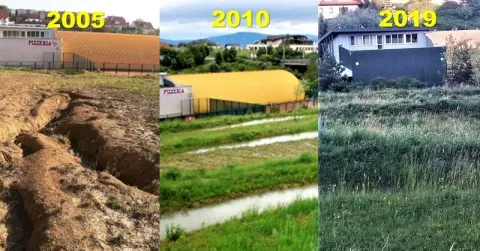
The national Landscape Revitalisation and Integrated River Basin Management Program (2010) aimed to curb ecosystem degradation and flood/drought risk by retaining rain where it falls, especially in damaged parts of the landscape. It deployed many small water-retention elements across 488 municipalities, restoring landscape storage via basins, ponds and similar measures. Early phases created ~7,700 seasonal jobs with about €43 million invested; the programme was adopted by Government Resolution 744/2010.

Following a change of government in 2012, the national programme was wound down; only ~4% of planned funds were disbursed and monitoring was not established in time. Yet many structures remained in place. In the Košice region alone, ~250,000 m³ of green/retention works were completed in 2010–2012, and the approach continues there under a region-wide Restoration Programme approved in 2021 with a 2021–2030 horizon. The Ministry of Agriculture is also preparing a ‘Climate Fund for Soil’ to support such measures.

Photo gallery
Vue d'ensemble
Year of issue
2025
Project
NWRM
Implementation status
Completed
Contact
Jovanka Ignjatovic
Location of the project
Multi-site, nationwide across Slovakia. 488 villages and towns from all regions. Early roll-out started in 24 municipalities in the basins of the Ondava, Torysa, Hornád, Váh and Kysuca rivers.
Sponge measures implemented in the case study
Check dams
Peak flow control structures
Ponds and scrapes
Objectives
Retain 250 million m³ of rainwater in the landscape by building distributed water-retention systems (“cyclic retention capacity”), to mitigate floods and droughts and support ecosystem recovery.
Activate 23 pilot municipalities first, then scale up nationwide.
Engage ~95% of Slovakia’s territory in flood-prevention actions through landscape revitalisation and better land-use practices.
Create jobs: ~300 initially; ≥5,000 jobs by 2011 (conditional on ~€33.5 m allocation).
Improve governance and maintenance of small streams/melioration, and establish a system for upkeep of new retention structures, as part of integrated river-basin management.
Involved partners
Authority typeAuthority nameAuthority roleAuthority responsibility
Regional / sub-national water authorityGovernment Plenipotentiary for Self-Government and Integrated River Basin Management and LandscapeImplementationResponsible
NGOPeople and Water NGOImplementationResponsible
National water authorityCentral office of LabourOtherSupporting
Site Information
Climate Zone
Cool temperate moist
Precipitation
649.00 mm
Temperature (°C)
10.00 °C
Runoff coefficient
0.85
Elevation range
up to 2500 m
Vegetation class
There is no single predominant class because the programme spans forests, agricultural land and settlements (multi-site). The Košice regional follow-up explicitly targets forests, agricultural land and cities; at national scale, forests and agricultural areas are the dominant land covers.
WFD Ecological status
Unknown
WFD Chemical status
Unknown
Design and Implementation
Project scale
Large
Project scale specifications
National, multi-site programme spanning 488 municipalities across all regions of Slovakia; the NWRM entry lists the application scale as “Country.” It was launched under Government Resolution 744/2010, confirming its nationwide scope.
Project area
1700
Area subject to Land use change or Management/Practice change (ha)
1700.00 ha
Basis of design
Torrential rains in spring and summer.
Principles
Use of soft hydraulics.
Financing
Total cost
43080000.00 €
Total cost information
Government budget allocations & disbursements (2011): €26.31 m, of which €17.55 m to the 1st implementation project (190 municipalities), €8.04 m to the 2nd (354 municipalities), €0.495 m transferred to the Ministry of Agriculture, plus minor programme/admin items. For 2012, €10 m was allocated (incl. €9.6 m intended for a 3rd project and small amounts for control/monitoring capacity).
Financing authorities
Authority nameType of fundingCommentsFinancing share
European UnionEU-funds: Cohesion and regional development funds€18 m European Social Fund57 %
Slovak Republic GovernmentNational funds€24 m state budget43 %
Compensations
Non
Policy and Governance
Policy description
Due to the farming methods in the territory, the landscape's ability to hold water was substantially weakened, contributing to increase risks of landscape overheating, local and regional climate changes, floods and droughts, soil water erosion, pond silting, permanents soil degradation, disruption of ecosystems, etc.
Land ownership
Mixed ownership. Works could be built on municipal land or on land of another owner/manager, provided the municipality secured the owner’s consent.
Policy targets
Increase Water Storage
Runoff control
Erosion Control
Part of a wider plan
Oui
Wider plan
Wider plan typeWider plan focusNameComments
NationalWaterIntegrated River Basin ManagementAdopted by the Slovak Republic Government on 27 August 2010
NationalOtherAct of Employment ServicesIn cooperation with the Central Office of Labor, Social Affairs and Family to help with the high unemployment rate that especially consists of young people and the long-term unemployed.
Public consultation
Oui
Consultation activities
Activity stageActivity typeComments
Design phaseWorkshopsHundred of workshop with mayors in different regions of Slovakia and meetings with representatives of local public administration authorities.
Has contractual arrangements
Non
Impacts and Monitoring

Monitoring System

Monitoring requirements
No formal hydrological monitoring was established for the national programme; Košice plans monitoring through 2030 but reports a current funding gap for gauges and related measurements.
Monitoring parameters
The national programme lists no measured parameters because monitoring never started; subsequent administrative inspections verified the existence/functionality of structures rather than hydrological or water-quality metrics. For Košice, the case study specifies the need for gauging stations to evaluate catchment restoration but doesn’t enumerate parameters (e.g., flow, levels) beyond this intent. In short: parameters not specified in sources; evidence refers to inspections/oversight and planned—but unfunded—instrumented monitoring.

Maintenance

Maintenance requirements
In 2011, municipalities signed grant contracts committing to control, maintain and service the built retention/flood-protection works for 20 years. Routine post-storm checks and cleaning of ditches/culverts to keep works functional.

Impact Assessment Methodology

Performance impact assessment method
Catchment outlet
Performance impact estimation information
N/A info

Socio-economic Impacts

Direct benefits information
7700 seasonal jobs during the three first implementation projects
Ancillary benefits
500000
Ancillary benefits information
The measures helped to reduce damage and costs that may have been incurred by preventive and rescue investment work during torrential rains in spring and summer.Positive influence on 500 to 1000 municipalities located lower in the river basins because the reduction of flooding risks and drought risks down the watercourse. Enhance the life in the place of water retention.

Biophysical impacts: Hydrology

Information on retained water
In Košice region, the national programme completed 250,000 m³ of GI/rainwater-harvesting works (2010–2012). NGO estimates suggest ~12 million m³ of retained rainwater benefitted municipalities there since 2010. Local example: Jarovnice municipality planned 30,000 m³ but reports ~42,000 m³ of measures built (cost ≈ €3/m³).

Information on increased water storage
The measures helped the villages to diminish flooding risks of torrential rains in 2011 and the retained water was gradually released over the period of extreme drought the affected Slovakia in the second half of the same year.
Information on runoff reduction
The power of rainwater runoff helps to keep the country to be vital
Information on increased infiltration
There is a better infiltration due to increase of time in water storage
Ecosystem water supply
1

Biophysical impacts: Biodiversity

Improved biodiversity
Oui
Information on improved biodiversity
The measure protect nature and strengthen biodiversity

Biophysical impacts: Water & Soil Quality

Water quality overall improvements
Positive impact-WQ improvement
Ecosystem erosion control
Oui

Biophysical impacts: Others

Ecosystem impact climate regulation
No information available
Information on ecosystem impact climate regulation
No measured cooling reported for 2010–2012. The Košice programme expects average −0.7 °C (region) and −1.3 °C (cities) after full implementation; Sušnik et al. 2022 (regional modelling across DE-CZ-SK) also finds WRMs can increase water availability and cool landscapes, but these are modelled potentials, not site monitoring.
Lessons Learned
Key lessons
The case shows that rapid, cost-effective landscape restoration is feasible and that “a big amount of small measures” can add up to meaningful change at catchment scale - an approach presented as a fundamental response to climate change, ecosystem degradation, floods and droughts, with international recognition.
Yet programme continuity matters as much as design. The national roll-out ended early after a change in government; only about 4% of the allocated funds were ultimately used and monitoring was halted before it began. Future nationwide schemes need governance and budget safeguards that outlast political cycles.
Build monitoring in from day one. The Košice regional follow-up (2021–2030) explicitly includes research and monitoring but notes current funding gaps for gauging stations - evidence that instrumentation and data management must be budgeted and scheduled alongside works, not after.
Local stewardship is crucial. Municipalities were implementers and, per grant contracts, must keep the small retention works functional for 20 years after completion; routine post-storm checks and cleaning are part of staying power. This underscores the value of simple designs that communities can maintain.
Quality control and permitting need special attention when deploying tens of thousands of micro-structures. Public debate and inspections in 2013–2014 highlighted concerns and led to financing being stopped at national level; clear technical standards and oversight are essential to maintain safety and credibility.
Finally, scale itself is a management challenge. The NWRM record notes that the “huge amount of small measures for such a big project” was a barrier - future programmes should plan for the administrative load (landowner consents, supervision, documentation) as part of the core design.
Barriers
Barrier typeBarrier roleComments
OtherMain barrierHuge amount of small measures for such a big project
Lacking financing sourcesMain barrierAt national-programme level (2010–2012), funding was suspended before any monitoring was put in place. In the Košice regional programme (2021–2030), projects are “to be implemented and monitored,” but the region currently lacks funding for monitoring and gauging stations. District environmental offices did conduct inventory/inspection campaigns of the earlier works, initiated by the Ministry of Environment. Water & Land Restoration Advisory Boards were created to supervise project completion with possible support from scientific institutions and municipalities.
Drivers
Driver typeDriver roleComments
Organisation committed to itMain driverNGO People and Water
OtherSecondary driverCompetition between the stakeholders who will invent something original that is better, more effective and of a higher added value.
Success factors
Success factor typeSuccess factor roleComments
Communication activitiesSecondary factorHundred of workshop with mayors in different regions of Slovakia and meetings with representatives of local public administration authorities.
Attitude of decision makersSecondary factor—
Existing staff and consultant knowledgeSecondary factorThe experience gained in the first implementation project help to make better the next ones with a big difference.
Transferability
Highly transferable to regions with rural/forest–agricultural mosaics and small catchments, where many small measures can add up. Success hinges on stable governance, landowner consent and permits, clear technical standards, and budgeting O&M plus monitoring (gauges) from day one; also plan for the admin load of thousands of micro-works and address safety/legality concerns around check-dams.
Sources