
Résumé
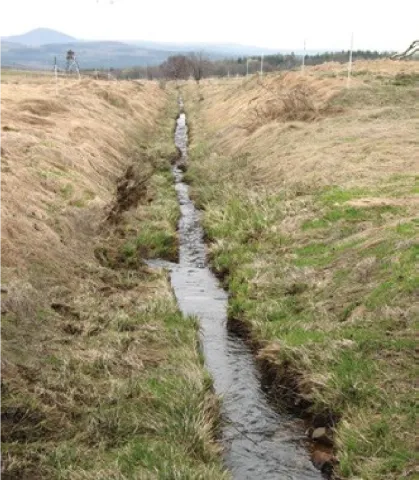
The Nature Conservation Agency of the Czech Republic (AOPK ČR) restored the Černý potok (Black Brook) in the Černá louka Nature Reserve (Ore Mountains, near Adolfov). Early trials began in 2001–2003; the main works in 2009–2010 (OP Environment/ERDF) went beyond in-channel fixes: shallow, meandering channels were newly excavated and reconnected to remnants of the historical course or led across alluvial meadows to reduce depth/volume, slow runoff and re-wet the peat meadows. Designed by Terén Design and built by EPS-Servis, the project reshaped ~2.5 km within the reserve and delivered c. 1,820 m of new channels, ~0.963 ha of ponds/wetland and an ~8 ha meander belt.
Post-restoration monitoring by UJEP found only very small lateral movement (≤10 cm), no significant incision, and that after 1980s straightening had shortened length by ~52% the restored reach in 2011 was ~43% longer than the straightened channel. AOPK notes continued monitoring and documented fish passage, incl. brown trout spawning. Media coverage during the 2019 drought reported the area stayed wet and ponds held water. In 2022, ČSOP with private partners extended restoration to a small tributary just outside the reserve.
Photo gallery

Vue d'ensemble
Re-establish the water regime degraded by drainage and straightening: increase retention capacity and restore natural runoff conditions/retention space in PR Černá louka.
Support biodiversity associated with wetland habitats in the reserve (Natura 2000 mire meadows).
| Authority type | Authority name | Authority role | Comments | Authority responsibility |
|---|---|---|---|---|
| National water authority | Nature Conservation Agency of the Czech Republic | Initiation of the measure | Nature Conservation authority | Responsible |
| NGO | Czech Union for Nature Conservation | Monitoring | National association | Supporting |
| NGO | Local Chapter Teplice Fergunna | Monitoring | CUNC Teplice is one of hundreds of the Czech Union for Nature Conservation, which operates throughout the Czech Republic. A new activity of this organization is to create a basic land league (PS) Fergunna, whose main objective is the protection of nature and landscape of the Ore Mountains. | Supporting |
Site Information
Design and Implementation
Modifications within the channelized streambed were not sufficient to respect all these criteria, therefore new streambeds were proposed and constructed. They were reconnected with the remains of the original stream course or directed freely to the alluvial meadows.
The volume of the new beds was designed at 30-day design flows (or max. one-year flows).
Financing
Policy and Governance
Also expected are flood control elements, e.g. reduction of the outflow velocity and retardation and flattening of flood waves.
Regulation of hydrological cycle and water flow
Flood control and flood risk mitigation
| Directive | Relevant pressure |
|---|---|
| WFD identified pressure | 4.1.5 Physical alteration of channel/bed/riparian area/shore – unknown |
| Floods Directive identified pressure | Other pressure contributing to flooding /flood risk |
| Other EU | Birds Directive 2009/147/EC Surface drainage and peat cutting |
| Directive | Relevant impact |
|---|---|
| WFD identified pressure | Altered habitats due to hydrological changes |
| Floods Directive identified pressure | Protected areas |
| Other EU | Loss of natural habitats and wild fauna and flora |
| Requirement directive | Specification |
|---|---|
| WFD-mitigation of significant pressure | Restored stream sections (including adjustment of channelized streambeds and making water flow into the alluvium) |
| WFD-restoring a HMWB | Restored meandering segment and pools with marsh habitats |
| Floods Directive-mitigating Flood Risk | Natural overflow in case of Q100 floods |
| The Birds and Habitat Directives | Both new and restored marshes with still or running waters |
| Activity stage | Activity type |
|---|---|
| Design phase | NGOs were involved in the restoration project. Members of the Czech Union for Nature Conservation (Local Chapter Teplice †“ Fergunna) participated in study, project preparation and implementation. |
| Implementation phase | The restored site is used for education, and both experts and the public from the Czech Republic and abroad have visited it. |
Impacts and Monitoring
Monitoring System
The effect of restoration on the local fauna and flora was monitored as well (Nature Conservation Agency of the Czech Republic, Czech Union for Nature Conservation, Local
Chapter Teplice – Fergunna, 2007–2011)
Biodiversity,flow velocity, kind and quantity of sediments and graphic cross section profiles
Maintenance
Impact Assessment Methodology
Socio-economic Impacts
Biophysical impacts: Hydrology
1,820 m new channels, 0.963 ha ponds/wetlands, ~8 ha meander belt; ~4.3 ha wetlands created/restored.
Post-works morphology (UJEP 2013): lateral shift ≤ 10 cm; no significant incision; after 1980s straightening (−52 % length), the restored reach was ~+43 % longer than the straightened one (measured in 2011).
The area stayed wet and ponds held water during the 2018–2019 drought.
Biophysical impacts: Biodiversity
In 2011 about 20 dragonfly species were recorded. The local population of the endangered plant species Menyanthes trifoliata has increased in the floodplain.
Connectivity/biota: fish passage confirmed during brown trout spawning after restoration.
Biophysical impacts: Water & Soil Quality
Biophysical impacts: Others
Lessons Learned
Controlled restoration is a step in the right direction and is allowing further researches and studies concerning habitat restorations.
Solid knowledge on the baseline and the desired ecosystem status should be embedded early in project design phase.
“Let-nature-work” approaches (backfilling the entrenched channel and allowing free pathfinding) can reconnect the floodplain more fully than excavating a single new channel ; documented with rapid development of multi-thread flows and wetland formation.
Early post-restoration stability with minimal incision and measured lengthening supports using shallow, meandering designs on peat meadow streams.
Drought resilience is a tangible co-benefit worth monitoring and communicating (media-visible).
Pair public funding (OP Env/AOPK) with NGO/private finance to act on private land and speed delivery.
| Driver type | Driver role | Comments |
|---|---|---|
| Past flooding events | Main driver | Restoration of streams and their floodplains |
| Balancing different objectives | Secondary driver | Restoration of other wetlands in the landscape |
| Success factor type | Success factor role | Comments |
|---|---|---|
| Specific incentives for stakeholder involvement | Main factor | New methods were applied in the design of shape and course of the streambed, and their successful implementation was enabled by good collaboration between investor, designer and subcontractors. |
| Financing possibilities | Main factor | Available financing for capital investments |
| Attitude of decision makers | Main factor | Commitment and support provided by competent authorities |
| Attitude of relevant stakeholders | Secondary factor | Local communities and NGO involvement and support. |
| Public participation | Secondary factor | The restored site is used for education, and both experts and the public from the Czech Republic and abroad have visited it |
improvement of hydraulic conditions